

More news on this day
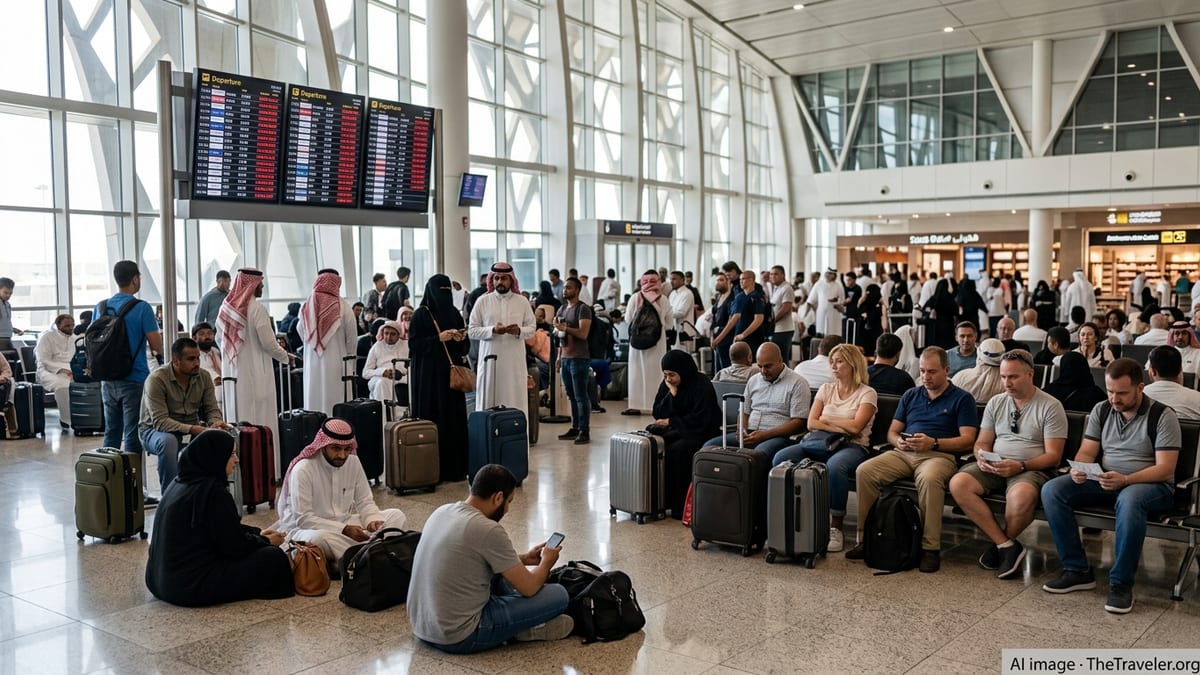
Hundreds of travellers were left stranded at Riyadh’s King Khalid International Airport on March 20 as published data showed at least 17 flight cancellations and 11 delays affecting services operated by Gulf Air, Etihad Airways, Emirates, Saudia, Flynas and Flyadeal across regional and long haul routes.
Get the latest news straight to your inbox!
Regional Turbulence Hits Key Gulf Gateway
King Khalid International Airport in Riyadh has been operating under constrained conditions in recent weeks amid wider Middle East airspace disruptions, and the latest wave of cancellations on March 20 intensified pressure on passengers and airlines. Publicly available operations trackers and regional aviation advisories indicate that the airport continues to report a mix of cancellations, delays and schedule changes tied to airspace restrictions and shifting safety assessments.
The 17 cancellations and 11 delayed departures or arrivals reported on Friday primarily involved services linking Riyadh with other major regional hubs and selected international destinations. Travellers connecting through Gulf Air, Etihad, Emirates, Saudia, Flynas and Flyadeal were among those most affected, with some journeys terminated in Riyadh and others subject to rolling departure estimates.
Recent regional security assessments have warned that airports across the Gulf face an elevated risk of last minute schedule adjustments when specific air corridors are restricted or temporarily closed. Advisories issued this month have repeatedly listed King Khalid International among airports experiencing limited flights and ongoing disruption, underscoring the fragility of current operations and the potential for sudden changes in flight plans.
While core airport infrastructure in Riyadh remains intact and open, the combination of rerouted traffic, changing overflight permissions and airline schedule revisions has created a stop start operating environment. For travellers, this has translated into long waits at departure gates, congested check in halls and uncertainty around onward connections, particularly on multi leg itineraries routed through other Gulf hubs.
Multiple Airlines, Multiple Routes Affected
The impact of Friday’s disruption has been felt across a range of airlines that normally provide dense connectivity between Saudi Arabia and neighboring states. Gulf Air, which in recent weeks has already adjusted schedules because of restrictions affecting its Bahrain hub, saw additional pressure on services connecting via Saudi territory, including routes serving Dammam and other points commonly used as alternates or temporary gateways.
Emirates and Etihad, both of which have been operating in a constrained regional environment since early March, were also listed among carriers affected by cancellations or extended delays on services touching Riyadh. Public timetables showed disruptions on flights connecting to Dubai and Abu Dhabi, key transfer points for long haul journeys onward to Europe, North America and Asia, meaning that missed connections compounded the immediate local cancellations.
Saudi Arabia’s own carriers, Saudia, Flynas and Flyadeal, likewise faced knock on effects. These airlines operate a dense network linking Riyadh to other Saudi cities and to regional destinations such as Amman, Alexandria and Gulf hubs, as well as selected longer routes. The cancellations and delays recorded on March 20 included flights to and from Dammam within the kingdom and cross border services serving Dubai, Kabul, Shanghai, Alexandria and Amman, according to openly available flight status boards.
Because many passengers in Riyadh were using these services to connect onward, disruptions on a relatively small number of flights quickly translated into wider challenges across the day’s operation. Travellers reported on social channels that rebooking options on the same airlines were limited or pushed several days into the future, reflecting how tightly scheduled many regional networks are at present.
Knock On Effects in Dammam, Dubai and Beyond
The network nature of Gulf aviation means that cancellations and delays at a major Saudi hub are rarely contained to a single airport. Flights linking Riyadh with Dammam, Dubai, Kabul, Shanghai, Alexandria and Amman play a dual role, serving both origin and destination traffic and acting as feeders into larger long haul networks. When departures from Riyadh are cancelled outright or held on extended delay, aircraft and crew rotations across this broader system are affected.
In Dammam, which has in recent weeks taken on additional traffic as airlines adjust routings around sensitive airspace, schedule changes in Riyadh had the potential to disturb carefully balanced rotations operating through King Fahd International Airport. Passengers booked on Gulf Air and other carriers using Dammam as a temporary alternative to their primary hubs faced renewed uncertainty whenever Riyadh based aircraft or crews were out of position.
Dubai and Abu Dhabi, still gradually rebuilding full schedules after earlier airspace closures this month, likewise remain vulnerable to disruptions upstream in Riyadh. Delayed or cancelled feeder flights from King Khalid can lead to empty seats on some long haul departures and excess demand on others, as rebooked passengers converge on a limited set of alternative connections. Similar dynamics can be seen on routes to Kabul and Shanghai, where aircraft and crew often rotate across multiple sectors within a tight time window.
For secondary destinations such as Alexandria and Amman, the effect is often fewer same day alternatives when a Riyadh flight is cancelled. Unlike major hubs that may see multiple daily services on competing carriers, these cities can rely on only a small number of frequencies, so disruption to even one rotation can leave travellers with little choice but to accept lengthy delays or indirect routings via third countries.
Passengers Face Long Queues and Limited Options
Inside King Khalid International Airport, the immediate, visible impact of the disruption was manifested in long lines at check in counters and transit desks, along with crowded seating areas around affected gates. Photographs and first hand descriptions posted to public platforms showed groups of travellers clustered around departures boards, attempting to interpret updated departure times and gate changes.
According to public airline notices, standard responses to these kinds of disruptions include free rebooking within defined time windows, refunds where flights are cancelled, and in some cases hotel accommodation and meal vouchers for passengers facing extended waits. However, the sheer number of travellers displaced by multiple cancellations in a short period can strain these arrangements, particularly when nearby hotels are already busy with rerouted guests from other airports in the region.
Travel insurance providers and independent travel advisories have repeatedly recommended that passengers in the region allow extra buffer time for connections, maintain flexible itineraries where possible and keep close track of airline notifications. For those already at the airport, practical guidance circulating on public channels has included suggestions to stay near the gate of the next likely departure, keep boarding passes and baggage receipts readily accessible and be prepared for repeated security and document checks if flights are re gated.
Families travelling with children, elderly passengers and those with medical needs appear to have been particularly affected by the extended waits and changing information. In such cases, reports suggest that airport assistance services were in high demand, including wheelchair support, priority rebooking queues and access to quieter waiting areas away from the busiest concourses.
What Travellers Should Do Next
With airspace conditions and flight schedules across the Gulf still evolving from day to day, travel specialists recommend that passengers treat departures listed as scheduled or even delayed as subject to late change. Public information from airlines operating at King Khalid International emphasizes the importance of verifying flight status through official channels on the day of travel and avoiding unnecessary trips to the airport when a service is still under review.
For those whose flights have already been cancelled from Riyadh, guidance from consumer advocacy groups suggests first confirming eligibility for refunds or free rebooking directly with the airline, then exploring whether alternative routings via less congested airports such as Jeddah or certain regional hubs are available. In some cases, passengers holding flexible tickets or comprehensive insurance policies may find it more practical to postpone travel until schedules in and out of Riyadh stabilize.
As the situation develops, observers expect that airlines including Gulf Air, Etihad, Emirates, Saudia, Flynas and Flyadeal will continue to update their travel waivers and rebooking policies to reflect the ongoing operational challenges. For now, however, the experience of hundreds of travellers stranded at King Khalid on March 20 illustrates how quickly regional airspace issues can cascade into widespread disruption for ordinary passengers moving between cities such as Dammam, Dubai, Kabul, Shanghai, Alexandria and Amman.
Looking ahead to the coming days, the key unknowns remain the duration and intensity of airspace restrictions and how quickly airlines can rebuild predictable schedules once conditions permit. Until then, travellers using Riyadh as either an origin or transit point may need to prepare for a fluid and sometimes frustrating journey, shaped as much by external events as by their original booking plans.