

More news on this day
A fresh round of flight cancellations by Azul, Gol and Latam has disrupted travel across Brazil this week, with more than a dozen domestic services reportedly withdrawn from schedules and affecting major routes into São Paulo, Rio de Janeiro, Belo Horizonte, Brasília, Recife and other key cities.
Get the latest news straight to your inbox!
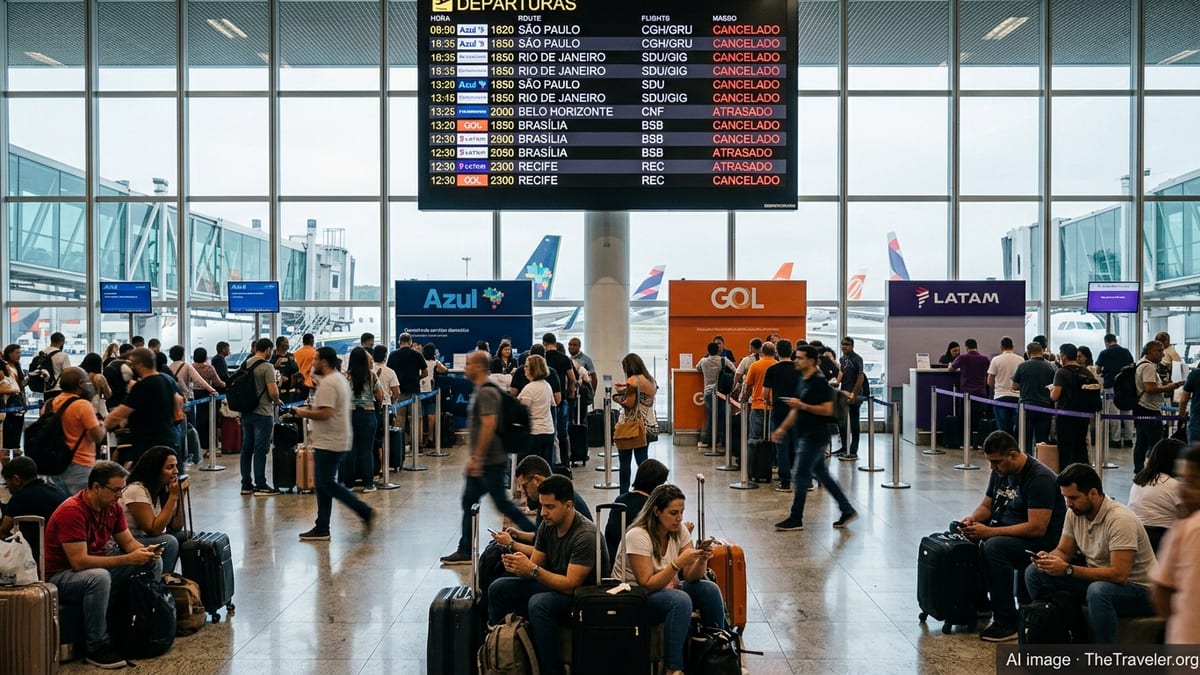
Key Brazilian Hubs See Schedules Thinned
Published airline data and local media coverage indicate that Brazil’s three largest carriers Azul, Gol and Latam have trimmed or cancelled a series of domestic flights, concentrating the impact on some of the country’s busiest corridors. Services into São Paulo’s main airports, Rio de Janeiro, Belo Horizonte and Brasília are among those reportedly affected, with knock-on effects for connections to Recife and other regional centers.
The reductions appear scattered across the day rather than limited to a single wave of operations, leading to gaps in frequencies on routes that normally see multiple daily services. For passengers, even a modest cut in departures on trunk routes can quickly translate into fuller remaining flights, fewer schedule options and longer waits for rebooking when itineraries are disrupted.
Operational cutbacks in Brazil’s domestic network are particularly sensitive because the country relies heavily on air links between distant state capitals. When large carriers thin out frequencies between hubs such as São Paulo, Rio and Brasília, travelers from secondary cities can lose convenient same‑day connections, often forcing overnight stays or significant schedule changes.
In some cases, cancellations are being flagged to customers in advance through airline apps and email notifications, while others surface closer to departure, as updated schedules propagate through reservation systems. That timing can significantly change how easily travelers can adjust their plans without incurring extra costs for accommodation and ground transport.
Rondônia Dispute Highlights Wider Capacity Pressures
Publicly available corporate filings and legal documents show that Azul, Gol and Latam have recently been involved in disputes over service levels in the northern state of Rondônia, where a combination of high volumes of passenger lawsuits and challenging weather has contributed to a fragile operating environment. One reference in Azul’s regulatory reporting cites an action related to announcements of cancellations and interruptions of flights by all three major carriers in the state, underscoring how legal and financial pressures can feed back into network decisions.
Although the current wave of cancellations is impacting much larger markets such as São Paulo and Rio de Janeiro, analysts note that the issues in Rondônia illustrate a broader tension in Brazil’s aviation sector: carriers must balance commercial viability, legal exposure and operational resilience on routes that are critical for regional connectivity but often operate on thin margins.
In this context, airlines may be more inclined to consolidate capacity onto higher‑demand departures, withdrawing or merging less profitable flights. When several carriers do this at the same time, the effect for passengers can resemble a coordinated thinning of service across multiple cities, even when each company is responding individually to its own costs and constraints.
Consumer advocates in Brazil have previously highlighted how abrupt schedule adjustments can leave travelers with fewer alternatives, particularly in regions where a single airline controls most of the available seats. As the latest cancellations ripple through major hubs, similar concerns are now surfacing in relation to large urban centers and the secondary cities that depend on them for onward connections.
Weather, Crewing and Financial Strains Intersect
Reports from aviation oversight bodies and recent operational statistics suggest that Brazilian airlines have been navigating a combination of volatile weather, crew availability challenges and tight financial conditions. Azul has highlighted in earlier seasonal planning materials how it adapts its network during winter months to reduce weather‑related cancellations, while Gol and Latam have disclosed restructuring efforts and debt strategies intended to stabilize their operations.
Travel disruption this week appears to follow that broader pattern, where relatively small schedule adjustments made for operational or financial reasons can cascade into visible disruption at busy airports. When one or more flights on a key route is removed from the timetable, the remaining services must absorb displaced passengers, which increases the risk of overbooking, delays during boarding and longer lines at service counters.
Brazil’s air traffic reports also show that São Paulo and Rio de Janeiro remain the dominant nodes in the country’s network, with Brasília and Belo Horizonte serving as important secondary hubs. Any disturbance in flight flows through these cities rapidly affects nationwide connectivity, meaning that cancellations centered there tend to be felt far beyond the immediate origin and destination points.
Industry observers point out that while each individual cancellation may have a clear operational justification, the cumulative impact can look and feel like a wider disruption to travelers moving between Brazil’s major metropolitan regions, especially when changes occur repeatedly over a short period.
Impact on Passengers Heading to Coastal and Northeastern Destinations
The latest cancellations are particularly disruptive for travelers bound for coastal and northeastern destinations, including Recife, which rely on connections through the major southeastern hubs. According to routing patterns published by the airlines and Brazil’s aviation authorities, many itineraries from the south and center‑west of the country to the Northeast involve a change of planes in São Paulo, Rio de Janeiro or Brasília.
When flights into those hubs are cancelled or rescheduled, passengers may miss onward connections and face rebooking onto later services that are already heavily booked, especially in busy travel periods. This increases the risk of extended layovers, unexpected overnight stays and additional out‑of‑pocket expenses for food and lodging.
Travelers heading to leisure destinations along the northeastern coast are particularly sensitive to disruptions that cut into limited vacation time. Reports from consumer forums and social media often describe situations where a single cancelled leg can cost travelers a full day of their trip, especially when alternative options involve circuitous routings or long ground transfers from alternative airports.
For business travelers, reduced flexibility on high‑frequency routes between hubs such as São Paulo and Recife or Brasília and Belo Horizonte can complicate same‑day returns, prompting some companies to reconsider meeting schedules or shift to virtual formats when flight reliability becomes uncertain.
What Travelers Can Do as Disruptions Continue
Publicly available guidance from Brazil’s National Civil Aviation Agency and consumer protection bodies emphasizes that passengers affected by cancellations are entitled to clear information and, depending on the circumstances, options such as rebooking, refunds or assistance at the airport. While the specific remedies can vary by situation, understanding these baseline rights is an important first step for travelers facing sudden itinerary changes.
Given the current pattern of cancellations by Azul, Gol and Latam, travel advisers recommend that passengers monitor their bookings closely in the days leading up to departure, using airline apps and checking for schedule updates directly on carrier websites. Early awareness of a cancelled or retimed flight generally makes it easier to secure alternative arrangements before remaining seats are taken by other displaced travelers.
Specialists also suggest building additional buffer time into itineraries that involve critical connections, especially when traveling through São Paulo, Rio de Janeiro, Belo Horizonte, Brasília or Recife. For those with fixed‑time commitments such as events or cruise departures, arriving a day earlier than strictly necessary can provide an important cushion if a scheduled flight is removed from the timetable.
As Brazil’s three main airlines navigate operational and financial headwinds, the prospect of further short‑notice adjustments cannot be ruled out. For now, travelers are being urged to stay vigilant, keep documentation of any changes to their journeys and factor the risk of disruption into their planning when flying on domestic routes served by Azul, Gol and Latam.