

More news on this day
Travelers in South Korea faced fresh disruption as key flights operated by Malaysia Airlines and Korean Air were cancelled on routes linking Incheon and Jeju with Kuala Lumpur and Yeosu, leaving passengers stranded at two of the country’s busiest airports and scrambling for alternative connections.
Get the latest news straight to your inbox!
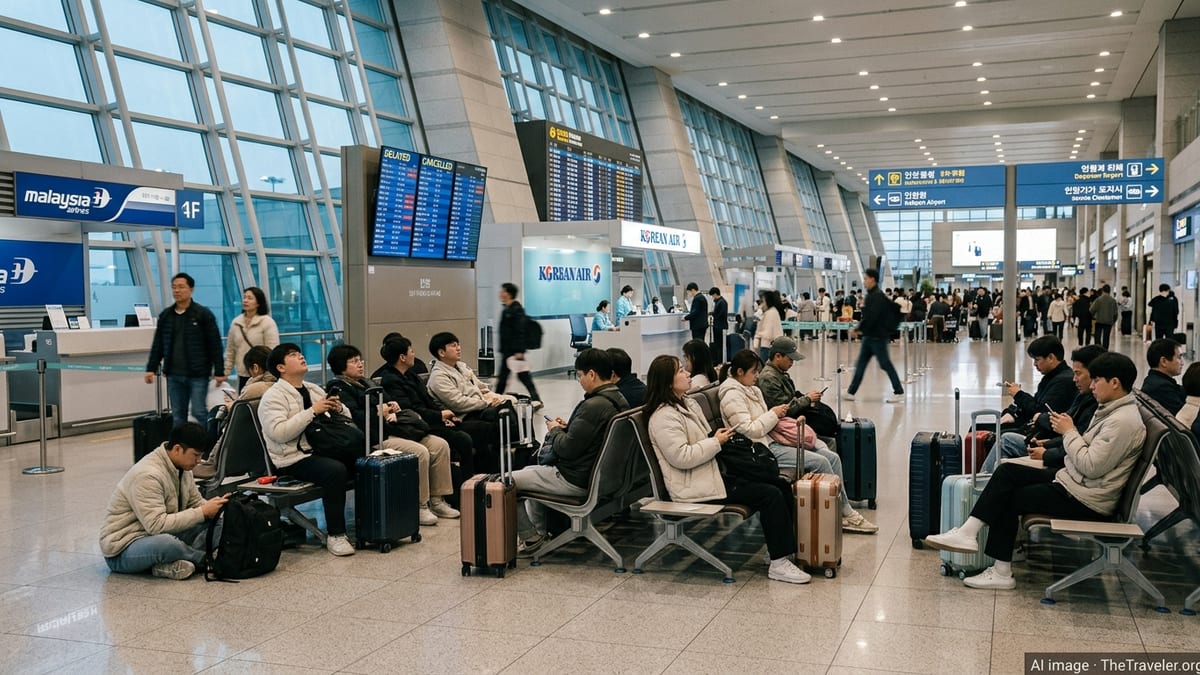
Key Cancellations Strain Incheon and Jeju Operations
Publicly available flight-tracking data and local media coverage indicate that two heavily used services, a Malaysia Airlines connection between Incheon and Kuala Lumpur and a Korean Air link affecting travel between Jeju and the southern city of Yeosu via mainland hubs, were cancelled with limited advance notice, triggering knock-on disruption for connecting passengers. The affected services sit on important leisure and business corridors, amplifying the impact beyond point-to-point travelers.
At Incheon International Airport, reports describe passengers bound for Kuala Lumpur being held in departure areas as ground staff worked through rebooking options on later departures and partner carriers. Some travelers reportedly faced overnight waits while seat availability was recalculated in the context of broader schedule adjustments tied to changing airspace conditions.
Jeju International Airport, a major domestic and regional tourism gateway, also saw queues build as Korean Air’s cancellation fed into an already tight schedule on the Jeju mainland routes. Travelers heading onward toward Yeosu and other southern coastal destinations faced missed connections and last-minute changes, with some opting to switch to rail or ferry services on the mainland when rebooking options were limited.
The disruption comes during a period when airlines serving South Korea and Southeast Asia have been operating at high load factors, leaving fewer spare seats to absorb irregular operations and increasing the likelihood that a single cancellation strands a large number of passengers.
Wider Aviation Context: Regional Airspace and Capacity Pressures
Recent advisories from aviation regulators in the region highlight that evolving airspace restrictions across parts of the Middle East and rerouted long-haul operations have contributed to operational complexity for carriers linking Asia with Europe and beyond. Publicly available information from Malaysian authorities notes that such conditions can lead to delays, retiming and cancellations on selected international services as airlines adjust routings and crew schedules for safety and regulatory compliance.
Industry data released in late 2025 and early 2026 also show that routes between Kuala Lumpur and major Northeast Asian hubs, including Seoul Incheon, have undergone capacity adjustments as airlines balance demand recovery with fuel costs and operational constraints. In this environment, even a limited number of cancellations can quickly cascade into missed onward connections and unexpected overnight stays for travelers.
Domestic air travel within South Korea has faced its own pressures. Jeju, one of the country’s busiest air markets, has periodically experienced weather-related shutdowns that strand thousands of passengers, and airlines have been recalibrating schedules following earlier safety reviews and infrastructure constraints at certain regional airports. Against this backdrop, the latest Korean Air cancellation affecting access to Yeosu adds a further layer of complexity for travelers relying on tight domestic connections after or before international flights.
Travel analysts note that while airlines typically build buffers into schedules, a combination of constrained capacity, rerouted long-haul services and high seasonal demand can narrow the margin for absorbing unforeseen disruption, especially at hub airports like Incheon and high-volume leisure gateways such as Jeju.
Impact on Passengers Bound for Kuala Lumpur and Yeosu
For passengers booked on the cancelled Malaysia Airlines service between Incheon and Kuala Lumpur, the most immediate impact has been missed onward connections to destinations in Malaysia and across Southeast Asia. Kuala Lumpur functions as a hub for travel to secondary Malaysian cities and nearby regional markets, so delays at the South Korean end of the journey can ripple across multi-leg itineraries, forcing reissues of tickets and re-coordination of hotel and tour arrangements.
Travelers connecting through Jeju and onward toward Yeosu on itineraries involving Korean Air and domestic feeders have similarly reported itinerary upheavals. Yeosu, a coastal city known for marine tourism and industry, relies heavily on domestic air and rail links. When air connections are severed or reduced, passengers often have to pivot to high-speed rail from other mainland gateways, adding hours of ground travel and additional costs to what are often tightly scheduled trips.
Families, tour groups and independent travelers caught by the cancellations have turned to airline counters and digital channels to seek rerouting, refunds, or accommodation support. According to published consumer guidance in South Korea and Malaysia, carriers are expected to offer care and alternative travel options during significant disruptions, but the specific remedies available can vary depending on ticket type, fare rules and whether the disruption is categorized as within or beyond the airline’s control.
Observers point out that when high-demand routes operate close to capacity, replacement flights can quickly sell out, meaning even passengers who are rebooked may not depart until the following day or later. This is especially challenging for travelers on time-sensitive trips such as business meetings, cruise departures or fixed-date events in Kuala Lumpur, Yeosu or intermediate stopover cities.
How Airlines and Airports Are Managing the Disruption
Operational updates published by airlines and airport operators show a gradual effort to normalize schedules while accommodating displaced travelers from the cancelled flights. Ground staff at Incheon and Jeju have focused on re-accommodating passengers on later services operated by the same carriers, as well as on partner and codeshare airlines where interline agreements permit.
Airports have emphasized standard contingency measures such as extended customer-service desk hours, increased staffing at information counters and coordination with ground transport providers to help passengers whose journeys have been interrupted. In some cases, passengers have been encouraged through public notices to check digital channels for real-time updates rather than relying solely on airport displays, which can lag behind airline-controlled systems during fast-evolving disruption.
Industry guidance referenced in publicly accessible airline policies indicates that when cancellations occur at short notice, carriers may provide meal vouchers, hotel accommodation or ground transport assistance depending on the duration of the delay and local regulations. However, travelers often report variations in how this support is implemented in practice, which can fuel frustration when large numbers of people are affected simultaneously, as seen at Incheon and Jeju.
Airlines serving South Korea have, in recent years, also invested in automated rebooking tools and mobile notifications intended to shorten queues at customer-service counters during irregular operations. The latest cancellations provide another test of these systems, particularly for complex itineraries involving connections in Kuala Lumpur, Yeosu or third-country hubs that may themselves be under strain from wider regional airspace issues.
What Travelers Should Know Before Flying Through Incheon or Jeju
Travel advisories issued by aviation regulators and consumer agencies in the region consistently recommend that passengers check their flight status frequently, especially in periods of heightened operational uncertainty. This is particularly relevant for those planning to fly between South Korea and Southeast Asia, or to transfer through Jeju and lesser-served domestic airports such as those used to access Yeosu.
Publicly available consumer-protection codes in Malaysia and South Korea outline rights related to notification of schedule changes, care and assistance, and options for refunds or rerouting when cancellations occur. Travelers are encouraged to familiarize themselves with these frameworks, along with the specific conditions of carriage of their chosen airline, before departure.
Experts in travel planning also advise building longer connection times into itineraries that link domestic South Korean flights with international departures or arrivals, particularly when one leg is on a separate ticket. In situations like the Malaysia Airlines cancellation at Incheon or the Korean Air disruption affecting access to Yeosu, passengers on tightly timed self-connecting itineraries are often the most exposed to missed onward flights and additional expenses.
As airlines continue to adjust schedules around evolving airspace and capacity conditions in early 2026, the latest cancellations at Incheon and Jeju illustrate how localized operational decisions can have far-reaching consequences for travelers. Those planning upcoming trips through these hubs are being urged, through public guidance and media coverage, to monitor developments closely, maintain flexibility in their plans where possible, and confirm their flight status repeatedly in the days and hours before heading to the airport.