

More news on this day
Passengers travelling through Singapore this week are facing a fresh wave of disruption after flight cancellations by TransNusa, Singapore Airlines and Jetstar disrupted key routes to Jakarta, New York, Melbourne and other regional hubs, underscoring how quickly weather and operational issues in different parts of the world can ripple through one of Asia’s busiest aviation gateways.
Four Cancellations Underscore Singapore’s Vulnerability to External Shocks
Changi Airport, long regarded as one of the world’s most reliable hubs, has again been reminded of its exposure to events beyond its control. Over recent days, a combination of severe winter weather in North America, unsettled conditions in parts of Indonesia and ongoing schedule adjustments in Australia has culminated in at least four notable cancellations by TransNusa, Singapore Airlines and Jetstar on routes that are vital for both business and leisure travel.
While the raw number of flights affected remains small compared with Changi’s daily movements, the cancellations hit disproportionately important city pairs: Singapore to Jakarta for regional business traffic, Singapore to New York for ultra long-haul connectivity, and Singapore to Melbourne for Australia links. Travellers reported crowded airline service desks, long call-centre waits and a scramble for alternative routings as they sought to salvage trips planned around meetings, school holidays and family reunions.
For Singapore’s tourism and aviation sectors, the latest disruption highlights how quickly a confluence of weather systems and airline network changes can fray the perception of seamless travel. Even when the root causes lie thousands of kilometres away, the operational impact is immediately visible in departure boards, gate areas and baggage halls across Changi’s terminals.
Industry observers note that with aircraft operating at high load factors and schedules optimised to maximise utilisation, there is less slack in the system to absorb sudden cancellations. When a single long-haul rotation is scrubbed, the knock-on effects can radiate across multiple routes, including those not directly affected by adverse weather or airspace constraints.
Singapore Airlines Cancels New York Services as Blizzard Halts US Northeast
Singapore Airlines has been among the most visible carriers affected after a powerful winter storm swept across the northeastern United States, prompting airport closures and extensive delays. In an advisory issued in recent days, the flag carrier confirmed it would cancel a series of flights linking Singapore with New York, including services operating via Frankfurt as well as non-stop ultra long-haul sectors.
Among the affected flights are high-profile services that normally connect Changi with John F. Kennedy International Airport and Newark Liberty International Airport, routes that anchor Singapore’s trans-Pacific and trans-Atlantic connectivity. At least one long-haul departure from Singapore to New York and its corresponding return sector were cancelled as the storm intensified, with further adjustments flagged as possible while conditions remain volatile around major New York airports.
Passengers booked on the disrupted flights were offered re-accommodation on later services or the option of refunds for unused portions of their tickets, according to the carrier’s customer advisories. However, with multiple airlines simultaneously trimming capacity due to weather, some travellers found that rebooking involved significant delays, extended layovers or rerouting through alternative hubs in Europe and the Middle East.
Travel agents in Singapore reported a surge in requests from corporate clients to adjust itineraries or switch to virtual meetings, particularly for travellers who had been scheduled to fly into New York for time-sensitive events. For leisure passengers, the cancellations meant curtailed holidays and the prospect of additional accommodation and transport costs while waiting for new flight options to open up.
TransNusa’s Singapore–Jakarta Disruption Adds Pressure on a Busy Regional Corridor
Closer to home, Indonesian carrier TransNusa contributed to the turbulence facing travellers when a scheduled service between Singapore and Jakarta was cancelled, adding strain to one of Southeast Asia’s busiest business corridors. The airline has been rebuilding its network in recent seasons, targeting high-demand short-haul routes that connect the Indonesian capital with key regional hubs.
Passengers booked on the affected TransNusa flight reported receiving short-notice notifications and being advised to seek rebooking on later services or on other carriers. With Singapore–Jakarta frequencies already heavily subscribed during weekday peaks, same-day alternatives were limited, particularly for those holding restricted or promotional fares that offered less flexibility.
Singapore’s air link with Jakarta is essential for corporate and government travel, given the volume of cross-border investment and trade between the two neighbours. Any loss of capacity on the route, even for a single rotation, can quickly translate into higher load factors and compressed seating availability across the day’s remaining flights. For travellers aiming to connect onward via Singapore to long-haul destinations in Europe and North America, a missed Jakarta–Singapore sector can mean a domino effect of missed connections and overnight layovers.
The TransNusa cancellation also revived questions about the resilience of smaller regional carriers operating in a competitive marketplace dominated by larger full-service and low-cost airlines. Industry analysts said that while operational hiccups are inevitable, consistent communication and clear rebooking policies are critical to maintaining passenger confidence, particularly on trunk routes where travellers have multiple carrier choices.
Jetstar Cancellation Hits Singapore–Melbourne Leisure and VFR Traffic
Australian low-cost carrier Jetstar, which serves Singapore from cities including Melbourne and Perth, has also been caught up in the latest wave of disruptions. One Melbourne-bound service from Singapore was cancelled amid what the airline described as a combination of operational constraints and schedule reshuffling tied to its recent move between terminals at Changi and evolving fleet deployment plans.
The affected flight was significant because Singapore–Melbourne is a key leisure and visiting-friends-and-relatives corridor, particularly for families straddling Australia and Southeast Asia. Budget-conscious travellers often rely on Jetstar’s lower fares to make frequent trips more affordable, meaning a cancellation can have outsized personal impact compared with disruptions on higher-yield corporate routes.
At Changi’s terminals, passengers left without an immediate departure option turned to service counters seeking explanations and alternatives. Some were transferred to later flights or rebooked via other Australian cities, while others were offered refunds and asked to arrange their own onward transport. For those with tight timeframes due to work or school schedules, such options were far from ideal.
The episode comes at a delicate moment for Jetstar’s Singapore operations, following the closure of its former Singapore-based affiliate and the consolidation of routes under its Australian arm. With aircraft now rotated across a broader network, unplanned maintenance or crew availability issues on one leg can have rapid knock-on impacts for services touching Changi, especially during busy travel periods.
Knock-On Effects at Changi: Crowded Desks, Retimed Connections
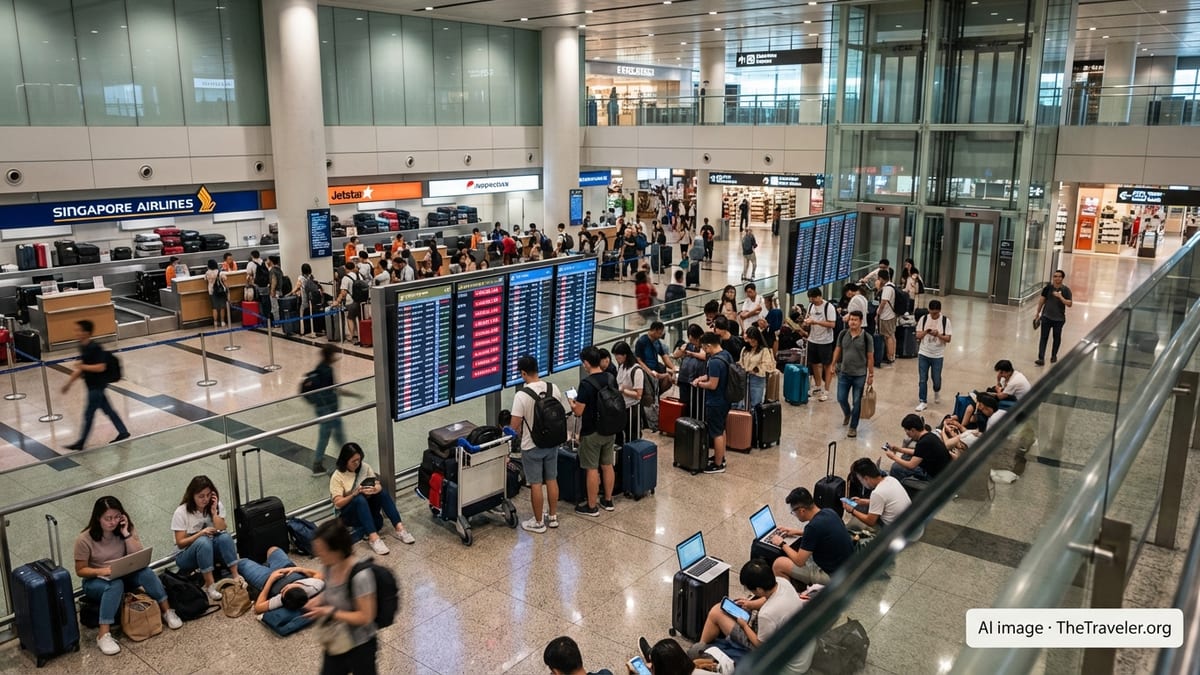
Although the cancellations originated from different causes and carriers, their effects converged at Changi Airport in visible ways. Departure and arrival screens lit up with status changes as check-in staff worked to adjust passenger flows, while transit passengers arriving from elsewhere in Asia sought clarity on whether their onward flights to New York, Jakarta or Melbourne would proceed as planned.
Airline customer service counters in several terminals reported elevated foot traffic as travellers sought personalised assistance. For some, the priority was securing the earliest possible replacement flight, even if it meant inconvenient transit times or longer total journey durations. Others focused on making sure their luggage was correctly rerouted or retrieved after abandoned itineraries.
Hoteliers near the airport saw a modest uptick in last-minute bookings from stranded travellers, particularly those affected by the long-haul Singapore–New York cancellations. With the storm-related disruption in the United States expected to last through multiple days, some passengers chose to delay their departure from Singapore entirely, turning an enforced wait into an unplanned stopover.
Digital tools helped to soften some of the impact, as airlines urged customers to track their bookings via apps and online portals rather than queuing in person. However, for passengers already at the airport or those with complex, multi-stop itineraries, face-to-face interaction remained the preferred way to navigate rebooking and compensation questions.
Travellers Scramble to Rebook and Reroute Amid Limited Capacity
For affected passengers, the most immediate concern has been how to reach their intended destination with the least possible delay. Corporate travel managers described a challenging environment in which alternative seats, particularly in premium cabins on the Singapore–New York sector, quickly became scarce once the cancellations were announced.
Some travellers opted to reroute via other Asian or European hubs, piecing together longer but still viable journeys using a mix of alliance and codeshare partners. For example, passengers originally booked on a cancelled non-stop Singapore–New York flight might instead connect via Frankfurt, London, Tokyo or Dubai, depending on visa requirements, fare rules and seat availability.
On shorter-haul routes such as Singapore–Jakarta and Singapore–Melbourne, the options were somewhat broader but still constrained during peak travel windows. Low-cost carriers and full-service airlines alike have been operating with high load factors, leaving little room to absorb last-minute shifts. Some passengers reported accepting red-eye departures or arrivals at less convenient times in exchange for simply getting to their destination within 24 hours of their original schedule.
Travel insurance providers noted a rise in claims inquiries related to weather and operational disruptions, with policyholders seeking clarity on reimbursement for extra hotel nights, meals and ground transport. The complexity of claims has been heightened by the fact that separate legs of a journey may be operated by different carriers, each with its own conditions of carriage and compensation policies.
Operational and Weather Factors Combine to Test Airline Resilience
The latest spate of cancellations highlights how intertwined operational reliability has become across global networks. In the case of Singapore Airlines, the proximate cause lay in a severe snowstorm affecting the northeastern United States, prompting safety-driven decisions to suspend certain rotations to and from New York and nearby hubs. Even though conditions at Changi itself remained stable, aircraft and crew that would normally cycle through the system were effectively frozen in place.
TransNusa and Jetstar, by contrast, have been contending with a different set of challenges more closely linked to fleet utilisation and regional scheduling. For smaller or low-cost operators, a single aircraft technical issue or crew shortage can force difficult choices about which flights to prioritise, especially when spare capacity is limited and demand remains robust on multiple routes.
Aviation analysts argue that such disruptions are likely to become more common as airlines seek to maximise efficiency in the face of cost pressures and evolving travel patterns. Networks now stretch further, and aircraft are flying more hours per day, leaving limited buffers to absorb unexpected weather events or technical snags without resorting to cancellations or significant delays.
For Singapore as an aviation hub, the situation underlines the importance of close coordination among airlines, airport operators and air traffic management authorities across multiple jurisdictions. When storms close runways in New York or operational bottlenecks arise in regional markets, the resulting decisions about aircraft positioning and crew duty times have direct consequences for passengers checking in at Changi’s terminals.
What Passengers Should Do When Flights via Singapore Are Cancelled
As travellers absorb the latest round of cancellations, consumer advocates and travel professionals are reiterating practical steps passengers can take when itineraries through Singapore are suddenly disrupted. The first is to monitor official airline channels closely, including mobile apps and text or email alerts, which often provide the earliest indication of schedule changes and rebooking options.
Experts also recommend that passengers familiarise themselves with the fare rules and conditions of carriage associated with their tickets. Flexible or semi-flexible fares may allow for free changes or refunds, while deeply discounted tickets can carry more restrictive terms. Understanding these details before a disruption occurs can help reduce stress and decision time when every minute counts at a crowded service desk.
Where possible, travellers are urged to keep essential items such as medication, chargers and a change of clothes in carry-on bags, in case checked luggage becomes difficult to access after a cancellation. For those with tight onward connections, arranging slightly longer layovers when booking complex itineraries through major hubs such as Singapore can provide a modest but valuable buffer against minor delays cascading into missed flights.
Ultimately, while airlines are responsible for managing their operations and communicating changes, the latest disruptions involving TransNusa, Singapore Airlines and Jetstar show that even well-run hubs like Changi cannot fully insulate passengers from global weather systems and network pressures. For now, flexibility, preparation and timely information remain the most effective tools travellers can deploy when their flights through Singapore suddenly are no longer taking off as planned.