

More news on this day
Air travel across parts of China and the Gulf is facing fresh disruption as more than 20 flights operated by Air China, China Eastern, China Southern, Gulf Air and other carriers are reported cancelled or heavily rerouted, affecting links between Bahrain and a series of key Chinese cities including Lhasa, Urumqi, Shanghai and Chongqing.
Get the latest news straight to your inbox!
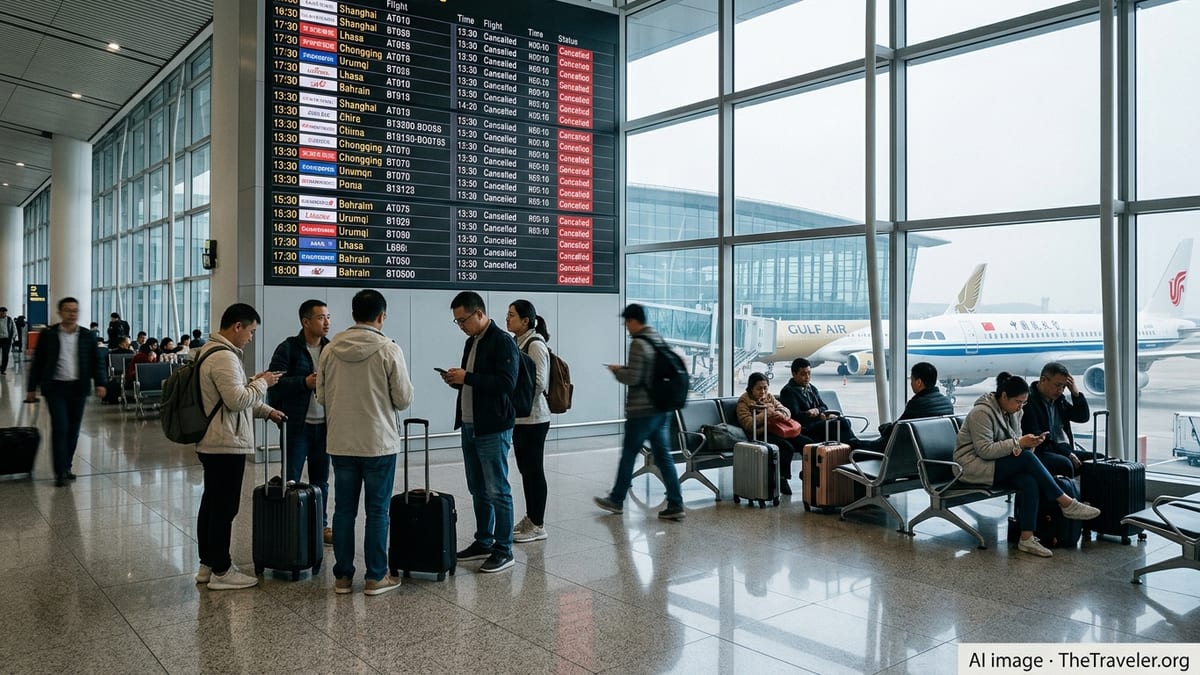
Multiple Carriers Adjust Schedules Amid Regional Volatility
Recent schedule changes published by airlines and airport operators indicate that a cluster of cancellations and frequency reductions has emerged on routes connecting China with the Gulf region, particularly services touching Bahrain. These changes involve major Chinese carriers such as Air China, China Eastern and China Southern, alongside Gulf Air and a handful of other operators using Bahrain and Chinese hubs as transit points.
Publicly available timetable data and media coverage of airspace constraints in parts of the Middle East suggest that airlines have been revisiting their spring schedules, trimming underperforming sectors and temporarily suspending some flights into and out of Bahrain. While the number of affected passengers has not been detailed, the cancellation of more than 20 flights across several days is expected to ripple through already busy networks in Shanghai, Chongqing and western China.
China’s big three state-owned airlines had already been recalibrating international capacity as demand recovered unevenly across regions. Reports indicate that this latest round of alterations focuses on routes with exposure to Gulf airspace and on long domestic connections that rely on tight transfer windows at Chinese hubs. The result is a patchwork of cancellations, retimings and aircraft swaps that travelers are beginning to notice as departure dates draw closer.
Gulf Air, which uses Bahrain International Airport as its primary hub, has also made a series of schedule changes this month. Online booking channels show fewer options on some China-linked itineraries, and travel forums include accounts of passengers being offered refunds or rerouting when Bahrain services were removed from the timetable. These adjustments add to the wider regional volatility that has affected carriers across the Gulf since late February.
Domestic Chinese Routes to Lhasa, Urumqi and Chongqing Affected
Within China, the disruption is particularly visible on long-haul domestic sectors that connect eastern coastal hubs with interior and far-western cities such as Lhasa, Urumqi and Chongqing. These routes are critical for both local travelers and international passengers connecting to or from long-haul flights via Shanghai and other coastal gateways.
Chinese aviation schedule data for late March shows a cluster of cancellations on selected rotations bound for Tibet Autonomous Region and the Xinjiang Uygur Autonomous Region. Lhasa and Urumqi, which depend heavily on air links due to their distance from coastal population centers, have seen certain flights removed from sale or zeroed out in reservation systems. In several cases, only one leg of a multi-sector itinerary has been cancelled, leaving passengers uncertain about the status of onward connections.
Travelers posting on flight and China travel forums describe receiving short-notice cancellation notifications from Chinese carriers on regional and domestic legs that feed into major hubs such as Shanghai Pudong. In some instances, passengers reported that alternative routings were available but required substantial backtracking or overnight stops in secondary cities rather than direct same-day connections.
Industry analysts note that airlines often consolidate thinner routes during periods of operational strain, rolling multiple lightly booked flights into a smaller number of departures. In regions such as Tibet and Xinjiang, where demand is highly seasonal and weather-sensitive, this can translate into abrupt timetable changes that are felt most acutely by travelers with fixed onward international tickets.
Shanghai and Other Major Hubs Face Knock-On Disruptions
Shanghai remains the primary international gateway for China Eastern and an important transfer point for Air China and China Southern. The cancellation of feeder flights from interior cities like Chongqing has a direct impact on passengers planning to connect in Shanghai onto long-haul services to Europe, the Middle East and beyond.
Reports shared by travelers indicate that some have seen regional legs into Shanghai cancelled while their long-haul sectors remain listed as operating. This creates a disconnect in itineraries that can be complicated to resolve when tickets involve multiple airlines or separate reservations. Without an intact first segment, passengers risk losing the rest of their journey unless new arrangements are confirmed in advance.
Travel discussion boards in recent days have also highlighted ongoing difficulties in reaching customer service for some Chinese carriers, with callers citing long wait times and limited self-service options on airline websites. Where rebooking tools are available, travelers report mixed success in securing alternative flights that maintain original connection times, especially on days when overall capacity has been trimmed.
Operationally, even modest schedule changes at a large hub can cascade into wider disruption. When a domestic leg into Shanghai or another coastal city is withdrawn, seats on the remaining services quickly fill, leaving fewer options for last-minute adjustments. Airlines may then prioritize rebooking passengers onto flights that support higher-yield international connections, while others are offered refunds or travel credits.
Strains on Bahrain Connectivity and Gulf Air Operations
The situation is compounded by ongoing tensions in parts of the Gulf, which have led to intermittent airspace and operational constraints for carriers in the region. News coverage over recent weeks has highlighted how missile and drone activity around several Gulf states, including Bahrain, has introduced additional complexity for airlines planning routings and crew schedules.
Gulf Air, headquartered in Bahrain, sits at the center of this environment. Publicly accessible information on booking platforms and customer reports suggests that the airline has been adjusting its network to manage both safety considerations and fluctuating demand. Some services through Bahrain appear to have been temporarily reduced or re-timed, with knock-on effects for itineraries linking the Gulf to Chinese cities.
For travelers, the practical result is a higher likelihood of itinerary changes, particularly on journeys that combine Chinese domestic sectors with Gulf connections. A cancelled feeder flight into Bahrain or a removed frequency on a China–Gulf sector can break carefully planned journeys and force travelers into longer routings through alternative hubs such as Dubai, Doha or Istanbul.
Travel agents describe a more complex ticketing environment for trips involving Bahrain and Chinese secondary cities. Where a single through-ticket is not available, passengers often piece together separate tickets on different airlines, increasing the risk that a cancellation on one segment leaves the rest of the itinerary stranded. In today’s environment, those fragmented bookings are proving especially vulnerable.
What Travelers on Affected Routes Should Watch For
Given the number of cancellations and the fluidity of schedules, travelers booked on Air China, China Eastern, China Southern, Gulf Air and other airlines serving Bahrain and key Chinese cities are being advised by travel specialists to monitor their reservations closely. In many cases, airlines update reservation systems before sending formal notifications, meaning that checking bookings online can provide earlier warning of a change.
Passenger rights and rebooking options vary by ticket type, booking channel and jurisdiction. Public information from airlines and consumer agencies generally indicates that when a flight is cancelled by the carrier, passengers may be entitled to a choice of rerouting or a refund. Travelers who booked through online travel agencies or third-party platforms may need to work through those intermediaries, which can add processing time.
For journeys involving multiple legs, experts recommend keeping all segments on a single ticket where possible, which can offer stronger protection if one part of the itinerary is disrupted. Where separate tickets are unavoidable, allowing longer connection times and favoring hubs with multiple daily frequencies can help reduce the risk that a single cancellation will derail the entire trip.
With schedules under pressure in both China and the Gulf, the overall environment remains dynamic. Regularly checking flight status, updating contact details with airlines and considering flexible booking options are emerging as key strategies for passengers trying to navigate the current wave of cancellations affecting links between Bahrain, Shanghai, Chongqing, Lhasa, Urumqi and other important destinations.