

More news on this day
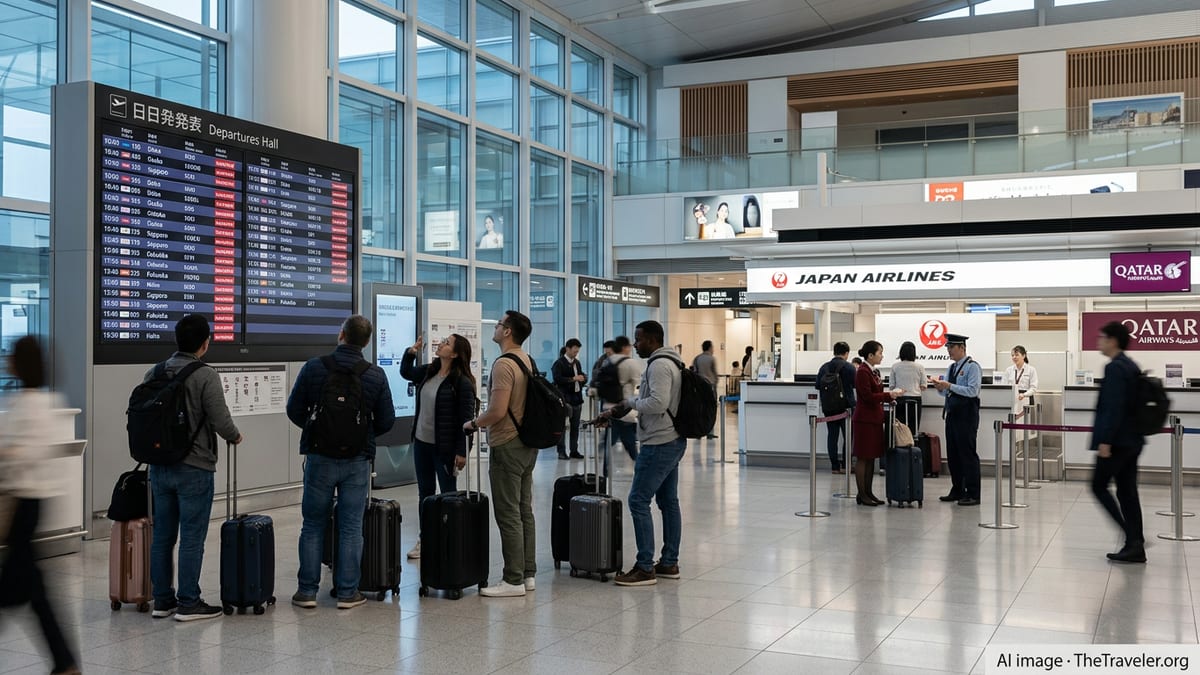
Travelers heading to and from Japan are facing mounting disruptions this week as Qatar Airways, Japan Airlines, Air Do and other carriers scrap more than 20 flights, affecting key routes to Tokyo, Osaka, Hokkaidō, Fukuoka and Okinawa amid ongoing airspace restrictions linked to the security crisis in the Gulf.
Get the latest news straight to your inbox!
Middle East Security Crisis Ripples Across Japan’s Skies
The latest round of cancellations stems from the continuing closure and restriction of airspace around Qatar and neighboring states following Iranian missile strikes earlier this month, which forced carriers across Asia to reroute or suspend services. As long-haul itineraries between Japan and Europe, the Middle East and Africa often rely on Doha as a key hub, knock-on effects are now being felt by passengers traveling through major Japanese gateways.
Operational data compiled by aviation analysts indicates that more than 300 flights across Asia have been canceled since late February due to the widening airspace disruption, with over 1,600 more delayed. Within that broader picture, at least 20 Japan-related services operated or marketed by Qatar Airways and Japan Airlines have now been removed from schedules or placed on indefinite hold, with further short-notice changes likely.
For Japanese airports, the timing could hardly be worse. The cancellations are hitting just as airlines roll out their late-winter and early-spring schedules and as inbound demand from Europe and the Middle East begins to build ahead of the popular sakura cherry blossom period.
Qatar Airways Scales Back Japan Network via Doha
Qatar Airways confirmed this week that it is operating a sharply reduced schedule to and from Doha, prioritizing what it describes as essential connectivity and operationally viable routes. While the airline has not publicly itemized every affected city pair, passengers booked on services linking Doha with Tokyo and Osaka report receiving cancellation notices and rerouting offers, often only days before departure.
Travelers posting on consumer forums and social media say flights from Osaka Kansai and Tokyo to Doha in mid to late March have been canceled outright or removed from booking systems, with customers offered alternative itineraries via partner carriers in Seoul, Istanbul or European hubs. Some passengers with Japan-bound tickets originating in Europe or the Middle East report that their segments into Tokyo or Osaka have disappeared from their reservations while feeder legs into Doha remain technically “on time,” creating confusion over their final destination.
In response, Qatar Airways has extended and updated its flexible rebooking and refund policies several times, allowing certain passengers traveling in the affected period to change dates or seek refunds without standard penalties. However, travelers with departures after the latest cut-off dates say they are being advised to wait until flights are formally canceled before they can rebook at no extra cost, adding anxiety and uncertainty as departure dates approach.
Japan Airlines Suspends Doha Link and Adjusts Domestic Connectivity
Japan Airlines has also moved to cut its exposure on routes linked to the Gulf. The carrier has suspended its Tokyo Haneda to Doha service at least through March 22, removing an important non-stop option between Japan and Qatar just months after the route’s launch. The airline cited the security situation and airspace constraints in the region, noting that it continues to monitor developments and will decide on later flights in line with safety and operational considerations.
The loss of that link has immediate implications for onward connectivity, as the Haneda to Doha route was structured to feed Qatar Airways’ long-haul network to Europe, Africa and South Asia. With both partners now paring back their operations, travelers who once relied on the Haneda–Doha–Europe corridor are scrambling to secure seats via alternative hubs such as Dubai, Singapore or Seoul, where capacity is already under pressure.
Domestically, JAL is pressing ahead with its fiscal 2026 network plan, which includes both frequency increases on some leisure-heavy routes and targeted reductions elsewhere. Schedule documents show adjustments on several city pairs touching Tokyo, Osaka, Fukuoka and Okinawa, including the suspension or thinning of less profitable services and the redeployment of capacity into peak holiday periods. For travelers, that means that even those not directly affected by the Middle East situation may find fewer time options or tighter loads on certain domestic legs feeding international flights.
Air Do and Regional Carriers Trim Hokkaidō and Okinawa Services
Hokkaidō-focused airline Air Do has also announced schedule changes for the upcoming season, including the withdrawal of select new or marginal flights and a restructuring of its fare products. While the airline is framing the moves as part of a broader simplification of its pricing and network, the result is that some planned additional frequencies linking Sapporo’s New Chitose Airport with Honshu and Kyūshū cities will not go ahead as initially proposed.
Industry sources say a combination of higher operating costs, soft shoulder-season demand and uncertainty over international feed from Europe and the Middle East has prompted Japanese regional carriers to take a more cautious stance on expansion. On routes where new flights had been scheduled into Sapporo, Fukuoka and Okinawa Naha, airlines are opting to consolidate demand onto existing services rather than risk lightly loaded new rotations in the current environment.
For visitors hoping to use Japan’s regional hubs as gateways to ski resorts, onsen towns or subtropical islands, the trims mean fewer direct options and more reliance on connections via Tokyo or Osaka. Travel agents are warning that popular weekend departures into Hokkaidō and Okinawa could sell out earlier than usual if airlines do not restore the canceled flights later in the season.
Stranded Passengers, Rising Fares and What Travelers Can Do
The immediate human impact of the disruptions is already visible at major Japanese airports. Passengers arriving at Tokyo Haneda and Narita expecting to connect onto Doha-bound flights are finding their onward legs canceled, sometimes with limited on-the-spot rerouting options. In Osaka, international departure halls have seen clusters of travelers queuing at transfer desks after receiving overnight cancellation notices.
With capacity constrained and alternative routings often longer and more complex, fares on remaining options via other hubs have risen sharply on some dates. Travelers report prices from Japan to Europe via East Asian or Middle Eastern hubs spiking well above seasonal norms, particularly for departures over the next two weeks. Those able to shift their trips into April or beyond may find more reasonable options as airlines recalibrate schedules, but much depends on how long airspace restrictions in the Gulf remain in place.
For now, airlines and travel advisors are urging passengers booked on Qatar Airways, Japan Airlines or codeshare services touching Doha to monitor their bookings daily, ensure contact details are up to date, and consider building in additional connection time through alternative hubs. Travelers planning domestic add-ons to Hokkaidō, Fukuoka or Okinawa are also being encouraged to lock in seats early and to check for time changes as Japanese carriers refine their spring and early-summer schedules in response to the fast-evolving situation.