

More news on this day
Passengers traveling across Colombia on Tuesday, March 10 and Wednesday, March 11 are facing unexpected disruptions after Avianca and Aeroregional canceled nearly a dozen flights, snarling connections on some of the country’s busiest domestic routes between Bogotá, Medellín, Cali and other key cities.
Get the latest news straight to your inbox!
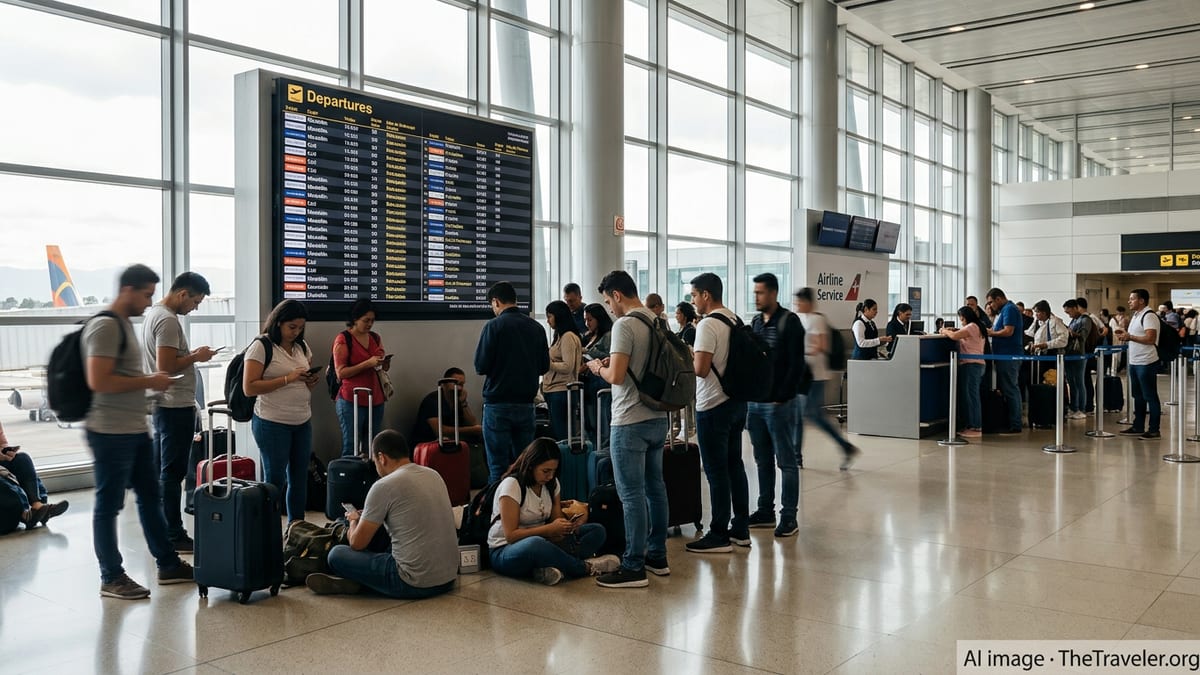
Key Routes Hit by Sudden Wave of Domestic Cancellations
The latest disruption began unfolding late on March 10, when data from flight tracking platforms and airport information boards started showing a series of cancellations on high-demand routes linking Bogotá with Medellín and Cali. Several Avianca services scheduled to depart El Dorado International Airport for José María Córdova International Airport near Medellín and Alfonso Bonilla Aragón International Airport in Cali were listed as canceled, including at least two Bogotá–Medellín and Bogotá–Cali rotations.
By early March 11, the pattern had expanded to include additional frequencies and at least one Aeroregional-operated sector, bringing the total number of cancellations close to a dozen across the two days. While some flights remain scheduled on the core Bogotá–Medellín and Bogotá–Cali corridors, the loss of multiple departures in a short window has sharply reduced options for travelers who depend on these shuttles for business and onward international connections.
The cancellations are being felt most acutely in Colombia’s main urban triangle of Bogotá, Medellín and Cali, where air links effectively function as an aerial highway. Routes from secondary cities into Bogotá, such as Barranquilla, Bucaramanga and Santa Marta, have also seen schedule changes and sporadic cancellations, adding to uncertainty for passengers attempting to reach the capital in time for connecting flights.
Aeroregional, which operates a smaller domestic and regional network, has quietly withdrawn several services over the past 24 hours, compounding the impact of Avianca’s cancellations. Together, the moves have chipped away at capacity on some of Colombia’s core business and leisure routes during what is normally a busy March travel period.
Airlines Cite Operational Adjustments as Travelers Scramble
As of Wednesday morning, neither Avianca nor Aeroregional had provided a detailed, unified public explanation for the series of cancellations beyond generic references to operational adjustments and schedule optimization. People attempting to rebook through call centers and digital channels report long wait times and limited alternative options on the same day, reflecting how tight domestic availability has become on affected routes.
Internally, the adjustments appear to be tied to a mix of aircraft rotation changes, crew availability and broader efforts to refine networks as carriers head toward the Easter travel period. Industry observers in Colombia note that airlines have been aggressively fine-tuning schedules in recent months, trimming weaker frequencies and consolidating passengers onto fewer departures to boost load factors.
For passengers, the result has been abrupt notification of cancellations, often just hours before departure, followed by a scramble to secure seats on later flights or on rival carriers. Social media and traveler forums have been filled with reports of missed connections, unplanned overnight stays in Bogotá and Medellín, and confusion over refund and voucher options for disrupted journeys.
In several instances, travelers who had purchased separate tickets for onward international legs report particular anxiety, as domestic cancellations place those non-protected connections at risk. Without a single booking reference covering the full itinerary, they bear the cost if they fail to reach their long-haul departure in time.
Bogotá Hub Under Strain as Knock-On Delays Build
With Avianca’s main hub at Bogotá’s El Dorado operating as the central transfer point for much of Colombia’s domestic traffic, cancellations on trunk routes have quickly produced knock-on effects across the wider network. Reduced frequencies to and from Medellín and Cali ripple out to secondary destinations, where passengers depend on tightly timed connections through the capital.
By mid-morning on March 11, Bogotá’s departure boards showed a patchwork of statuses: some Avianca flights running on time, others delayed, and several still listed as canceled on routes that had already seen one or more disruptions the previous day. This uneven pattern is forcing travelers to re-evaluate their plans on the fly, and in some cases to switch to buses or private cars to guarantee essential journeys between Colombia’s major cities.
Medellín’s José María Córdova and Cali’s Alfonso Bonilla Aragón airports, both heavily reliant on flows to and from Bogotá, are also experiencing pressure as ground staff work to re-accommodate stranded passengers. Queues at airline counters and customer service points lengthened on Tuesday evening and remained substantial early Wednesday, particularly for those hoping to be placed on the next available departure.
Aviation analysts caution that even a relatively modest number of cancellations on such dense corridors can have an outsized impact, given how many itineraries are built around short, reliable hops to Bogotá before longer domestic or international sectors. The disruptions over March 10 and 11 illustrate how sensitive Colombia’s air travel system remains to sudden schedule changes at the country’s main hub.
What Affected Passengers Should Do Right Now
Travel experts in Colombia recommend that anyone booked to fly between Bogotá, Medellín, Cali or other major cities over the next 24 to 48 hours closely monitor their reservation status through airline apps and airport information screens. Even if a flight still appears as scheduled, recent patterns suggest that last-minute changes remain possible while carriers continue to adjust operations.
Passengers whose flights have already been canceled are being offered a mix of options, typically including rebooking on the next available departure, changing travel dates without penalty, or requesting a refund in line with each airline’s policies. Given the limited same-day capacity on some routes, travelers needing to reach their destination urgently may want to proactively ask about re-accommodation on partner or competing airlines, or explore ground transport alternatives.
Consumer advocates also urge passengers to document all communications with airlines and to keep receipts for hotels, meals and ground transport in case compensation or reimbursement is later offered. While Colombia’s consumer protection framework for air travel differs from rules in the United States or European Union, written evidence of disruption and out-of-pocket costs can strengthen claims filed with carriers or regulators.
Those holding separate onward tickets, especially for international flights, are being advised to build in additional buffer time where possible or to move long-haul departures to later in the day. The unpredictable nature of rolling domestic cancellations means tight connections through Bogotá, Medellín or Cali could still be at risk as Wednesday’s operations evolve.
Outlook for Colombia’s Busy March Travel Period
The latest wave of cancellations comes as Colombian aviation continues to recalibrate after several years of turbulence, including the collapse of low-cost carrier Viva Air and mergers and restructurings among major players. With demand rebounding and fleets still being reconfigured, airlines have been walking a fine line between offering sufficient capacity and avoiding lightly booked flights.
In the short term, network planners at Avianca and Aeroregional are expected to keep a close eye on load factors and operational reliability on core domestic routes, including Bogotá–Medellín, Bogotá–Cali and links to coastal cities such as Barranquilla and Cartagena. Further fine-tuning of schedules is likely through the rest of March, raising the possibility of additional short-notice changes even if large-scale cancellations are avoided.
For travelers, this environment underscores the importance of flexibility and vigilance when flying within Colombia. Purchasing fares that allow for easier changes, avoiding ultra-tight connections and checking flight status repeatedly in the 24 hours before departure are emerging as best practices, especially on routes that have already seen disruption.
While airlines insist that the current cancellations are part of routine operational management, the concentration of affected flights on some of the country’s busiest corridors has amplified frustration among passengers and drawn fresh scrutiny to how carriers communicate and respond when plans suddenly shift. How Avianca and Aeroregional handle re-accommodation and customer care in the coming days will shape traveler confidence as Colombia moves into one of its key tourism and business travel seasons.