

More news on this day
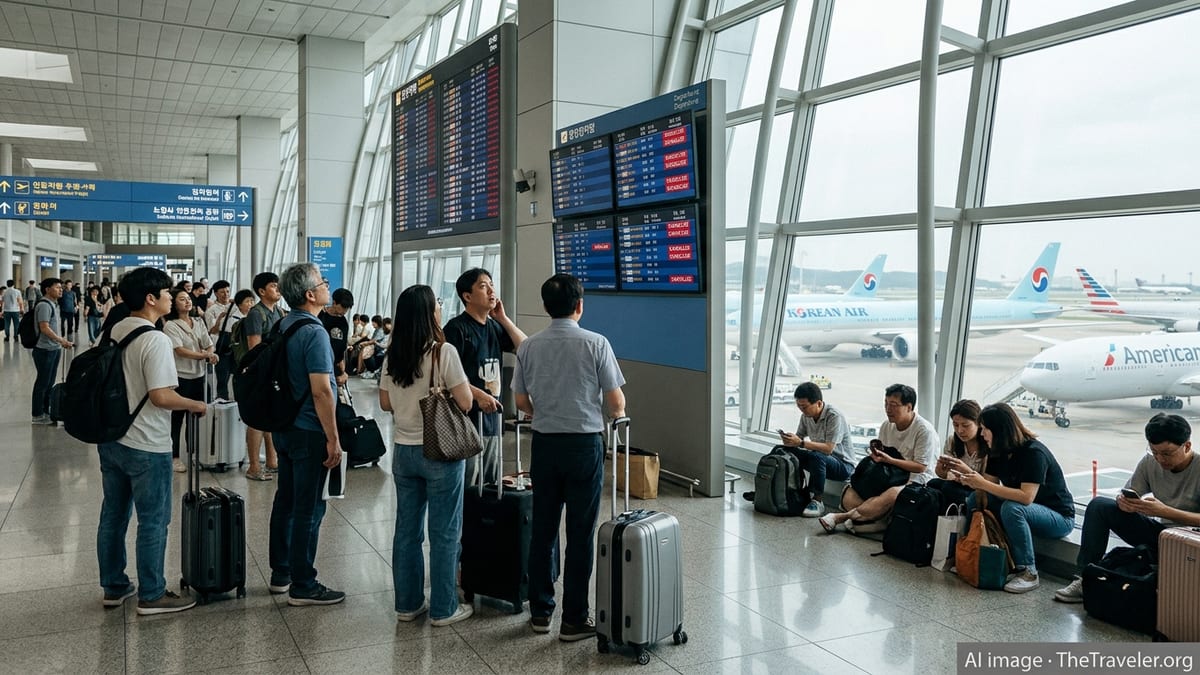
Travelers moving through South Korea’s major hubs are facing fresh uncertainty as American Airlines and Korean Air cancel selected services at Seoul Incheon and Jeju airports, disrupting links between Dallas and South Korea and reducing domestic connectivity between Jeju and Yeosu.
Get the latest news straight to your inbox!
Targeted Cancellations Hit Incheon–Dallas and Jeju–Yeosu Links
Publicly available schedule data and airline updates indicate that American Airlines has recently withdrawn a limited number of Seoul Incheon services that connect with Dallas Fort Worth, while Korean Air has removed selected Jeju–Yeosu segments from upcoming timetables. These targeted changes are contributing to a new round of disruption for travelers who rely on the two hubs for both long haul and regional journeys.
At Incheon, adjustments involve long haul operations that feed into Dallas, a key U.S. gateway for connections across North America. While the core Incheon–Dallas pattern remains in place on many days, cancellations on specific dates are reducing flexibility and leaving some passengers with fewer options for rebooking when delays or irregular operations occur elsewhere in the network.
On the domestic side, Jeju’s role as a critical leisure and transfer hub is under pressure as Korean Air pares back services to Yeosu on South Korea’s south coast. Schedule snapshots show fewer nonstop choices on certain days, forcing some travelers to route via other airports or adjust trip dates, particularly during shoulder periods between peak holiday seasons.
The combined effect is a noticeable tightening of capacity on two routes that serve very different parts of South Korea’s travel market, but are both important to international visitors planning multi‑stop itineraries.
Operational Pressures and Network Realignment Behind the Cuts
According to industry scheduling databases and aviation trade coverage, both American Airlines and Korean Air continue to recalibrate their networks in response to aircraft availability, evolving demand, and broader fleet planning. For American, long haul schedules into East Asia have been adjusted repeatedly over recent seasons, with shifts in aircraft type and frequency used to balance transpacific services against competing priorities in Europe and Latin America.
Reports on recent schedule filings suggest that the Incheon–Dallas operation is being fine tuned rather than permanently withdrawn, with sporadic cancellations and temporary reductions aligned to maintenance windows and fleet utilization. This pattern reflects a broader trend in which long haul carriers maintain a route’s presence while trimming marginal flights to protect reliability and yields during periods of tight capacity.
Korean Air’s domestic network is undergoing its own transformation as the carrier adapts to changing travel flows and gradually aligns operations following its integration of Asiana Airlines. Regional routes such as Jeju–Yeosu, which rely heavily on leisure and short‑break traffic, are particularly sensitive to seasonal demand and aircraft deployment decisions, making them more exposed when airlines seek to consolidate frequencies.
Public information on the Jeju–Yeosu market shows that multiple local and low‑cost carriers share the corridor at various times of year, and Korean Air’s adjustments appear to be part of a strategy to focus flying on periods and city pairs where it retains the strongest competitive advantage.
Impact on International Tourists and Domestic Travelers
For international visitors, the most immediate impact is felt when planning itineraries that combine an intercontinental arrival or departure via Dallas with onward travel inside South Korea. Reduced Incheon–Dallas availability on certain days can limit options for same‑day connections, requiring longer layovers or overnight stays, especially for those linking from or to regional airports such as Jeju, Busan, or Yeosu.
Travelers who had expected a straightforward combination of a Dallas–Incheon long haul flight with a short domestic hop may now find that the Jeju–Yeosu piece of the journey requires additional planning. Fewer nonstop options make it more likely that itineraries will involve a change of planes at other domestic hubs, potentially adding travel time and increasing the risk of missed connections in the event of weather or congestion.
Within South Korea, residents using Jeju as a weekend or holiday base may also experience fuller flights and higher fares on remaining services to Yeosu, particularly around popular festivals, cherry blossom season, and peak summer holidays. Airline comparison tools already show tighter seat availability on some dates where Korean Air has scaled back frequencies.
While alternative airlines and routes exist, the loss of even a small number of well‑timed flights can significantly affect travelers with fixed dates, pre‑booked accommodation, or cruise and tour departures scheduled from southern coastal cities.
What Travelers Need to Do Now
Travel planners and passengers holding tickets that involve Dallas–Incheon or Jeju–Yeosu sectors are being advised by publicly available guidance to treat their bookings as fluid rather than fixed. The most consistent recommendation is to monitor reservations frequently through airline apps or booking platforms, as same‑day timetable changes continue to occur on some long haul and domestic segments.
Those yet to book are finding it increasingly important to build extra buffer time into connections, particularly when piecing together separate tickets on different carriers. Industry commentary highlights that tight self‑planned connections between long haul arrivals at Incheon and short domestic hops to Jeju or Yeosu carry more risk when schedules are in flux.
Travelers with flexibility are also being encouraged by consumer travel advisories to consider alternative routings into South Korea, such as entering via other U.S. gateways with strong Korean connectivity or routing domestic segments via major mainland airports instead of relying solely on Jeju as a transfer point. In some cases, high‑speed rail from Seoul to the south coast can offer a practical substitute when short‑haul flights are constrained.
Across both the Incheon and Jeju markets, the current pattern of cancellations suggests that disruptions are likely to persist intermittently rather than resolve overnight. For now, the most effective strategy for travelers is to remain informed, allow additional time, and keep backup options in mind when planning trips that depend on the affected routes.