

More news on this day
Travel across Kuwait faced fresh turmoil this week as more than a dozen flights operated by Gulf Air, Misr Airlines, and Kuwait Airways were cancelled, disrupting passenger journeys on key routes to Manama, Cairo, New York, Amsterdam, and several other international destinations.
Get the latest news straight to your inbox!
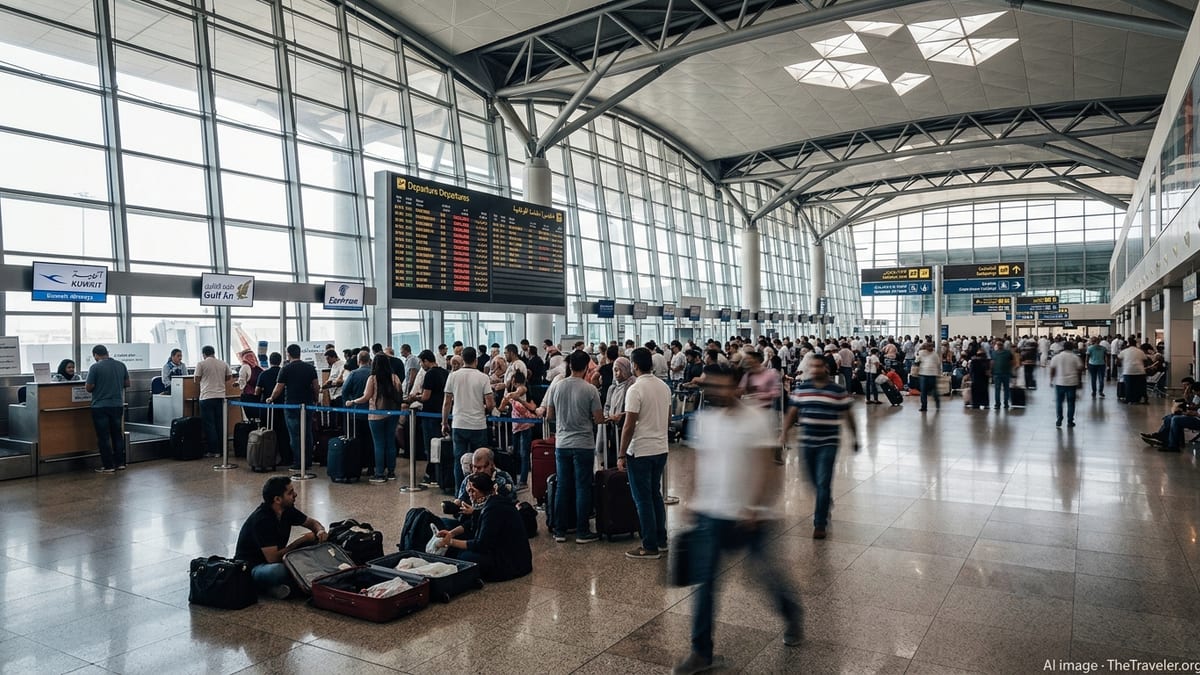
Wave of Cancellations Hits Kuwait International Airport
Publicly available flight-tracking data and local media reports indicate that Kuwait International Airport has seen a sharp spike in short-notice cancellations involving Gulf Air, Misr Airlines, and Kuwait Airways. The disruptions, concentrated over a single operational window, affected departures and arrivals across a mix of regional and long haul services.
Routes to Manama with Gulf Air, Cairo with Misr Airlines, and multiple Kuwait Airways long haul services, including connections toward New York and Amsterdam via Kuwait, were among those impacted. In several cases, flights were removed from departure boards shortly before scheduled departure, leaving passengers to navigate last minute changes or seek alternative routings.
The cancellations come against the backdrop of wider regional airspace constraints and continuing operational uncertainty across parts of the Gulf, which have already forced many carriers to trim schedules, reroute aircraft, or consolidate lightly booked services. Kuwait’s role as a transfer point between Asia, the Middle East, Europe, and North America has magnified the effect for connecting travelers.
While some airlines have been able to substitute aircraft or combine flights to keep passengers moving, the clustering of cancellations by three different carriers at the same airport within a short timeframe has amplified the overall level of disruption felt by travelers in and out of Kuwait.
Key Routes Affected: Manama, Cairo, New York, Amsterdam
Regional connectivity has been particularly strained on the Kuwait to Manama corridor, where Gulf Air typically operates frequent services feeding its Bahrain hub. Flight status information shows multiple Kuwait–Manama rotations scrubbed, tightening capacity on a route that many travelers rely on for onward connections across the Gulf and into Europe and Asia.
Northbound and westbound links have also been hit. Kuwait Airways flights that feed into or connect with services toward New York and Amsterdam have been among those affected, according to flight schedules and published travel advisories. For some passengers, this has meant missed transatlantic connections and the need to rebook through alternative hubs such as Doha, Riyadh, or Istanbul.
Misr Airlines, operating between Kuwait and Cairo, has also seen cancellations on its Kuwait services. For many expatriate workers and families, the Kuwait–Cairo route is a critical lifeline, particularly around peak travel periods tied to holidays and school breaks. Reductions on this corridor have an immediate impact on availability and fares, with remaining seats on alternative carriers often selling out quickly.
The combined impact across these routes has been a patchwork of partial operations, last minute schedule changes, and longer journey times for travelers forced to piece together new itineraries around cancellations that were not always communicated far in advance.
Passengers Confront Last Minute Changes and Limited Guidance
Accounts shared through social media and travel forums describe passengers arriving at Kuwait International Airport to find their flights delayed, retimed, or cancelled outright, sometimes with only a few hours of notice. Some travelers reported that bookings continued to appear as confirmed on airline websites and apps even as airport departure boards and third party trackers showed the flights as cancelled.
Publicly available discussions also suggest that contact channels such as call centers and messaging apps have been heavily strained, with long response times and inconsistent information about rebooking options or refund eligibility. This has added to the uncertainty for travelers with imminent departures who are attempting to decide whether to wait for potential reinstatement of flights or proactively reroute via other hubs.
In several cases, passengers have reported being advised to wait until 24 to 48 hours before departure for confirmation on whether their flight will operate. That approach, while aligned with dynamic operational decision making, leaves travelers with limited time to secure alternatives if a cancellation is ultimately confirmed, particularly on long haul routes where capacity is already tight.
For those already partway through multi leg journeys, airport disruptions in Kuwait have in some instances translated into extended layovers or overnight stays while airlines work to rearrange onward connections, further lengthening what are already complex itineraries.
Airlines Adjust Policies as Regional Constraints Bite
According to publicly available guidance, Kuwait Airways has gradually broadened the range of tickets eligible for refunds or fee waivers on affected dates, reflecting the sustained operational constraints around Kuwait’s airspace and hub activity. Travelers have shared examples of full refund offers and fee free rebooking windows on cancelled services, typically processed via email or through local offices and travel agents.
Gulf Air and Misr Airlines have likewise updated travel advisories and waiver policies at various points, allowing passengers on cancelled or heavily disrupted Kuwait flights to change dates, reroute via alternative gateways, or obtain refunds in line with standard conditions. The specifics have varied by fare type and point of purchase, which has led some travelers to rely on their issuing travel agency or online booking platform to manage changes.
Industry analysts note that airlines across the region are attempting to balance passenger protections with the operational and financial strain of maintaining schedules in a volatile environment. For carriers with smaller fleets or limited spare aircraft, a single day of airspace restrictions or technical disruptions can cascade into multiple cancellations across several routes, especially at constrained hubs.
As a result, policy updates have tended to roll out in stages, often linked to specific travel periods, which can leave passengers with tickets beyond the currently announced windows unsure about how their trips might ultimately be affected if the situation persists.
What Travelers Through Kuwait Should Expect Next
Travel industry observers suggest that passengers with upcoming flights on Gulf Air, Misr Airlines, or Kuwait Airways involving Kuwait should expect continued schedule volatility in the short term. Flight status checks in the days leading up to departure, combined with close monitoring of airline travel advisories, are likely to remain essential.
Travelers are also being encouraged, through publicly available guidance, to keep contact details up to date in their bookings so airlines and agents can push notifications if schedules change at the last minute. In addition, many carriers advise arriving at the airport earlier than usual when regional operations are under strain, in order to allow more time to resolve issues if a cancellation or rerouting is required at check in.
For those yet to book, routing through alternative hubs with more stable operations or greater aircraft and crew flexibility may reduce the risk of disruption, although demand shifts into these hubs can quickly tighten availability. Flexible tickets and comprehensive travel insurance that explicitly addresses cancellation and delay scenarios in the region are also being highlighted in consumer guidance as prudent measures.
With more than a dozen cancellations clustered across services operated by Gulf Air, Misr Airlines, and Kuwait Airways, the latest disruption underscores how quickly conditions around a single Gulf gateway can ripple out across multiple continents, affecting journeys between the Middle East, Europe, Africa, and North America in a matter of hours.