

More news on this day
Travel through Kuwait faced fresh turbulence this week as Gulf Air, Misr Airlines, and Kuwait Airways scrubbed more than a dozen flights, disrupting links between Kuwait and major hubs including Manama, Cairo, New York, and Amsterdam, according to airline notices and airport monitoring data.
Get the latest news straight to your inbox!
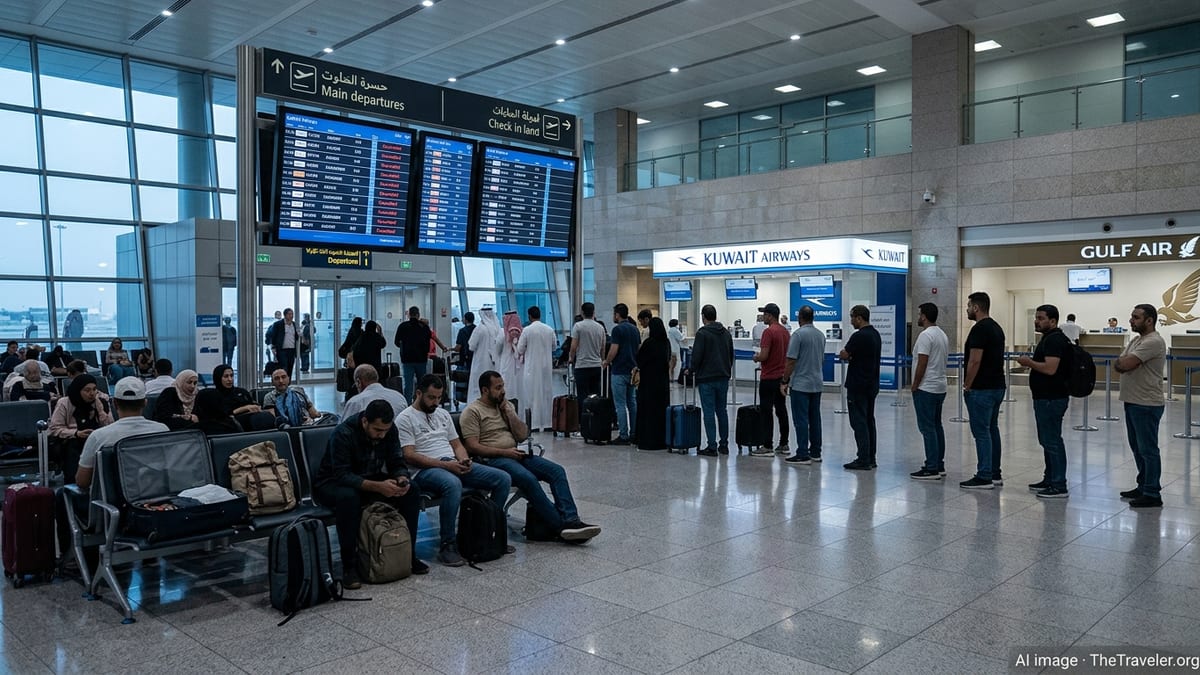
Multiple Carriers Pull Flights From Kuwait Schedules
Published flight information for Kuwait International Airport shows a cluster of cancellations affecting regional and long haul services operated by Gulf Air, Misr Airlines, and Kuwait Airways. The three carriers, which together handle a significant share of Kuwait’s regional connectivity, removed a series of departures and arrivals over a short window, triggering missed connections and last minute itinerary changes for passengers transiting the Gulf.
Routes between Kuwait and Manama, Cairo, New York, and Amsterdam feature prominently among the disrupted services, alongside additional regional links. Publicly available tracking boards indicate cancelled rotations in both directions, meaning passengers in Kuwait and at foreign gateways have been left to seek alternative options or await rebooking on later dates.
While some schedule changes in the region are often tied to seasonal adjustments or aircraft rotations, the concentration of cancellations across multiple airlines and key routes has stood out to travel agents and frequent flyers. The pattern has effectively thinned Kuwait’s role as a same day connection point for parts of the Middle East, Europe, and North America, at least temporarily.
Airport data viewed on Tuesday showed gaps in usual peak bank timings, when Kuwait typically handles a wave of arrivals connecting to outbound services operated by the same set of carriers. With several of those flights withdrawn, travelers have reported fragmented journeys, including overnight layovers and reroutes via other Gulf hubs.
Gulf Air Cuts Manama Services as Schedules Tighten
Gulf Air, the flag carrier of Bahrain, has been among the first regional airlines noted for broad schedule flexibility in March, with public advisories outlining options for free changes on certain itineraries. Recent updates from travel industry channels indicate that selected Kuwait to Manama services were cancelled outright, rather than simply retimed, reducing the number of daily frequencies between the two capitals.
The Manama link is a key short haul corridor for passengers connecting onward on Gulf Air to destinations in the Middle East, the Indian subcontinent, and Europe. When Kuwait departures are removed from the schedule, travelers lose a convenient one stop path to a number of onward cities, adding pressure on remaining flights and competing carriers in nearby hubs such as Doha and Dubai.
Published coverage of airline waiver policies suggests that Gulf Air has been encouraging affected passengers to either shift travel dates or seek refunds where applicable. However, the timing of some cancellations, coming within days of departure, has limited the pool of alternative seats available at comparable fares, especially for those with fixed return dates or onward connections arranged separately.
Industry observers note that regional carriers often adjust short haul routes first when facing operational constraints, as these flights can be consolidated more easily than long haul sectors. In this case, the Kuwait to Manama corridor appears to have absorbed a noticeable share of the disruption, amplifying the knock on effect across Gulf Air’s wider network.
Misr Airlines Disrupts Cairo Link as Egypt Routes Shift
Misr Airlines, commonly associated with Egypt’s national aviation sector, has also contributed to the current disruption through cancellations on the busy Kuwait to Cairo corridor. Publicly available schedules show withdrawn frequencies between the two cities, affecting workers, students, and families who rely on regular flights for both business and personal travel.
The Kuwait Cairo route is traditionally one of the most heavily trafficked in the region, with high demand driven by a substantial Egyptian expatriate community in Kuwait. Any reduction in available seats tends to be felt quickly, especially during peak travel periods or around public holidays when flights are already near capacity.
According to information shared via aviation tracking platforms and travel trade bulletins, some Misr Airlines passengers have been shifted onto alternative departures on different days, while others have been advised to coordinate directly with ticketing agents for refunds or rebooking. The mixed responses reflect varying fare rules and purchase channels, creating an uneven experience for travelers depending on how and when they booked.
With other carriers also serving the Kuwait Cairo market, there remains some capacity on competing airlines, but higher last minute fares and limited seat availability mean that not all affected travelers can easily replicate their original itineraries. The result has been a patchwork of revised travel plans, extended stays, and postponed trips.
Kuwait Airways Cancellations Hit Long Haul Links
Kuwait Airways, the country’s flag carrier, has drawn particular scrutiny for a wave of cancellations on both regional and long haul routes. Passenger reports circulated on social media and forums in recent days describe flights scrubbed with relatively short notice, along with evolving guidance on refunds and rebooking windows.
Among the most disruptive changes are cancellations affecting Kuwait’s long haul links to New York and Amsterdam, which serve as important gateways for transatlantic travel and European connectivity. When these flights are removed from the schedule, travelers often face substantial detours via other hubs or must completely reconfigure their journeys, especially if separate tickets on onward carriers are involved.
Publicly shared communications from Kuwait Airways’ customer channels indicate that the airline has been expanding the range of dates eligible for full refunds on cancelled flights, with processing times often measured in several weeks. At the same time, some travelers have reported difficulty accessing immediate rebooking options through online platforms, prompting them to seek assistance through local offices or third party agents.
Travel discussion boards highlight a degree of uncertainty among passengers whose flights are scheduled beyond the currently published cancellation windows. Many are monitoring their bookings closely, expecting that further cancellations could be announced closer to departure if operating conditions do not improve. This environment of rolling changes has made it challenging for travelers to plan with confidence.
Passengers Face Refund Delays and Complex Rebookings
The combined effect of cancellations by Gulf Air, Misr Airlines, and Kuwait Airways has been a complicated landscape for passengers seeking refunds, credits, or alternative flights. Reports shared by travelers describe lengthy response times on customer service channels and queues for email based refund requests, with some being advised that processing may take a month or more.
In many cases, travel agents have become crucial intermediaries, particularly for complex itineraries involving multiple segments or mixed carriers. Agents are working within the parameters of each airline’s evolving waiver policies, which can differ by date of travel, booking class, and point of sale. This patchwork of rules has led to different outcomes for passengers on seemingly similar routes.
Some travelers have opted to secure replacement journeys on other Gulf carriers immediately, absorbing additional costs in exchange for greater certainty. Others are waiting for formal cancellation notices from airlines in order to qualify for full refunds, a strategy that carries the risk of reduced availability if they move too late. The choice often depends on individual risk tolerance and budget.
Consumer advocates monitoring the situation note that official guidance on passenger rights varies by jurisdiction and point of ticket purchase. Travelers who bought tickets through outlets in North America or the European Union may have different protections than those who purchased directly in the Gulf region, further complicating expectations around compensation and rebooking.
Kuwait’s Role as a Transit Hub Tested
The latest round of cancellations underscores how quickly Kuwait’s position as a mid sized transit hub can be affected when several key airlines adjust operations at once. Even a relatively modest number of scrubbed flights can cascade across global journeys, particularly when they involve links to major cities such as Manama, Cairo, New York, and Amsterdam.
Travel industry analysts point out that Kuwait competes with larger hubs in the Gulf that often have more redundancy built into their networks. When Kuwait based routes are thinned or paused, passengers frequently divert through airports in neighboring countries, which may gain temporary traffic but also face their own capacity constraints.
As airlines continue to refine schedules in response to operational and commercial pressures, passengers with upcoming trips through Kuwait are being advised by travel planners to monitor their bookings closely, check airline notices regularly, and consider flexible arrangements where possible. The current wave of cancellations may ease as airlines stabilize their timetables, but for now, travel plans touching Kuwait remain subject to rapid change.