

More news on this day
Air travellers moving through Oman are facing fresh disruption this week as Gulf Air, Qatar Airways and IndiGo cancel or curtail nearly a dozen services, affecting links between Muscat, Salalah and major regional hubs including Doha and Kochi amid ongoing airspace restrictions across the Gulf.
Get the latest news straight to your inbox!
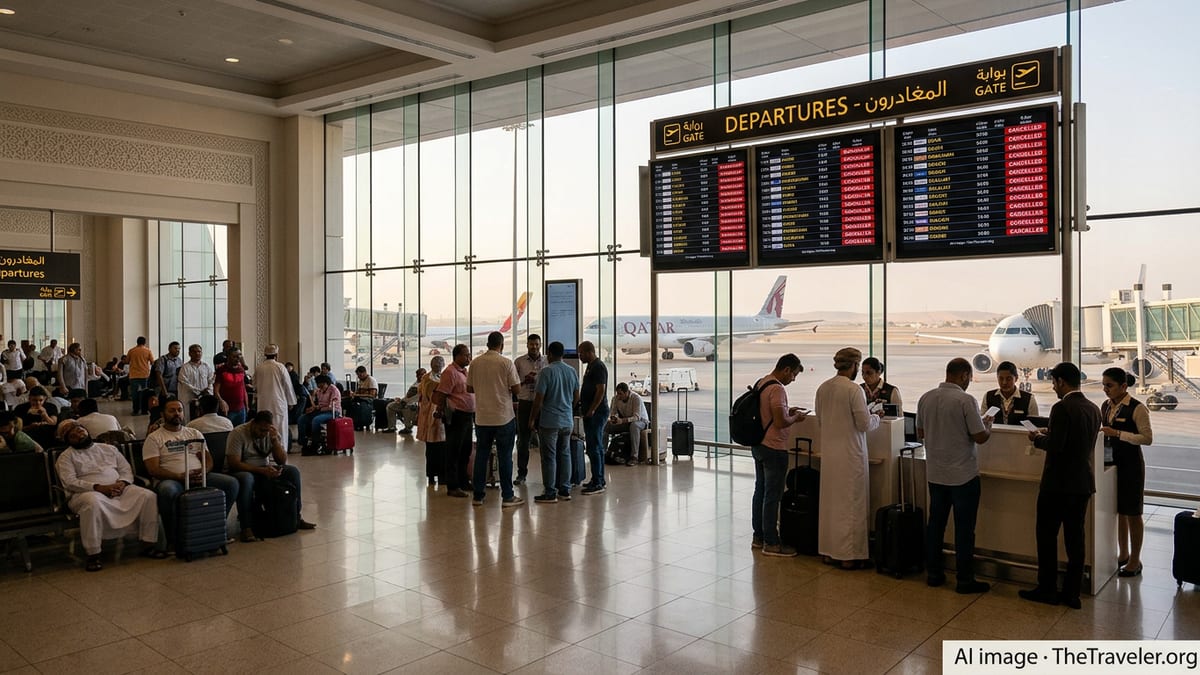
Regional Airspace Closures Ripple Across Oman’s Gateways
The latest wave of schedule changes follows more than ten days of instability in Gulf aviation triggered by airspace closures linked to heightened tensions around Iran and Qatar. Since the end of February, airlines serving Muscat and Salalah have had to repeatedly redraw their timetables, canceling flights outright or rerouting them through alternative corridors as regional authorities impose safety restrictions on overflights.
Oman’s position as a key transfer point between South Asia, the Gulf and Europe means that any closure of nearby airspace quickly cascades across its own network. Airlines reliant on Doha as a primary hub, notably Qatar Airways, have been especially exposed, with Hamad International Airport operating on a sharply reduced schedule and carriers forced to park aircraft or operate limited relief services.
While Oman’s own airspace remains open, the knock-on effect of neighboring shutdowns has constrained the number of viable routings in and out of Muscat and Salalah. That, in turn, has prompted airlines including Gulf Air, Qatar Airways and IndiGo to trim frequencies, consolidate services and cancel some rotations entirely over the coming days.
Travellers connecting between Oman and Gulf destinations such as Doha, Bahrain and Kuwait, or onward to Indian cities like Kochi, now face last-minute changes, missed onward connections and extended layovers as airlines prioritize stranded passengers and essential links.
Qatar Airways Cuts and Restarts Limited Services via Doha
Qatar Airways, normally one of the biggest foreign operators carrying traffic to and from Oman, has been running a skeleton schedule in and out of Doha since Qatari airspace was partially closed at the end of February. After several days in which most commercial services were suspended, the airline has begun operating limited frequencies under special approvals from regulators, but the number of flights remains far below normal levels.
In its latest travel alerts, the airline lists only a handful of daily departures and arrivals through Hamad International Airport for the coming week, prioritizing long-haul links and essential regional connections. Among the destinations being served on select days are Muscat and Kochi, though the pattern of flights is irregular, leaving gaps of 24 hours or more between operations on some routes.
The airline has acknowledged that many passengers heading between Oman and Qatar have seen their flights canceled, rebooked or pushed back by several days. Travellers with Muscat or Salalah as their starting point or destination are being moved onto the limited Doha services that remain, or shifted onto partner airlines where space is available. Others have been advised not to travel to the airport without a fresh confirmation, underscoring how fluid the situation remains.
Despite the gradual resumption of a few corridors, industry analysts warn that Qatar’s network will likely remain heavily disrupted at least through late March, meaning irregular operations between Doha and Omani cities and an elevated risk of late-notice schedule changes.
Gulf Air and IndiGo Trim Oman Operations as Demand Surges
Gulf Air and IndiGo, both significant players for Oman’s outbound and connecting traffic, have also cut back some services involving Muscat and Salalah as they navigate the same bottlenecks. Gulf Air, which uses Bahrain as its hub, has pulled a number of rotations that normally link its network to Oman, particularly on days when congestion in regional air corridors makes scheduling more complex.
IndiGo, India’s largest carrier by passenger numbers, has spent the past week juggling its busy Middle East schedule as airspace restrictions lengthen flight times and constrain capacity. The airline has reported that it has already operated well over a hundred additional or adjusted services to move stranded customers to and from the Gulf, but that effort has come at the cost of cancellations on other routes, including some Oman services connecting to Indian cities such as Kochi.
Passengers bound for Kochi, Kozhikode and other south Indian gateways via Oman are among those most affected. Many itineraries that typically route via Doha or Bahrain are no longer viable on their original dates, and some travellers report being rebooked via Muscat several days later or split across different airlines.
With seats at a premium on the remaining flights, fares on last-minute alternatives out of Muscat and Salalah have climbed, further complicating the situation for those needing to reach work commitments or family events back in India or elsewhere in the region.
Dozens of Flights Canceled as Muscat and Salalah Feel the Strain
Oman’s own flag carrier, Oman Air, has already confirmed the cancellation of multiple flights between March 9 and March 15 to cities including Doha, Dubai, Bahrain and Kuwait. In parallel, adjustments by Gulf Air, Qatar Airways and IndiGo are together removing close to a dozen additional flights touching Omani airports over a similar period, amplifying the disruption for travellers who rely on Muscat and Salalah as regional connectors.
Among the most affected links are short-haul hops between Muscat and Doha, Muscat and Kochi, and seasonal or lower-frequency services that cannot easily be consolidated. Travellers report being told that some of these flights will not operate at all this week, while others will run on different days or at different times than originally planned, forcing changes to hotel bookings and onward travel.
Salalah, which has a far smaller schedule than Muscat, is particularly sensitive to each cancellation. The loss of even a few rotations serving Gulf hubs can leave passengers with no same-day alternative, effectively stranding them until airlines can free up aircraft and crew to operate extra sections or relief services.
Airport authorities in Oman have advised passengers to arrive early, allow additional time for security and check-in, and be prepared for queues at airline counters as carriers process rebookings and address a backlog of customer inquiries stemming from the rolling changes.
What Impacted Travellers Through Oman Should Do Now
For travellers ticketed on Gulf Air, Qatar Airways or IndiGo services touching Oman in the coming days, the most urgent step is to reconfirm flight status before leaving for the airport. Airlines are updating schedules several times a day as airspace restrictions evolve, and a flight that appears on an older booking confirmation may already have been canceled or retimed.
Passengers whose flights have been canceled outright are generally being offered a choice between rebooking at no extra charge on the next available service, switching to an alternative routing where space exists, or requesting a refund or travel voucher. However, with limited seats across the region, rebooking may mean accepting travel several days later than originally planned, especially on high-demand routes like Oman to Doha and Oman to Kochi.
Travel experts advise those with flexible plans to consider postponing non-essential trips through Muscat and Salalah until operations stabilize, both to avoid potential disruption and to free up seats for travellers who must fly. Those who do need to travel are encouraged to stay in close contact with their airline or travel agent, monitor alerts throughout the day, and keep receipts for any additional accommodation or transport costs in case they can later be claimed through travel insurance or airline compensation policies.
While there are tentative signs of recovery as some corridors reopen and carriers add back limited services, Oman’s role at the crossroads of the Gulf means that its airports will likely remain a barometer of broader regional turbulence for some time, and passengers should plan with an extra margin of caution.