

More news on this day
Travelers passing through Singapore Changi Airport are facing mounting disruption this week as more than a dozen flights operated by Qatar Airways, Gulf Air, Scoot, Thai Airways and Singapore Airlines are cancelled or reshuffled, amid ongoing airspace closures and geopolitical tensions centered on the Gulf region.
Get the latest news straight to your inbox!
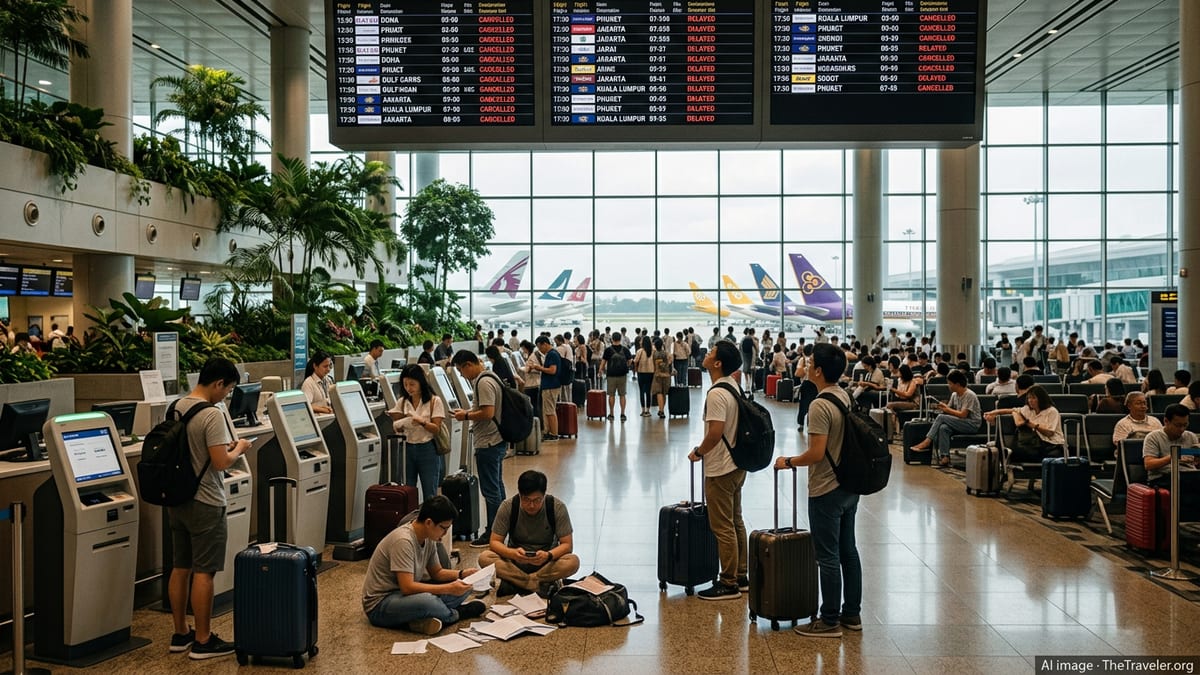
Changi Passengers Caught in Expanding Web of Cancellations
Airlines serving Singapore have been forced into rapid schedule changes as conflict in the Middle East triggers widespread airspace closures across Iran, Iraq, Qatar and neighboring states. Flight-tracking data and airline advisories indicate that at least a dozen services touching Singapore have been cancelled since late February, with more pulled from schedules in recent days as carriers grapple with rerouting and limited operating corridors.
At Changi Airport, the impact is most visible on routes that rely on Doha and other Gulf hubs as key connection points between Southeast Asia and Europe. Qatar Airways has cancelled multiple departures linking Singapore to Doha, while some passengers report future flights already marked as “cancelled” in airline apps for mid-March travel dates. The knock-on effects are rippling into onward journeys to Europe, the Middle East and North Africa, where connections via Doha typically form part of a single through ticket.
Other regional gateways closely tied to Singapore’s network, including Jakarta, Kuala Lumpur and Phuket, are also seeing irregular operations as crews and aircraft fall out of position. With aircraft and staff delayed or stranded elsewhere in the region, carriers are consolidating services, cutting frequencies and, in some cases, suspending individual flight numbers altogether to preserve capacity on the busiest remaining routes.
Qatar Airways and Gulf Carriers Scale Back Services via Doha
Qatar Airways, a major operator into Singapore and a key connector between Asia and Europe, is currently running a sharply reduced schedule in and out of Doha after Gulf airspace restrictions forced the airline to suspend regular operations earlier this month. The carrier has since outlined a limited list of destinations it can serve on specific days, focusing on a rolling roster of long haul and regional cities as temporary corridors open and close.
Travelers holding tickets from Singapore to Europe via Doha report that flights in the coming week have been proactively cancelled, with some itineraries requiring rebooking onto alternative airlines or routings that bypass the Gulf entirely. In several cases, passengers attempting to travel from Singapore to Athens, Amsterdam or other European cities via Doha have instead been offered routings through other Asian hubs or full refunds, adding hours or even days to their original journeys.
Gulf Air and other Gulf-based carriers have also trimmed or suspended services across the region as airspace remains volatile. While some flights continue to operate under carefully controlled corridors, the uncertainty has made forward planning difficult for both airlines and passengers. For Singapore-origin travelers heading to the Middle East, Europe or North Africa, itineraries that rely on Doha and other Gulf hubs now carry a heightened risk of last-minute disruption.
Singapore Airlines and Scoot Extend Middle East Cuts
Singapore Airlines and its low cost arm Scoot have responded to the crisis by extending cancellations on key Middle East sectors, aiming to give customers clearer guidance rather than issuing day-by-day changes. Services between Singapore and Dubai, as well as Scoot flights to Jeddah, were initially suspended when tensions first escalated and have since been extended into mid-March as the regional outlook remains uncertain.
The flag carrier’s Dubai rotation, a popular link for travelers connecting onwards to Europe and Africa, remains off the schedule following earlier advisories that cited the geopolitical situation in the Middle East. Scoot has likewise halted its Singapore–Jeddah flights, affecting religious pilgrims and migrant workers who rely on the route for essential travel.
Singapore Airlines is meanwhile reallocating widebody capacity to other long haul markets where demand remains robust and routings avoid affected airspace. This shift, while helping the airline maintain overall network resilience, leaves some passengers with fewer options to reach the Gulf and beyond without backtracking through alternative hubs such as Bangkok, Kuala Lumpur or European gateways.
Regional Knock-On Effects for Phuket, Jakarta and Kuala Lumpur
The disruption is not confined to point-to-point traffic between Singapore and the Gulf. Southeast Asian leisure destinations that funnel visitors through Singapore and Gulf hubs are increasingly feeling the strain, as cancellations and extended routings dampen demand and strand passengers mid-journey.
In Thailand, authorities have reported more than a hundred cancellations in the early days of the crisis, with Phuket, Krabi and Chiang Mai among the affected airports. Travelers bound for Phuket from Europe via Doha and Singapore have encountered extended layovers, last-minute rerouting and, in some cases, complete trip cancellations as long planned holidays become entangled in the airspace shutdown.
Jakarta and Kuala Lumpur, key regional partners in Singapore’s aviation network, are also facing schedule instability as carriers redeploy aircraft and crews. Qatar Airways and other Gulf airlines serve both capitals as part of their broader Asia networks, and cancellations at one end of the route can force additional cuts or delays at the other. As a result, some passengers flying between these cities and Singapore on separate tickets find their self-connecting itineraries unraveling when a Gulf sector is cancelled upstream.
Thai Airways and other regional carriers are attempting to absorb some of the displaced demand by offering alternative routings that avoid the Gulf altogether, such as direct services between Bangkok and European hubs. However, limited seat availability and sharp fare increases on remaining flights mean that many travelers are facing higher costs and longer travel times if they wish to proceed with their trips.
What Stranded Passengers in Singapore Should Expect
With schedules changing day by day, passengers in Singapore are being advised to treat any itinerary routed via Doha or neighboring Gulf hubs as fluid. Airlines are prioritizing rebooking for those whose flights have been outright cancelled, typically offering a choice between new travel dates, alternative routings that bypass affected airspace, or refunds. Travelers with separate tickets or complex multi-airline itineraries may face longer waits as customer service teams work through backlogs.
At Changi Airport, check in counters for Qatar Airways, Gulf Air and other affected carriers have seen periodic surges of stranded travelers seeking answers after receiving cancellation notifications. Many report long call center wait times and conflicting information, with some only securing alternative arrangements after repeated follow ups or visits to physical ticketing offices.
Industry observers note that as airspace restrictions evolve, airlines will continue to adjust operations with little lead time, particularly on flights scheduled several days out. Passengers are being urged to monitor their booking status closely, ensure contact details are up to date in airline profiles, and avoid going to the airport unless they hold a confirmed flight for the same day.
For now, Singapore’s position as a major connecting hub means it will remain both a refuge and a chokepoint for travelers caught in the Middle East crisis. Until Gulf airspace fully reopens and carriers can restore regular schedules, anyone planning to fly between Southeast Asia and Europe or the Middle East via Doha, Dubai or other regional hubs should be prepared for sudden changes, longer routings and the possibility that their flight from Singapore may not depart at all.