

More news on this day
Air travel across Brazil faced fresh disruption this week as more than 50 flights were cancelled on busy domestic routes, affecting services operated by TAM, Azul, LAN and regional carrier ACN and stranding passengers at major hubs including São Paulo, Brasília, Rio de Janeiro and Salvador.
Get the latest news straight to your inbox!
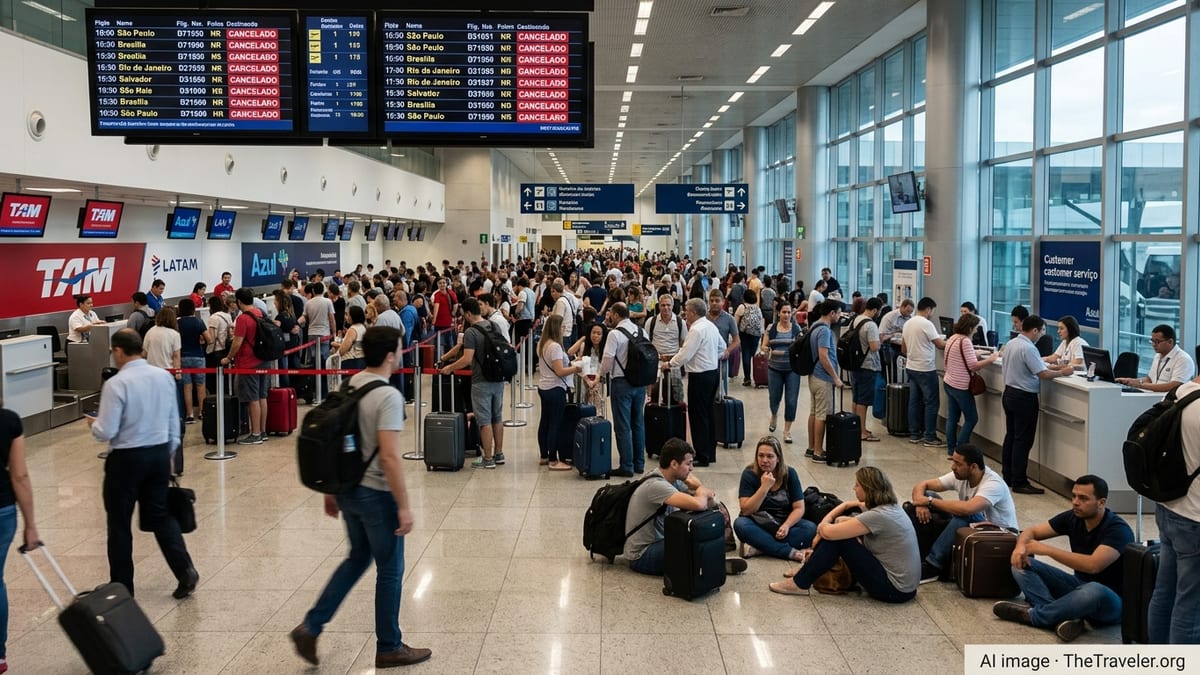
Wave of Cancellations Hits Major Brazilian Routes
Publicly available flight tracking data and local media coverage indicate that a cluster of cancellations has built up across Brazil’s domestic network, with a particular concentration on trunk routes between São Paulo, Brasília, Rio de Janeiro and Salvador. The disruption has primarily involved services marketed or operated by TAM, Azul and LAN, along with flights using the ACN code associated with Azul’s regional arm, Azul Conecta.
The affected flights include a mix of early morning and late evening departures, which are typically popular with business travellers connecting through São Paulo and Brasília. Cancellations on these high-demand sectors have created knock-on effects for secondary destinations, as aircraft and crews scheduled to continue onward have been left out of position.
While precise numbers vary by airport and time of day, aggregated schedules compared with live departure boards show at least 50 domestic and regional flights removed from operation over a short period. The pattern is most evident at São Paulo’s Guarulhos and Campinas hubs, Brasília’s main airport, Rio de Janeiro’s principal terminals and Salvador’s international airport, all of which serve as key connection points within Brazil’s vast network.
Travelers reported longer queues at check-in counters and rebooking desks as carriers attempted to redistribute passengers onto remaining services. Delays have also increased on flights that did operate, as boarding procedures and baggage handling slowed under the pressure of last-minute changes.
Operational and Weather Factors Combine
Published coverage and airline statements on similar disruption events in Brazil point to a familiar mix of causes behind the current wave of cancellations. Carriers have frequently cited crew scheduling constraints, aircraft rotation issues and localized weather problems as reasons for removing flights at short notice. In a tightly timed domestic network, even minor weather disturbances around São Paulo or Rio de Janeiro can cascade into widespread disruption later in the day.
Operational pressures have been amplified by strong demand on core business and leisure routes. Brazil’s largest airlines have been rebuilding capacity in the wake of recent economic and industry shifts, and this process can leave little slack in the system when a single aircraft or crew pairing becomes unavailable. If a jet scheduled to operate multiple legs between São Paulo, Brasília, Salvador and secondary cities is taken out of service, the result can be a string of cancellations along its planned routing.
Regional operations marketed under codes such as ACN, linked to Azul’s feeder network, are particularly sensitive to such disruptions. These smaller aircraft often connect remote cities to larger hubs, and any cancellation can cut off connections for onward travel to Rio de Janeiro, São Paulo or Brasília. When cancellations occur across both trunk and feeder routes, passengers may find that alternative itineraries involve lengthy detours or overnight stays.
Weather-related airspace restrictions and runway capacity limits at congested airports add another layer of complexity. Even when storms or low visibility are confined to a narrow time window, the loss of a departure slot can force airlines to trim schedules to restore punctuality later in the day, resulting in cancelled rotations on already busy corridors.
Impact on Passengers and Key Hubs
The immediate impact of the current cancellations has been felt most sharply at Brazil’s primary hubs. São Paulo’s Guarulhos and Campinas airports, together a central gateway for domestic and international connections, have seen banks of departures to Brasília, Rio de Janeiro and Salvador removed from departure boards, compressing remaining capacity into fewer time slots.
Brasília, a major connecting point between northern and southern Brazil, has also experienced cancelled flights on links to São Paulo and other state capitals. When these flights are withdrawn, passengers traveling from regional cities to Brasília for onward connections often have to wait for later departures or be rerouted via alternative hubs, extending journey times significantly.
In Rio de Janeiro and Salvador, cancellations on flights to and from São Paulo and Brasília ripple into the leisure market, affecting holidaymakers as well as residents returning from business trips. Reduced frequencies can quickly fill remaining seats, leaving some travelers with no same-day options. Those with separate tickets on different airlines or self-arranged connections are particularly vulnerable if their initial segment is cancelled.
According to information published by Brazil’s civil aviation regulator, passenger protection rules require carriers to provide assistance when flights are cancelled or significantly delayed, which can include meals, communication support and, in some cases, accommodation. In practice, passengers often report mixed experiences accessing these benefits, especially during periods when multiple airlines are handling large numbers of disrupted itineraries simultaneously.
What Travelers Should Expect in the Coming Days
Based on current schedules and recent patterns during similar disruption episodes, travelers on routes linking São Paulo, Brasília, Rio de Janeiro, Salvador and other large cities may continue to see short-notice changes. Airlines commonly adjust timetables on a rolling basis, and further cancellations or consolidations of lightly booked flights remain possible as carriers work to stabilize operations.
Publicly available guidance from airlines and consumer groups suggests that passengers should monitor their bookings frequently using airline apps or airport departure displays, as notifications may not always arrive in time for those already en route to the airport. Arriving earlier than usual can provide additional options if rebooking becomes necessary, particularly at large hubs with multiple daily frequencies to the same destination.
Travel industry advisories also emphasize the benefits of keeping itineraries on a single ticket where possible, especially when connecting between domestic and international flights. When separate tickets are used, cancellations on a domestic leg can jeopardize onward travel, and protection policies may be more limited. In the current environment of intermittent schedule changes, itineraries with longer connection times and flexible fare conditions can provide a measure of resilience.
As Brazil’s domestic aviation market continues to balance high demand with operational and economic constraints, episodes of concentrated cancellations such as the current one are likely to remain an occasional feature for travelers. Those flying with TAM, Azul, LAN or regional partners using the ACN code on busy routes to São Paulo, Brasília, Rio de Janeiro and Salvador should factor potential disruption into their plans and stay alert to updates from carriers and airports.