

More news on this day
Passengers across Asia-Pacific were left in limbo after a cluster of last-minute cancellations hit four key flights out of Bangkok, disrupting Thai Airways, Bangkok Airways, Jetstar-operated services and other carriers on some of the region’s busiest routes to Singapore, Kuala Lumpur, Melbourne and additional major hubs.
Key Bangkok Routes Abruptly Cut
Operational data from regional trackers and airport timetables on February 26 and 27 indicate that multiple departures from Bangkok’s Suvarnabhumi and Don Mueang airports were withdrawn within hours of scheduled take-off, rather than being removed from schedules in advance. The affected flights included services to Singapore, Kuala Lumpur and Melbourne, as well as an additional regional sector linking Bangkok with another Southeast Asian hub, forcing hundreds of travelers into overnight delays and unscheduled layovers.
Industry sources said at least one Thai Airways service and a Jetstar-operated code-share to Melbourne were among those impacted, while Bangkok Airways was forced to pull a short-haul regional departure as knock-on effects rippled through aircraft and crew rotations. Passenger accounts described departure boards that flipped from “Gate Open” to “Cancelled” in minutes, with little immediate explanation forthcoming from airline staff.
The cancellations came as Thai airports were already operating near peak capacity during a busy late-February travel period, when holidaymakers from Australia and Southeast Asia converge on Thailand’s beach destinations and onward connections. The sudden removal of key trunk flights from Bangkok amplified existing congestion across the network, particularly for evening departures feeding overnight long-haul services.
For many travelers, the disruption meant not only missing a single sector but also losing entire multi-leg itineraries. With Bangkok serving as a critical connecting hub between Southeast Asia, Australia and Europe, the loss of a handful of high-demand departures quickly cascaded into missed onward flights and rebooking challenges in several countries.
Passengers Face Long Queues and Limited Alternatives
At Suvarnabhumi, eyewitnesses reported long lines snaking from airline transfer desks and check-in counters as stranded passengers competed for scarce seats on remaining services. Families bound for school holidays in Melbourne, business travelers due in Singapore and Kuala Lumpur, and backpackers making regional hops all found themselves vying for the same limited rebooking options.
Several passengers said they received little more than a brief text message or app notification advising that their flight had been cancelled, with instructions to “contact customer service” for assistance. For those already airside in Bangkok, that translated into hours in line with minimal updates while staff attempted to rebuild itineraries around already crowded flights and constrained aircraft availability.
Accommodation support varied between carriers. Some passengers on full-service airlines reported being issued hotel vouchers and meal coupons, while others on lower-cost services said they were simply handed information leaflets outlining standard refund and credit procedures. With Bangkok hotels also busy, late-night arrivals with young children described struggling to find nearby rooms on short notice.
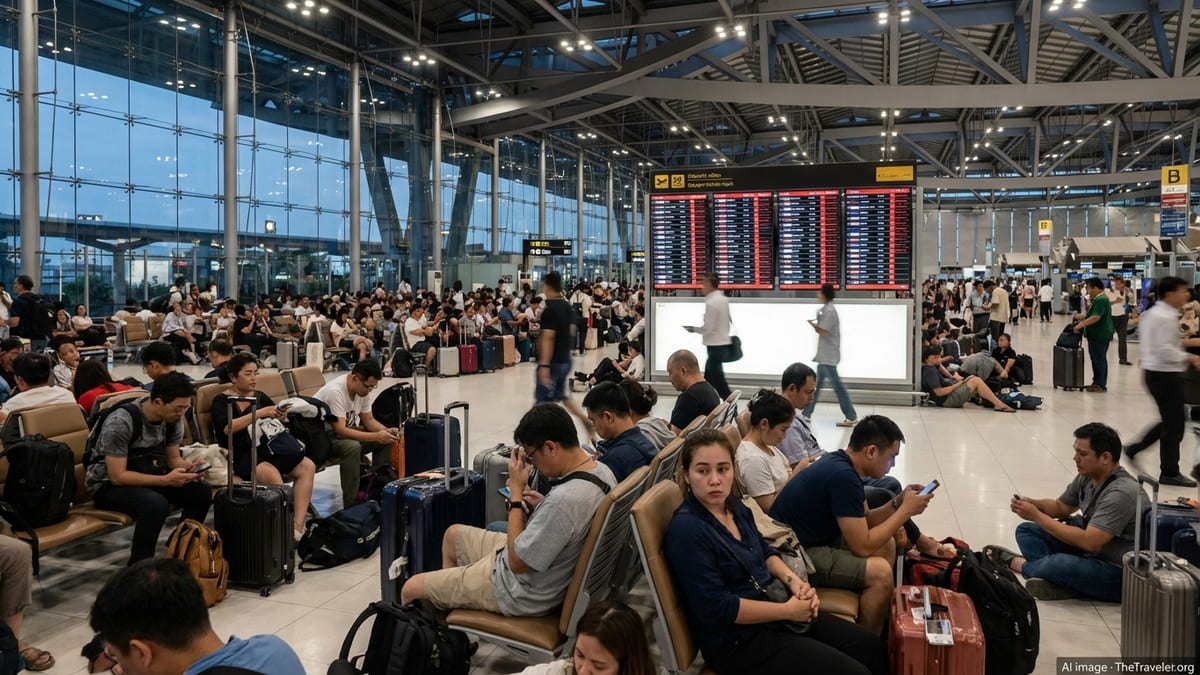
Social media posts from travelers showed crowded gate areas, departure screens filled with red “Cancelled” and “Delayed” indicators, and makeshift sleeping arrangements on terminal benches. Several passengers complained that they were not given clear estimates on when they might be able to depart, complicating visa limits, work commitments and onward accommodation plans in their final destinations.
Airlines Cite Operational Pressures Across the Region
While official explanations remained limited, aviation analysts pointed to a combination of factors placing stress on Thailand’s air network and its regional connections. Airlines across Asia have been rebuilding capacity with stretched fleets and tight crew rosters, leaving little margin to absorb unexpected maintenance issues, weather disruptions or air traffic restrictions without resorting to cancellations.
Recent days have already seen waves of cancellations and delays across neighbouring markets, including Malaysia, Indonesia and Singapore, as carriers struggle with aircraft availability and congested airports. The Bangkok cancellations appeared to reflect the same underlying pressures, but with a sharper impact because of the city’s role as a transfer hub linking multiple long-haul and regional flows.
Operational experts noted that once a single aircraft is pulled from a high-utilisation schedule, it can lead to sequential cancellations as airlines try to protect safety standards, mandatory crew rest times and maintenance windows. In such a fragile environment, disruptions on one leg of a rotation can quickly cascade into cancellations on subsequent sectors, including flagship routes like Bangkok to Singapore or Bangkok to Melbourne.
Thai authorities have previously flagged rising traffic and infrastructure constraints at major airports, while airlines contend with higher operating costs, from fuel to airport fees. Under these conditions, carriers may opt to consolidate loads and cancel lower-yield or operationally complex flights to stabilise schedules elsewhere in the network, even when passenger demand remains strong.
Regional Ripple Effects Hit Singapore, Kuala Lumpur and Melbourne
The impact of Bangkok-origin cancellations was rapidly felt at downline airports. At Singapore Changi, where Thai carriers and partner airlines maintain dense schedules, travelers waiting for Bangkok-bound connections saw their flights delayed or removed entirely, forcing last-minute changes to itineraries that included onward legs to Indonesia and other Southeast Asian destinations.
In Kuala Lumpur and Melbourne, airport information screens reflected the sudden absence of expected arrivals from Bangkok, while local ground handlers and tour operators scrambled to adjust airport transfers and hotel check-ins. Some inbound passengers who had pre-booked domestic connections within Malaysia and Australia found those onward segments departing without them, incurring additional rebooking fees and lost non-refundable reservations.
Travel agents reported a spike in calls from customers seeking to re-route around Bangkok altogether, shifting to alternative hubs such as Singapore, Kuala Lumpur, Hong Kong or Dubai when inventory permitted. However, the concentration of regional demand in late February meant that many popular alternatives were already near capacity, limiting the ability of airlines to absorb displaced Bangkok traffic.
The pattern underscores how a small cluster of cancellations at a single major hub can reverberate across multiple countries. With Bangkok positioned at the crossroads of leisure routes to Thai islands, business links to Southeast Asian capitals and long-haul services to Australia and beyond, disruptions there tend to propagate quickly through overlapping networks.
What Stranded Travelers Can Do Next
Consumer advocates in the region urged affected passengers to document communications with airlines and retain receipts for accommodation, meals and local transport in case of reimbursement opportunities under carrier policies. While compensation rules vary significantly between domestic and international tickets and between full-service and low-cost airlines, detailed records can strengthen claims once immediate travel issues are resolved.
Travel specialists also advised that passengers stranded in Bangkok or at downline airports should check not only with their operating carrier but also with any code-share partners shown on their booking, as additional rebooking inventory may be available through partner airlines even when front-line staff appear constrained. Online tools and airline apps can sometimes surface alternative routings more quickly than crowded airport counters.
For upcoming trips involving Bangkok connections, experts recommended building in longer layovers where possible, especially when linking regional flights to long-haul departures, and staying alert to schedule changes in the 24 to 48 hours before departure. Given the current fragility of regional operations, even travelers who have not yet been affected by cancellations may need to prepare for short-notice adjustments.
For now, passengers left isolated in terminals from Bangkok to Singapore, Kuala Lumpur and Melbourne are focused on a more basic goal: finding an available seat out. As airlines work through backlogs and reset rosters over the coming days, the pace of recovery on these key routes will be closely watched by both industry analysts and weary travelers who have borne the brunt of the latest wave of disruptions.