

More news on this day
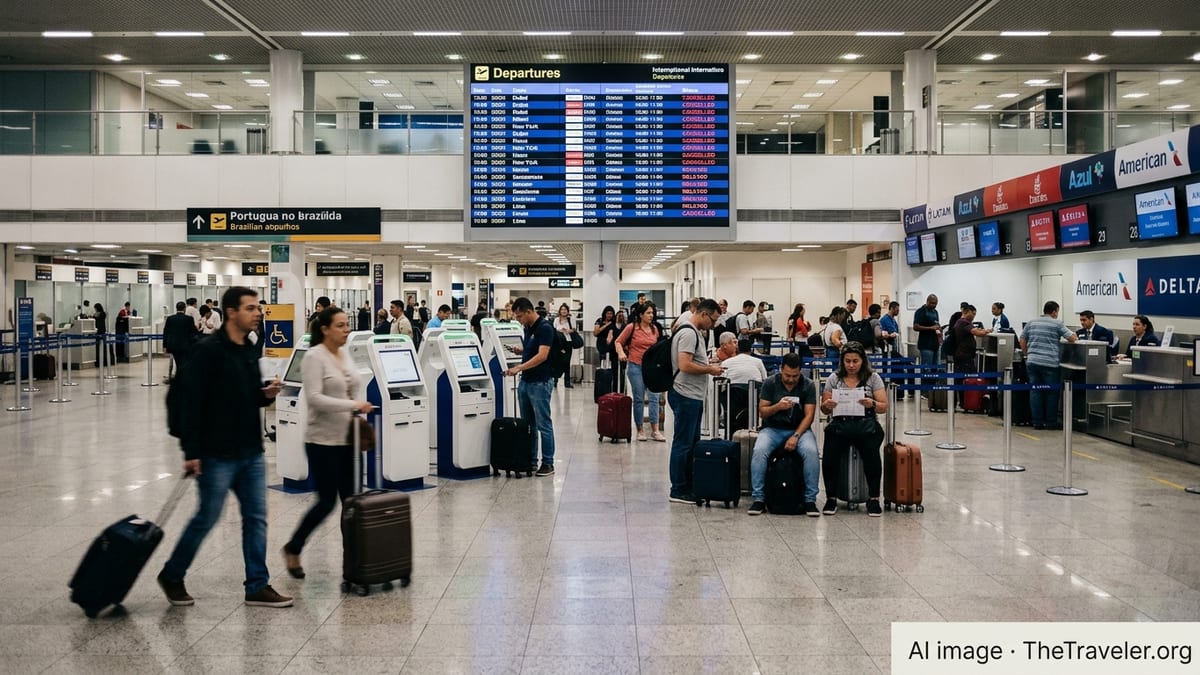
Brazilian and international travelers are facing another wave of disruption as more than 20 flights operated by major carriers including Latam, Azul, Emirates, Delta and American Airlines were cancelled on key routes linking Brazil with Dubai, Miami, New York, Lima and major domestic hubs such as São Paulo, Rio de Janeiro and Brasília.
Get the latest news straight to your inbox!
Global Tensions Ripple Into Brazil’s Long-Haul Network
Publicly available aviation data and media coverage show that the latest cancellations come against a backdrop of heightened instability in global air travel, particularly affecting routes that connect Latin America with the Middle East, North America and Europe. Recent disruptions in and around Gulf hubs such as Dubai and Abu Dhabi, including temporary airspace constraints and a heavy reliance on repatriation flights, have led airlines to reevaluate schedules and capacity on multi-leg itineraries that touch Brazil.
Emirates and other United Arab Emirates based airlines continue to operate a reduced and frequently changing schedule from Dubai, focusing on select long-haul destinations and special repatriation services. These adjustments have had a knock-on effect on passengers booked on Brazil bound itineraries via Dubai, where some flights have been consolidated, retimed or cancelled, even when the Brazilian sectors are several hours or days away from the core Middle East operations.
Carriers in North America and Europe have also thinned schedules or rerouted traffic in response to evolving risk assessments, higher operating costs and congestion at alternative hubs. According to recent analytical pieces and traveler reports, airlines including Delta Air Lines and American Airlines have periodically trimmed long-haul frequencies, which in turn reduces flexibility when weather, crew constraints or equipment issues arise on Brazil routes.
As a result, Brazil’s position as a key long-haul market means that even localized operational shocks can quickly spill over into cancellations and missed connections on transcontinental links from São Paulo, Rio de Janeiro and Brasília to cities such as New York, Miami and Dubai.
Key Routes Affected: Dubai, Miami, New York and Lima
Among the most visible impacts are cancellations on routes tying Brazil to major intercontinental gateways. On the Middle East side, Brazil Dubai services, which are vital for connecting South American travelers to Asia, Africa and beyond, have seen select departures removed at short notice. Reports from recent days highlight that certain flights scheduled from Dubai to South America have been scrubbed as airlines prioritize limited aircraft and crew for repatriation or higher demand corridors.
In North America, disruptions have been registered on Miami and New York links, two of Brazil’s busiest long-haul markets. Publicly available travel and tourism briefs issued earlier in the season highlighted expanded frequencies between Miami, New York and Brazilian cities, but the latest round of cancellations has underscored how quickly that added capacity can be rolled back when operational conditions deteriorate, whether due to weather, staffing or the broader global aviation backdrop.
To the west, connections between Brazil and Lima have also been affected, complicating itineraries that rely on Peruvian hubs for onward travel across the Andean region and the Pacific. Latam’s multi-country network, which ties Lima closely to São Paulo, Rio de Janeiro and other Brazilian cities, means that cancellations on one leg can cascade through multiple markets in a single day.
While the total number of cancelled flights reported so far remains modest relative to Brazil’s overall daily traffic, the concentration on long-haul and key regional connectors amplifies the disruption for travelers who depend on a limited set of daily departures.
Domestic Hubs São Paulo, Rio and Brasília Feel the Strain
Brazil’s main hubs at São Paulo Guarulhos, Rio de Janeiro Galeão and Brasília have all felt the effects of the current disruption. These airports serve as primary gateways for Latam, Azul and international partners, and cancellations on long-haul sectors typically reverberate through domestic networks as aircraft and crews are repositioned or held in reserve.
According to available schedule data, Latam and Azul continue to operate the vast majority of their domestic flights, but targeted cancellations and retimings have appeared on services feeding international departures. When a long-haul segment to destinations such as Miami or New York is cancelled, feeder flights from secondary Brazilian cities may be consolidated or removed to avoid leaving passengers stranded at hubs without onward options.
Brasília, which functions as a connecting point between Brazil’s interior and its international gateways, is particularly sensitive to such changes. Travelers who planned to reach long-haul flights through Brasília have reported having to reroute via São Paulo or Rio de Janeiro or delay their trips by several days, especially when itineraries involve partners such as Delta and American for the final transoceanic leg.
Airport operations teams have responded by adjusting gate allocations and staffing, but the combination of global uncertainty and rolling schedule changes has left terminal displays and departure boards in constant flux, with some flights reverting from cancelled to confirmed status and vice versa as airlines fine tune their daily plans.
What Travelers Are Experiencing on the Ground
In recent days, social media posts and online travel forums have been filled with accounts from passengers confronting abrupt cancellations on routes touching Brazil, Dubai and major North American hubs. Several travelers connecting through Dubai on their way to or from Brazil have described last minute notification of cancelled sectors and limited rebooking options, with some being reprotected on later dates or alternate routings that add many hours and additional connections to their journeys.
On Brazil United States routes, passengers report a mix of relatively normal operations and sharply reduced flexibility. When a single daily departure between a Brazilian city and Miami or New York is cancelled, alternative options often involve multiple connections across partner networks, sometimes at significantly higher last minute fares. Travelers holding separate tickets on Latam, Azul, Emirates, Delta or American have found rebooking particularly complex, as each airline applies its own rules for schedule changes and irregular operations.
Some reports also describe long lines at check in and customer service counters at São Paulo and Rio de Janeiro, especially at times when both domestic and international flights are being retimed. While many travelers are eventually accommodated, the experience has highlighted the vulnerability of complex itineraries that rely on tight connections between multiple airlines and hubs spread over several continents.
Consumer advocates quoted in recent analytical articles stress that the present disruption illustrates how globalized Brazil’s aviation market has become, and how quickly events thousands of kilometers away can spill into everyday travel within and beyond the country.
Practical Advice for Passengers Holding Brazil Tickets
Given the fluid situation, publicly available guidance from airlines and travel experts converges on a few practical steps for anyone booked on upcoming flights touching Brazil, Dubai, Miami, New York or Lima. The most important is to monitor flight status closely using airline apps and official airport departure boards, as schedules are being updated frequently across multiple time zones.
Travelers are also encouraged to allow extra connection time, particularly if their itinerary includes transfers through Middle Eastern hubs or single daily long-haul departures from Brazil. Where possible, booking all segments on a single ticket can simplify rebooking if a cancellation occurs, as the issuing airline remains responsible for offering alternative transport under its policies and any applicable local regulations.
For passengers already in transit, experts recommend keeping documentation such as boarding passes and receipts, which can be useful when requesting refunds, compensation or travel insurance claims. Flexible or changeable fares, while often more expensive upfront, may offer better options when sweeping schedule adjustments affect specific routes such as São Paulo to Dubai or Rio de Janeiro to New York.
As Brazil’s aviation system continues to adapt to global pressures, travelers on both domestic and international routes should be prepared for further short notice changes. Industry analysts note that while widespread cancellations on the scale seen during the pandemic era are not currently anticipated, localized disruptions concentrated on high profile routes will likely remain a feature of long haul travel to and from Brazil in the coming weeks.