

More news on this day
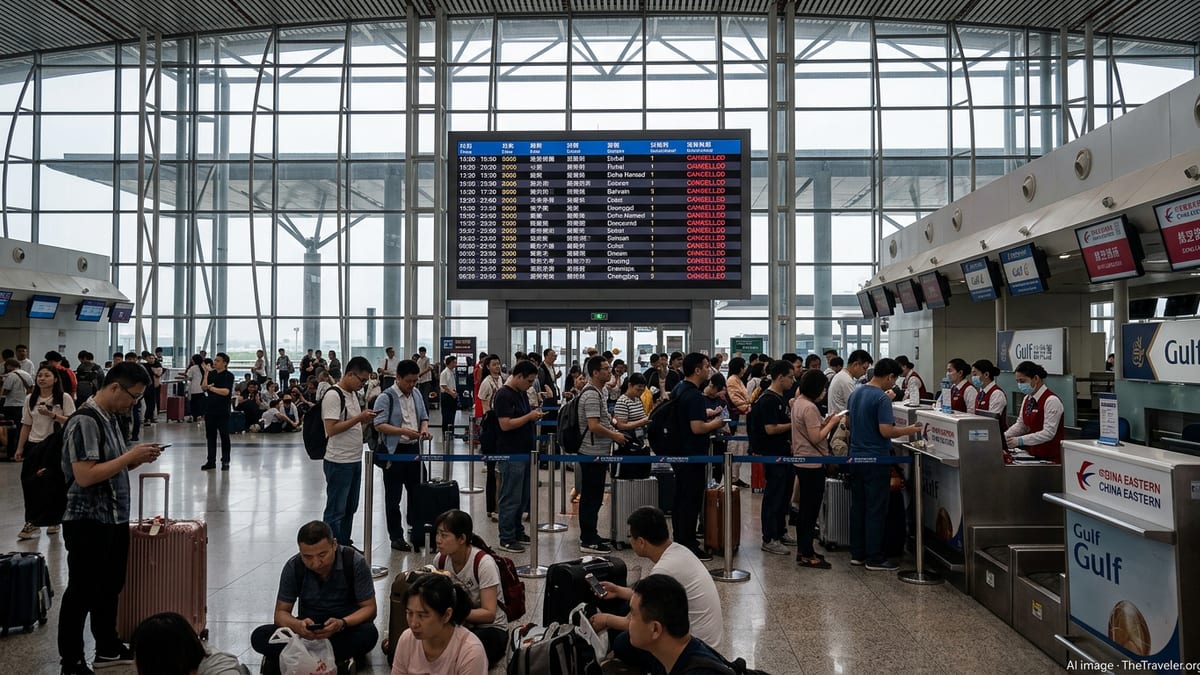
Travel between China and the Gulf region has been hit by a fresh wave of disruption as more than two dozen flights were cancelled or heavily curtailed this week, affecting services operated by China Southern, China Eastern, Qatar Airways, Gulf Air, China Express and other carriers on routes linking Dubai, Hamad, Bahrain and major Chinese cities including Urumqi, Chongqing, Changsha, Nanjing, Lanzhou, Wuxi, Xi’an, Xiamen and Shenyang.
Get the latest news straight to your inbox!
Airspace Restrictions Trigger Widespread Flight Cancellations
The latest round of cancellations follows tightened airspace restrictions across parts of the Middle East, which have forced airlines to reroute or suspend services that would normally cross contested corridors. Chinese and Gulf carriers alike have been adjusting schedules since late February, but this week’s moves mark one of the sharpest single-day cuts on China–Gulf itineraries so far.
Operational notices issued by major Chinese airlines describe affected services primarily on long-haul routes to the United Arab Emirates and Qatar, while Gulf-based carriers are trimming frequencies and, in some cases, halting commercial operations on selected days. The combined impact has pushed the number of cancelled or suspended flights on China–Gulf routes beyond two dozen, with further disruption possible if airspace constraints persist.
For passengers, the immediate effect is a shrinking range of options to connect between Chinese regional hubs and key Gulf transit points such as Dubai International Airport, Hamad International Airport in Doha and Bahrain International Airport. Many of these flights serve as important feeders to onward connections into Europe, Africa and South Asia, magnifying the knock-on impact of each cancellation.
Chinese Carriers Pull Back on Dubai and Doha Services
China Southern and China Eastern, which together operate a large share of China’s international capacity, have both reduced their Gulf schedules in recent days. While flagship routes from Beijing, Shanghai and Guangzhou to Dubai remain in operation on a limited basis, selected rotations have been cancelled, often at short notice, in response to evolving airspace assessments and crew duty-time constraints.
Regional flights feeding into these trunk services have also been affected. Routes connecting cities such as Urumqi, Chongqing, Changsha, Nanjing, Lanzhou, Wuxi, Xi’an, Xiamen and Shenyang to Gulf-bound hubs in China have seen cancellations or downgraded frequencies as airlines seek to consolidate demand onto fewer departures. In some instances, passengers booked on secondary city departures have been reprotected onto flights from larger coastal gateways.
China Express, a key operator in western and central China, has reported disruptions on select services that typically provide onward connectivity to international flights. Although its operations are largely domestic, cancellations of feeder routes into major airports such as Chongqing and Urumqi are compounding difficulties for travelers attempting to reach Gulf-bound long-haul departures on the same day.
Qatar Airways and Gulf Air Face Continuing Operational Constraints
Qatar Airways and Gulf Air, both heavily reliant on their respective hubs at Hamad and Bahrain International Airport, continue to grapple with the operational fallout from regional airspace closures. Qatar Airways has kept much of its commercial network on hold or sharply reduced, with limited repatriation and special services operating when safe corridors are authorized. This has significantly cut capacity between Doha and mainland China, including routes that historically served Shanghai, Beijing and other major cities.
Gulf Air, based in Bahrain, has also scaled back its flying program as it navigates shifting flight corridor availability and operational risk assessments. Services linking Bahrain with Chinese gateways have become increasingly sporadic, with some flights pulled entirely from schedules in recent days. Passengers have reported multiple rounds of rebooking as the airline adjusts timetables in response to regulatory guidance.
The situation has left travelers planning China–Gulf itineraries with fewer reliable transit options through Doha and Bahrain. With Qatar Airways and Gulf Air operating far below normal levels, many passengers are looking to alternative hubs or rerouting via other regions, even when this significantly extends total journey time.
Stranded Passengers, Tight Rebooking Windows and Limited Alternatives
The sudden cancellations have stranded some passengers mid-journey, particularly those transiting the Gulf on complex, multi-leg itineraries. Travelers returning from China to destinations in Europe, the Middle East and Africa have reported receiving cancellation notices just days before departure, or learning of flight suspensions only when attempting to check in.
Airlines are generally offering fee-free rebooking within specific windows, as well as refunds for flights cancelled by the carrier. However, limited remaining capacity on alternate dates, along with the disruption to feeder flights within China, has made it difficult for many passengers to secure timely alternatives. Those originating in secondary Chinese cities such as Lanzhou, Wuxi or Shenyang often face the added challenge of rebooking onward domestic connections to new departure points.
In the Gulf, airport terminals remain noticeably quieter on days when large blocks of services are suspended, yet queues at airline transfer desks and customer service counters still stretch long as affected passengers seek clarity. Travel agents report that some travelers have opted to abandon Gulf connections altogether in favor of itineraries via East Asia or Europe, even at higher cost and with extended travel times.
What Travelers Should Expect in the Coming Days
Industry analysts say the pattern of rolling schedule changes is likely to continue as airlines monitor airspace availability and reassess risk. While the number of outright cancellations on China–Gulf routes may fluctuate from day to day, carriers are expected to keep capacity tightly controlled until there is greater certainty around flight corridors.
Passengers booked on flights operated by China Southern, China Eastern, Qatar Airways, Gulf Air, China Express and other carriers serving Dubai, Hamad and Bahrain are being urged to check their flight status repeatedly in the days and even hours before travel. Many airlines are updating schedules in near real time, and automated notifications may lag behind changes posted in booking systems and at airport departure boards.
Travelers starting their journeys in inland Chinese cities such as Urumqi, Chongqing, Changsha, Lanzhou, Xi’an, Xiamen and Shenyang should pay particular attention to the status of domestic feeder flights that connect to international departures. Allowing greater buffer time between domestic and international legs, or positioning a day early in major hubs like Beijing, Shanghai or Guangzhou, may reduce the risk of misconnection.
With more than 25 flights already cancelled across the China–Gulf corridor and airlines signaling that further adjustments are possible, the coming days are likely to remain challenging for cross-regional travel. Passengers are being advised to stay flexible, keep contact details up to date with their airline and consider backup routing options in case schedules shift again at short notice.