

More news on this day
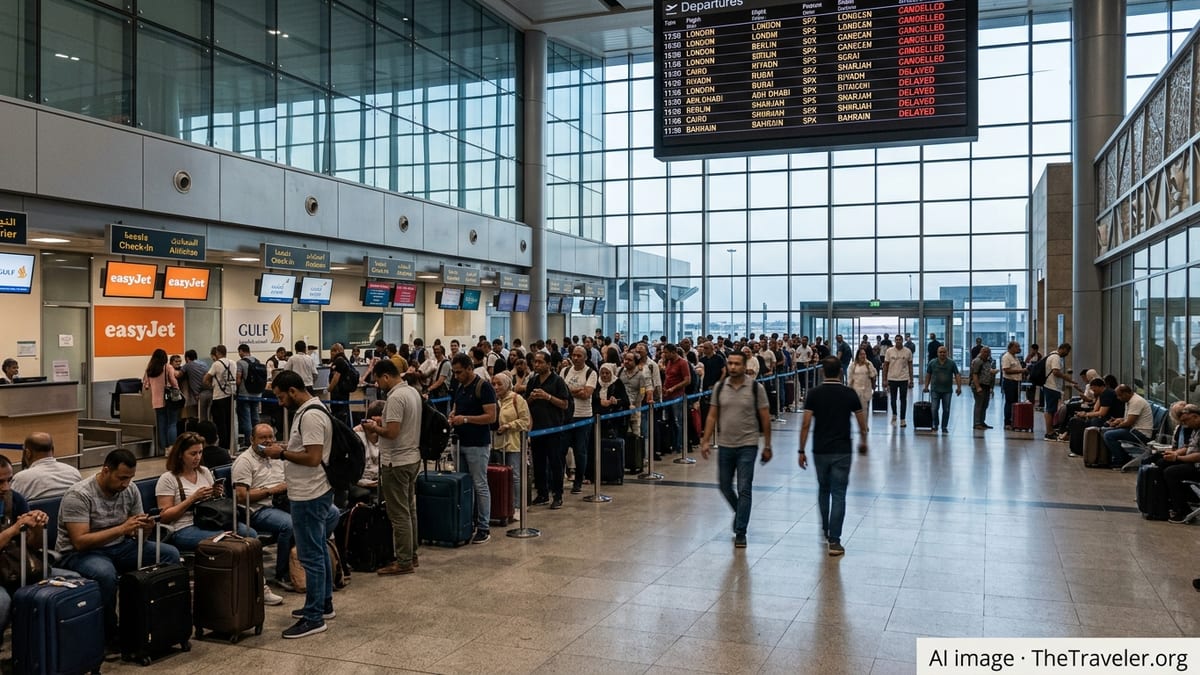
Air travel to and from Egypt has been hit by a new wave of cancellations, with more than 20 flights involving carriers such as easyJet, flydubai and Gulf Air reportedly scrubbed or rescheduled, disrupting links to London, Berlin, Riyadh, Dubai, Abu Dhabi, Sharjah, Bahrain and other major hubs.
Get the latest news straight to your inbox!
Fresh Cancellations Hit Egypt’s Emerging Sphinx Hub
Published reports and live schedule data indicate that flights serving Egypt’s newer Sphinx International Airport, on the western edge of Cairo, have been particularly affected. The airport has grown into a secondary hub for leisure and low cost traffic, with easyJet operating services to Berlin and London Luton, and flydubai connecting to Dubai. These links have been among those curtailed or cancelled in the latest round of disruption.
Routes involving Gulf Air and other regional airlines have also seen interruptions on services linking Egypt with Bahrain and further connections across the Gulf. Flight tracking boards show a cluster of cancellations concentrated over a short window, suggesting a coordinated schedule adjustment rather than isolated, aircraft specific issues.
The impact is being felt on both outbound and inbound rotations. Passengers traveling from European gateways into Egypt are encountering late night and early morning cancellations, while those attempting to depart Cairo and Sphinx for the Gulf are seeing flights removed from schedules with limited advance notice.
While some affected departures are being rebooked to Cairo International Airport, others appear to have been withdrawn entirely for the day, leaving passengers reliant on alternative routings through third country hubs or on different travel dates.
Regional Security Tensions Pressure Airspace and Schedules
The latest cancellations are unfolding against the backdrop of heightened security tensions and recent missile and drone activity across parts of the Gulf, which have already led to widespread airspace restrictions and temporary suspensions of commercial traffic in neighboring states. Publicly available coverage on the wider regional situation describes partial closures and controlled corridors that have complicated network planning for many carriers.
Although Egypt’s airspace has remained more stable than that of some Gulf states, airlines operating multi leg networks are adjusting schedules to accommodate aircraft rotations that avoid higher risk areas. This has knock on effects for services that do not directly traverse contested airspace but rely on shared aircraft and crews that circulate through the region.
Analysts following the situation note that point to point routes between Egypt and major Gulf hubs such as Dubai, Abu Dhabi, Sharjah and Bahrain are especially exposed to ripple effects. As carriers seek to prioritize limited flying rights and available slots, some secondary frequencies and leisure oriented departures have been thinned out or temporarily cancelled.
The result is a complex picture in which some flights on the same route continue to operate while others are removed from the timetable, creating confusion for travelers who may see a route as theoretically open but find their specific departure cancelled.
Knock On Effects for European Links via London and Berlin
Disruptions in Egypt’s connectivity with the Gulf are combining with cancellations on European bound services to squeeze passengers who rely on Cairo and Sphinx as gateways. EasyJet flights between Egypt and London and Berlin, which often feed onward connections across Europe, have been among those affected, reducing options for travelers aiming to bypass more congested Middle Eastern hubs.
Travel industry monitoring suggests that cancellations are not limited to any single airline, and they come on top of earlier cuts and diversions implemented by European and Gulf based carriers since late February. As schedules are thinned, flights that do operate are experiencing higher load factors and narrower rebooking windows, leaving stranded passengers with fewer alternatives.
For Egypt bound travelers starting their journeys in London or Berlin, the shifting landscape means itineraries that once relied on low cost or hybrid carriers into Sphinx may now require reconfiguration around Cairo International or other regional entry points. Some passengers are also turning to indirect routings via southern European cities that retain more stable links with Egypt.
At the same time, Egypt based travelers heading to Europe are contending with the prospect of overnight delays, last minute flight swaps and the possibility of being routed through hubs they had not originally chosen, depending on where seat availability can be found.
Stranded Passengers and Limited Rebooking Options
Passenger accounts shared on social platforms and travel forums describe travelers in Cairo and resort destinations trying to rearrange journeys after learning that their flights to London, Berlin, Riyadh, Dubai, Abu Dhabi, Sharjah or Bahrain have been cancelled. Some report that airline apps and websites initially showed services as operating, only to update closer to departure with notices of cancellation.
The pattern reflects a broader regional travel environment in which airlines are attempting to restore partial schedules while remaining responsive to evolving airspace and security guidance. This often results in provisional timetables that are advertised in advance but later trimmed if operating conditions or aircraft availability change.
Rebooking remains possible in many cases, but options can involve long layovers, backtracking routings or travel on different dates. Passengers on low cost carriers in particular may face additional costs if they choose to self reroute on other airlines, as not all tickets include flexible change provisions.
Travel insurance policies and credit card protections are playing a larger role in helping some passengers offset unexpected accommodation or alternative transport costs, though coverage varies widely and may depend on how the disruption is categorized.
What Travelers Should Watch in the Coming Days
Air travel observers note that additional short notice adjustments to Egypt related schedules are possible in the days ahead, especially on routes tied to Gulf hubs or operating during overnight hours when airspace restrictions can be more fluid. Timetables may evolve as carriers gain clearer visibility on aircraft positioning and regional overflight permissions.
Passengers booked on flights linking Egypt with London, Berlin, Riyadh, Dubai, Abu Dhabi, Sharjah, Bahrain and other key destinations are being advised by publicly available guidance to monitor their bookings frequently and to pay attention to airline notifications, as departure times and even operating airports can shift.
Those holding tickets on easyJet, flydubai, Gulf Air and other affected carriers may also find it helpful to check for alternative same day departures from both Cairo International and Sphinx, as some airlines are consolidating passengers from multiple cancelled flights onto a smaller number of operating services.
Industry analysts suggest that while the current wave of cancellations is significant, it may not represent a long term reset of Egypt’s air connectivity. Instead, it is more likely to be part of a rolling adjustment period as airlines work to balance demand, safety considerations and operational constraints across an unsettled region.