

More news on this day
Travel plans for thousands of passengers have been thrown into disarray after a fresh wave of cancellations and delays at Doha’s Hamad International Airport, where at least 26 flights operated by Qatar Airways, Gulf Air, Malaysia Airlines, EgyptAir, Virgin Australia and other carriers have been removed from schedules or heavily delayed on key routes linking Doha with Cairo, Kuala Lumpur, Bahrain, Warsaw and other hubs.
Get the latest news straight to your inbox!
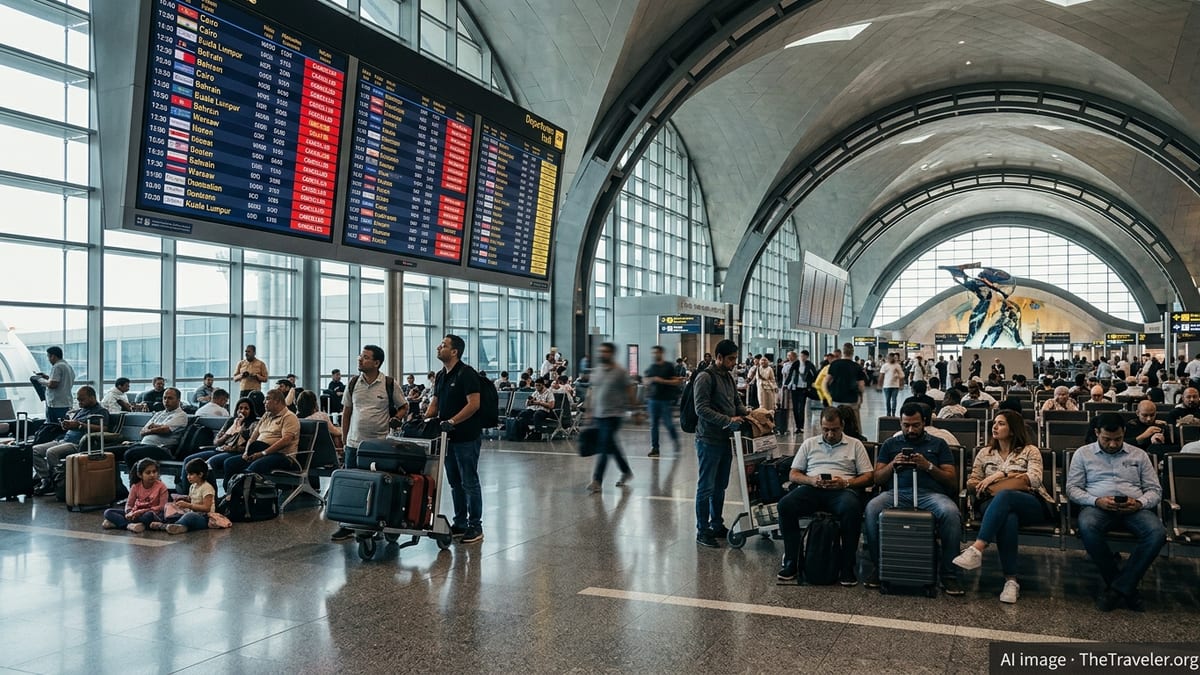
Airspace Restrictions Translate Into Fresh Cancellations
Publicly available aviation data and recent schedule updates indicate that disruption at Hamad International Airport is closely tied to the wider airspace restrictions and security situation in the Gulf region. Following Iranian missile activity and related military tensions, Qatar’s airspace has been operating under constrained conditions since late February 2026, with normal commercial schedules still not fully restored. Reports describe the current operating pattern as a patchwork of limited corridors, evacuation services and a reduced set of commercial routes.
Within this volatile environment, at least 26 flights touching Doha have been cancelled or sharply delayed over the past 24 to 48 hours, affecting a mix of flagship long haul services and high frequency regional links. These include flights that would ordinarily connect Doha with cities such as Cairo, Kuala Lumpur, Manama, Warsaw and other European and Asian gateways. Published megathreads on passenger forums and airline-operations summaries point to short-notice schedule changes as carriers respond to evolving risk assessments and airspace availability.
Hamad International Airport, which normally functions as a tightly banked global hub, is particularly sensitive to even small shifts in slot allocations or routing restrictions. When departure and arrival waves are thinned out or compressed, delays can cascade across the network, amplifying the impact beyond the original set of cancellations. The current reduction in capacity has therefore translated into knock-on disruption for itineraries that only pass briefly through Doha on connecting tickets.
Key Routes Affected: Doha to Cairo, Kuala Lumpur, Bahrain and Warsaw
Among the most visible impacts in recent days are cancellations on Qatar Airways services between Doha and Cairo, a trunk route that typically sees multiple daily departures. Updated interim schedules shared through passenger communities show that planned operations on this corridor during the second half of March, including widebody services, have been withdrawn on several days, removing important connectivity between Qatar and Egypt at a time of already limited alternatives in the region.
Doha to Kuala Lumpur flights have also been reduced, with daily services on large long haul aircraft cut back or removed from booking displays for selected dates in March. Travelers connecting to Southeast Asia through Doha report reroutings via alternative hubs, often adding hours of travel time and at least one extra stop. These changes are occurring even for journeys ticketed weeks earlier, underscoring how quickly the operational picture is evolving.
The disruption is not confined to Qatar Airways. Bahrain-based Gulf Air has adjusted its schedules as well, with some flights that would normally link Bahrain and Doha being cancelled or rerouted via alternative airports in Saudi Arabia. Separate coverage of regional operations indicates that Bahrain’s connectivity is being partially maintained through Dammam, shifting pressure away from Doha but complicating itineraries for passengers who originally expected seamless short-haul links through the Qatari hub.
Farther afield, reports of uncertainty surrounding flights such as Qatar Airways services from Warsaw to Doha and onward to Asia highlight how the disruption radiates into European markets. Passengers holding tickets on routes like Warsaw to Singapore via Doha have described facing last-minute schedule changes or the prospect of cancellations, as airlines weigh safety, overflight permissions and commercial viability day by day.
Multi-Carrier Impact Spreads Across Networks
While Qatar Airways, as the primary user of Hamad International Airport, is at the center of the current disruption, publicly available information shows that a broader group of airlines is being affected. Codeshare and interline partners are particularly exposed, as any reduction in Doha capacity narrows the options for onward travel to Africa, Asia and Australasia.
Malaysia Airlines, which relies on Gulf connections to supplement its long haul network, has seen selected services tied to Doha-linked itineraries removed or re-timed as it reshapes schedules to route passengers via alternative hubs in East Asia or the Middle East. EgyptAir’s connectivity with Doha and other Gulf points has also been pressured, as the airline balances demand for Cairo services with the operational realities of flying into a constrained airspace environment.
Virgin Australia, which has used partnerships with Middle Eastern carriers to feed traffic between Australia and Europe, is another carrier indirectly drawn into the disruption. Passengers on itineraries that combine Virgin Australia sectors with Doha-based connections report rebookings via other partner hubs or date changes when Doha options fall away. These workarounds help keep some journeys viable but often at the cost of longer travel times and reduced flexibility.
Collectively, these adjustments underscore how central Hamad International Airport has become to the global aviation system. When a hub of this size and specialization faces even partial interruption, the impact is quickly felt on partner airlines’ timetables and revenue management strategies, not just on the schedules of the home carrier.
Passenger Experience: Reroutes, Long Layovers and Uncertainty
For travelers, the most immediate consequence of the latest cancellations is a widespread sense of uncertainty. Social media posts and discussion boards are filled with accounts of journeys being rewritten days or even hours before departure, with some passengers learning of cancellations only when checking their booking status the day before travel. Others describe being offered reroutings through alternative hubs such as Beijing, Dubai or European gateways when their original Doha connections disappeared.
Extended layovers are another recurring theme. With banks of flights at Hamad International Airport thinned out, some passengers who do continue to travel via Doha report long overnight waits in the terminal while they wait for scarce onward connections. These extended ground times can create challenges for those traveling with families or on tight work schedules, especially when visa rules complicate leaving the airport between flights.
In several cases, travelers holding tickets that combine different airlines on a single itinerary have faced complex refund or rebooking negotiations when one segment cancels but others remain scheduled. Publicly available guidance from airlines and travel agents encourages passengers to monitor their flight status frequently, keep contact details updated in their bookings and be prepared for itinerary changes at short notice.
Reports also suggest that premium cabins, which normally offer greater flexibility, are not immune from the disruption. High-yield routes through Doha, such as those linking Europe and Australasia, have seen business-class passengers shifted to alternative routings or downgraded aircraft types when schedules are consolidated, highlighting the broad scope of the operational reset.
What Travelers Should Expect in the Coming Days
Industry commentary on the current situation suggests that volatility in Qatar-linked schedules is likely to persist in the short term. Analysts tracking the regional conflict and associated airspace restrictions note that even as limited corridors reopen, airlines may be cautious about rebuilding full capacity until there is sustained clarity on security conditions and overflight permissions. In practice, that means rolling adjustments to timetables rather than a single, definitive relaunch date for all services.
Travelers with bookings through Hamad International Airport over the coming weeks are therefore being urged, in publicly available advisories, to adopt a flexible mindset. That includes considering alternative routings that bypass the Gulf entirely, being willing to accept schedule changes or longer itineraries, and budgeting extra time for connections where possible. For some passengers, especially those on time-sensitive trips, it may be prudent to explore fresh point-to-point tickets on unaffected carriers rather than waiting for potential last-minute cancellations.
At the same time, there are signs that airlines are gradually refining their interim networks. Limited relief flights and carefully chosen commercial services have been used to clear backlogs and repatriate stranded passengers, while new interim timetables for late March continue to be published and revised. As those patterns become clearer, travelers may gain a better sense of which routes from Doha to cities such as Cairo, Kuala Lumpur, Bahrain and Warsaw are most likely to operate reliably.
For now, however, the wave of 26 cancellations and associated delays serves as a reminder of how quickly geopolitical events can reshape global travel. With Hamad International Airport operating below its usual capacity and multiple carriers recalibrating their plans, passengers across several continents are feeling the effects in missed connections, altered itineraries and an unusually high degree of uncertainty around flights that touch Doha.