

More news on this day
Operations at Queen Beatrix International Airport in Aruba faced another blow to regional connectivity on Sunday as a cluster of 13 flight cancellations by JetBlue, Delta Air Lines and American Airlines disrupted travel plans for hundreds of passengers at the Caribbean tourism hub.
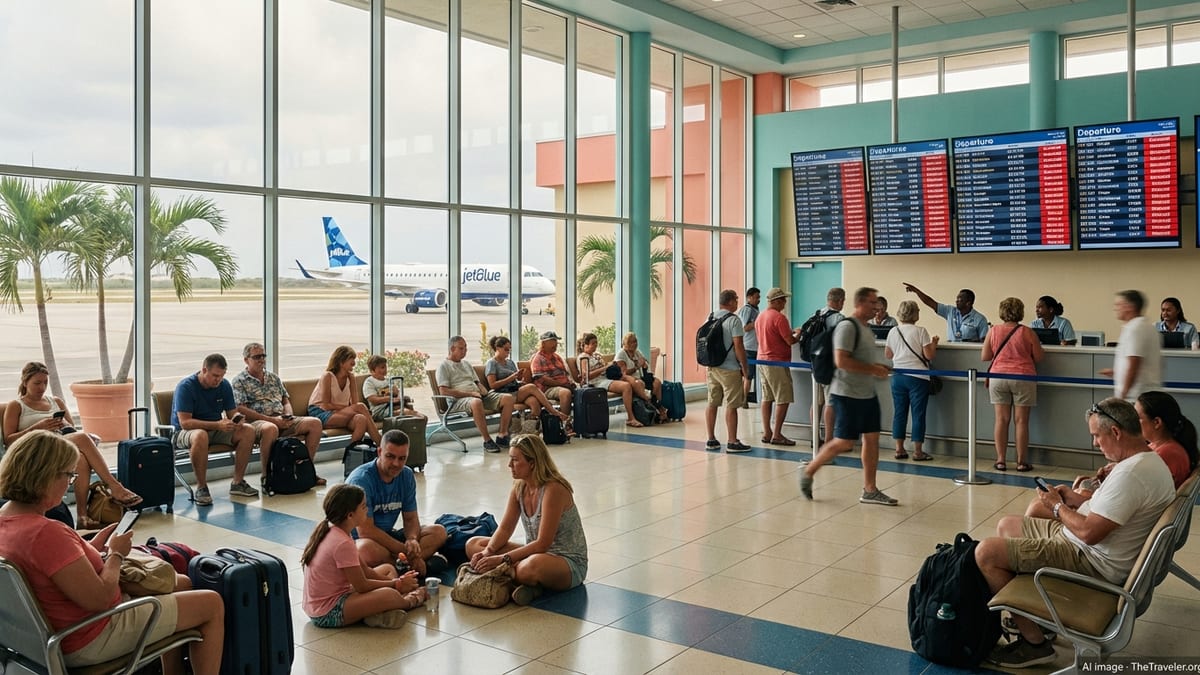
Cluster of Cancellations Hits Key U.S. Routes
According to live departure boards published by Aruba Airport Authority, several flights to major U.S. gateways were scrubbed on Sunday, including multiple JetBlue departures to Boston and New York’s John F. Kennedy International Airport. The cancellations, combined with schedule changes affecting Delta and American flights, amounted to a total of 13 flights taken off the board in a single operational window, a significant hit for an island that relies heavily on nonstop links to U.S. cities.
JetBlue’s service to Boston and New York was among the most visible disruptions, with at least two Aruba–JFK departures listed as canceled on airport and global flight-status platforms. The cuts coincided with a day that typically sees strong outbound demand from vacationers returning to the United States at the end of their stays.
Airport data showed that while some flights from Queen Beatrix to U.S. hubs, including select Delta services to New York, continued to operate, others were removed from the schedule entirely. The net effect was a noticeable thinning of the day’s transborder operation just as the airport was preparing for a high-volume winter weekend.
American Airlines, which connects Aruba to Miami and other U.S. hubs, also reported cancellations on certain rotations as carriers recalibrated their operations. Though not all affected flights originated in the United States, the bulk of the impact was felt on the tourist-heavy North American market that fuels much of Aruba’s visitor arrivals.
Recent Security Incident Adds Pressure to Operations
The cancellations came on the heels of a security-related incident involving a JetBlue flight from Boston earlier in the day, which triggered heightened procedures at Queen Beatrix International Airport. Passengers on the affected JetBlue service reported remaining onboard for an extended period while law enforcement and security teams carried out checks, underscoring the heightened sensitivity around aviation security in the region.
While airport officials have stated that operations have “fully resumed” following the security event, the knock-on effect on scheduling appears to have contributed to a complex operating environment for several carriers. JetBlue, already operating a dense winter schedule into Aruba, faced the twin challenge of managing the immediate security response and rebalancing its route network for the remainder of the day.
The incident has renewed discussion about the resilience of Queen Beatrix International Airport’s operations at a time when the wider Caribbean network remains under pressure from recent airspace restrictions and regional tensions. For airlines, even short-lived security disruptions can cascade into missed connections, crew-rest constraints and aircraft-rotation challenges that ultimately translate into cancellations.
For Aruba’s tourism stakeholders, the episode is a reminder of how quickly a single event on the tarmac can reverberate through hotels, tour operators and local businesses that depend on predictable airlift from North America. Industry observers say the airport and its airline partners will be closely reviewing protocols in the wake of the incident.
Regional Tensions and Earlier Airspace Closures Still Being Felt
Sunday’s cancellations follow a tumultuous start to the year for Caribbean aviation. In early January, Queen Beatrix International Airport saw roughly three-quarters of its scheduled flights canceled in a single day after U.S. authorities imposed temporary airspace restrictions in connection with military operations in Venezuela. On that day, Aruba Airport Authority reported that 44 out of 58 planned flights were scrubbed, the vast majority serving the U.S. market.
Those earlier disruptions were part of a broader wave of cancellations across the Caribbean, as U.S. airlines halted operations on selected routes and issued travel waivers. At the time, carriers such as JetBlue, Delta and American adjusted schedules and relaxed change penalties for travelers heading to or from affected islands, including Aruba.
Although the specific catalyst for Sunday’s reduced schedule appears to be operational and security-related rather than a fresh airspace closure, the aviation system in the southern Caribbean remains sensitive to events on the South American mainland. Route structures that rely on narrow corridors around restricted zones leave little room for last-minute rerouting, and airlines are often forced to cancel or consolidate services when conditions change quickly.
Aruba’s role as a key leisure gateway for U.S. travelers also magnifies the effect of any irregular operations. With the winter high season in full swing, even a moderate cut in daily flights can ripple through the island’s hotels and cruise connections, complicating arrivals and departures for visitors who have booked tightly timed itineraries.
Travelers Report Long Delays and Limited Rebooking Options
Passengers caught up in the latest wave of cancellations described a mix of long airport waits, abrupt schedule changes and scarce alternatives out of Queen Beatrix International Airport. On social platforms and travel forums, several travelers reported being offered rebooking options many days later than their original return dates, particularly on nonstop flights back to major U.S. cities.
Some passengers on Delta and American flights said they were told that the earliest available seats back to the United States were several days away, forcing families to extend hotel stays or seek expensive last-minute itineraries on foreign carriers through secondary hubs such as Bogotá or Panama City. Others reported success switching to less traditional routings, including flights to Midwestern or Southern U.S. cities and then connecting onward.
Travel advisers in the region noted that Aruba’s relatively limited runway capacity for wide-body aircraft and its dependence on a handful of U.S. carriers can make recovery from a sudden set of cancellations slower than at larger Caribbean hubs. When multiple airlines trim flights on the same day, the pool of available seats out of the island shrinks quickly.
For many visitors, the uncertainty has prompted closer attention to travel insurance coverage and flexible booking policies. Several travelers posting about the disruptions said they were seeking reimbursement for extra hotel nights and meal costs incurred while they waited for replacement flights home.
Airport Authority and Airlines Coordinate Recovery Efforts
In public updates, Aruba Airport Authority has emphasized that regular operations have resumed following the security incident and that the airport is coordinating closely with airline partners to manage passenger flows. Officials have urged travelers with confirmed flights to arrive on time and follow standard check-in procedures while also advising those whose flights were canceled to work directly with their airlines before heading to the terminal.
The airport has also warned of heavier-than-normal passenger volumes on subsequent days as carriers attempt to clear backlogs and as travelers rebook onto later flights. Ground handlers, immigration staff and security teams are being asked to manage fluctuating peak periods while maintaining safety and service standards for both departing and arriving passengers.
JetBlue, Delta and American have each issued schedule updates and, in some cases, travel waivers for impacted customers. These allow passengers whose flights were canceled or significantly delayed to rebook without additional change fees, though fare differences may still apply depending on the new itinerary. Customer-service channels at all three carriers have seen heightened demand as travelers seek earlier options and alternative routings.
Local tourism authorities are in turn liaising with hotels and tour operators to assist stranded visitors. Many resorts have reported relaxing check-out rules and offering discounted extra nights to guests whose departures were pushed back. Taxi operators and airport-transfer companies are also adjusting to repeated changes in pick-up schedules as flights are retimed.
Economic Stakes High for Aruba’s Tourism-Driven Economy
The sustained pattern of disruptions is raising concern among business leaders in Aruba, where tourism accounts for a substantial share of gross domestic product and employment. Queen Beatrix International Airport is the country’s primary air gateway, and sustained reliability issues can weigh on traveler confidence, particularly among repeat visitors who prize easy, nonstop access from the United States.
Industry analysts note that while one-off cancellations and security events are part of global aviation, the combination of regional geopolitical tensions, airspace restrictions and operational hiccups has made recent months unusually challenging. Travel agents have reported an uptick in questions from clients about contingency plans, airline reliability and the comparative resilience of different Caribbean destinations.
Hotel and restaurant owners on the island are watching flight patterns closely, aware that prolonged or repeated cuts in airlift can translate into softer occupancy, reduced spending and more volatile booking patterns. Some businesses are encouraging guests to build in more buffer time at the start and end of their vacations to guard against delays, a message that may appeal to risk-averse travelers but could complicate scheduling for those with fixed work or school calendars.
For now, tourism officials stress that Aruba remains open and welcoming, with the vast majority of flights operating normally on most days. They argue that close coordination between the airport, airlines and government agencies has kept the system largely resilient in the face of unusual external pressures, even as they acknowledge the frustration felt by travelers caught in the latest cancellations.
What Passengers Should Do if Their Aruba Flight Is Affected
Travel experts recommend that passengers scheduled to fly to or from Aruba in the coming days monitor their flight status frequently, using airline apps and airport departure boards rather than relying on static confirmation emails. Same-day schedule changes have become more common as carriers adjust to evolving operational constraints and crew availability.
In the event of a cancellation, specialists advise contacting the airline directly through multiple channels, including phone, online chat and direct messaging, to secure the earliest possible rebooking. Travelers willing to accept connections through less common gateways or to fly into alternative U.S. cities may have better odds of finding seats than those insisting on their original nonstop route or home airport.
Passengers are also encouraged to keep all receipts for additional expenses such as hotel nights, meals and ground transportation, as these may be relevant for travel insurance claims or for any compensation policies offered by airlines. While U.S. regulations do not require carriers to cover hotel or meal costs in most weather or airspace-related disruptions, some airlines choose to provide goodwill vouchers or partial reimbursements on a case-by-case basis.
Finally, advisers suggest that travelers with upcoming Aruba trips consider flexible or refundable fares where budgets allow, and review the fine print of any travel insurance policies to ensure that they understand coverage limits related to airspace closures, security incidents and civil unrest. As the situation in the southern Caribbean continues to evolve, preparedness and flexibility remain key for visitors heading to one of the region’s most popular beach destinations.