

More news on this day
Travelers at Denver International Airport faced mounting frustration today as Alaska Airlines, SkyWest Airlines, United Airlines and Lufthansa collectively suspended 16 flights and triggered well over 100 delays, disrupting key routes to Seattle, Dickinson, Laramie, Boston, Munich and other destinations across the network.
Get the latest news straight to your inbox!
Storms, Congestion and Operational Strain Converge at Denver
Denver International Airport, one of the country’s busiest hubs and a key connecting point for the Mountain West, spent much of the day grappling with cascading disruptions across multiple carriers. Airport data and airline status boards showed a cluster of cancellations and rolling delays as morning weather and air-traffic constraints rippled into the afternoon and evening schedule.
Alaska Airlines, SkyWest Airlines, United Airlines and Lufthansa each reported scrubbed departures or arrivals at Denver, with 16 flights canceled outright and more than 100 departures and arrivals delayed. The turbulence in the schedule primarily affected short regional hops and major trunk routes, turning routine connections into day‑long ordeals for many passengers.
While precise causes varied by carrier and route, a mix of adverse conditions around Denver’s airspace, ground‑handling constraints and earlier inbound delays contributed to the bottleneck. As aircraft and crews fell out of position, airlines struggled to restore normal flows, leaving planes parked at gates and passengers staring at departure boards filled with yellow and red status updates.
Denver’s sprawling airfield and proximity to the Rockies often make it particularly sensitive to fast‑changing weather and shifting wind patterns. When arrival and departure rates are reduced, even for short periods, congestion can build quickly, especially at peak travel times.
Key Routes to Seattle, Dickinson, Laramie, Boston and Munich Hit Hard
Among the routes hardest hit were services linking Denver to Seattle, Dickinson, Laramie, Boston and Munich, a cross‑section of regional lifelines and long‑haul connections. Several Alaska Airlines and United Airlines flights between Denver and Seattle were canceled or heavily delayed, affecting both local travelers and those connecting onward to Alaska and the Pacific Northwest.
Regional services operated by SkyWest to Dickinson, North Dakota, and Laramie, Wyoming, also saw cancellations and lengthy holds. These routes, typically served by smaller regional jets with limited frequencies, left passengers with few same‑day alternatives once their flights were scrubbed. Some travelers reported being offered rebookings a full day later or being routed circuitously through other hubs.
On the long‑haul side, Lufthansa’s link between Denver and Munich faced schedule disruption, with delayed departures cascading into missed onward connections in Europe. Passengers heading to destinations across Germany and beyond reported needing to be reprotected onto later flights or alternate routings through other European hubs.
Flights to and from Boston were another pain point, as delays on eastbound services collided with weather and congestion along the northeastern corridor. For some passengers, what was planned as a straightforward Denver–Boston trip turned into a multi‑stop journey involving last‑minute reroutes or overnight stays.
Stranded Passengers Face Long Lines, Missed Events and Extra Costs
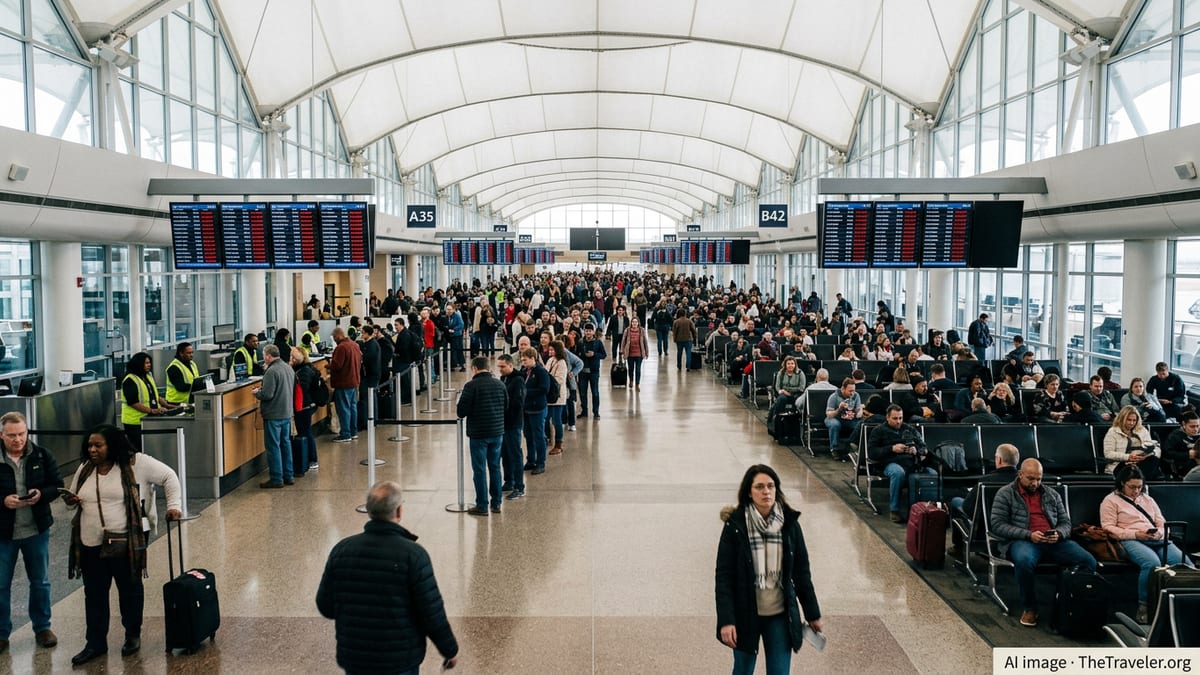
Inside Denver International Airport’s terminals, the operational strain translated into long queues at customer‑service counters, crowded seating areas and anxious conversations around charging stations. Families, business travelers and international visitors alike scrambled to secure new itineraries, hotel vouchers and meal credits as delay estimates were revised repeatedly.
Many passengers reported missing important events, including weddings, work meetings and cruise departures, as connection times evaporated. Others faced unexpected expenses for last‑minute hotel rooms or rideshares into Denver after late‑night cancellations left them without guaranteed overnight accommodation near the airport.
Parents traveling with young children described the challenge of keeping kids occupied through rolling two‑ and three‑hour delays, while older travelers expressed concern about navigating lengthy terminal walks to reach reassigned gates. With departure times shifting throughout the day, some passengers opted to abandon air travel altogether, renting cars to complete journeys to nearby states by road.
Airport amenities, including food outlets and lounges, saw surging demand as travelers waited out delays. By late afternoon, some eateries reported running low on popular items, a familiar side effect when prolonged disruptions keep passengers in the terminal far longer than planned.
Airlines Work to Recover Schedules and Rebook Customers
Airline operations teams concentrated on restoring network stability and minimizing knock‑on effects into subsequent days. Crews were reassigned, aircraft were swapped and some flights were combined where load factors and regulations allowed, as carriers tried to protect as many passenger journeys as possible without compounding congestion at Denver.
Alaska Airlines and United Airlines encouraged affected customers to use mobile apps and self‑service tools to rebook rather than wait in line, pushing out travel alerts and flexible change policies for impacted flights. Many passengers reported being able to move to later departures or alternate routings at no additional fare, though prime options were quickly snapped up.
Lufthansa, meanwhile, focused on rebooking Denver‑originating travelers through other gateway cities and coordinating with partners in Europe to secure onward seats. Regional operator SkyWest, which flies under partner brands, worked within those partners’ policies to reaccommodate stranded passengers on alternate regional or mainline services.
Despite these efforts, airlines cautioned that residual delays could persist as crews approached duty‑time limits and aircraft remained out of their usual rotations. Travelers were advised to monitor flight status frequently and build extra buffer time into any critical connections involving Denver.
What Travelers Should Know for Upcoming Flights Through Denver
With schedules still in the process of recovering, travelers booked to connect through Denver in the coming hours were urged to check in early, confirm their contact details with airlines and keep a close eye on departure boards and mobile notifications. Same‑day adjustments remained possible on many itineraries, especially for passengers who were flexible on departure times or routings.
Industry analysts noted that days like this underscore both the importance and vulnerability of large hub airports. When a single hub experiences simultaneous pressure from weather, air‑traffic constraints and operational challenges, the impact radiates outward to small communities and international destinations alike, as seen in the effect on Dickinson, Laramie, Seattle, Boston and Munich.
For travelers, the episode serves as a reminder to build contingency time into itineraries passing through high‑altitude, weather‑sensitive airports, particularly during peak travel seasons. Nonstop options, early‑morning departures and travel insurance that covers missed connections can all provide additional protection when disruptions occur.
As operations at Denver International Airport gradually normalize, airlines and passengers alike will be watching closely to see how quickly networks recover and whether any further cancellations or rolling delays emerge in the wake of this latest episode of turbulence on the ground.