

More news on this day
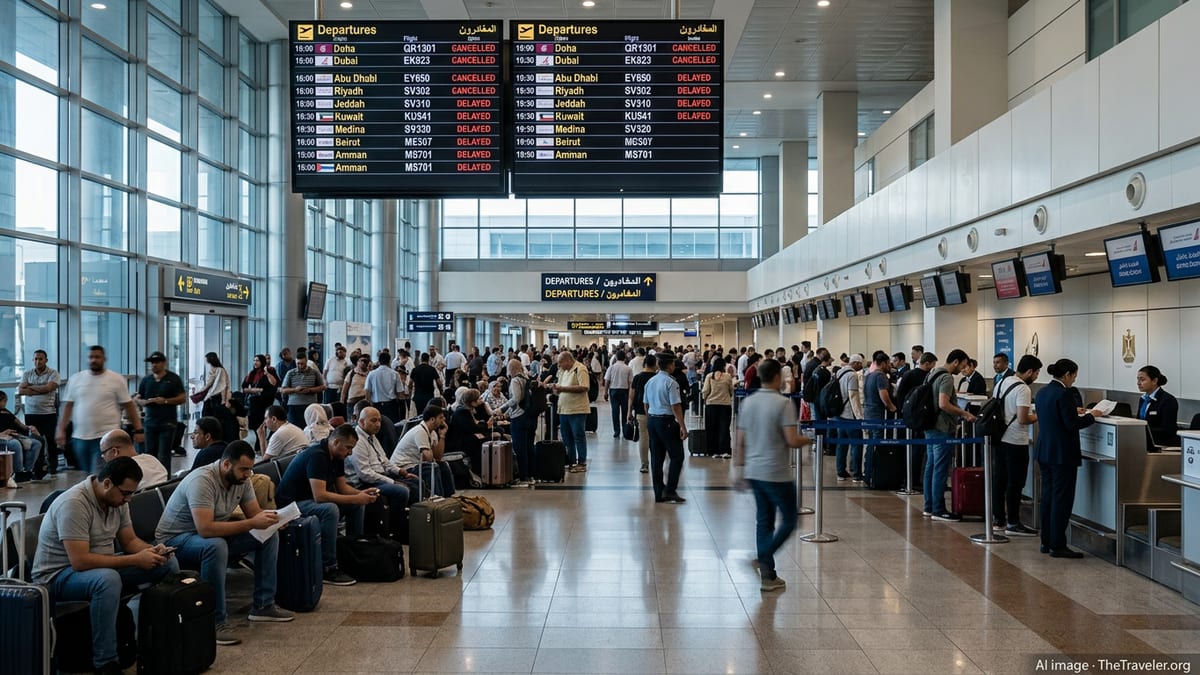
Air travel across Egypt is being thrown into fresh turmoil as Qatar Airways, EgyptAir, Gulf Air and other regional carriers cancel or curtail more than 50 flights, cutting key links from Cairo, Alexandria and Sharm El Sheikh to major hubs such as Doha, Dubai, Abu Dhabi, Riyadh, Jeddah, Beirut, Kuwait, Medina and Amman.
Get the latest news straight to your inbox!
Regional Conflict Triggers New Wave of Cancellations
The latest disruption follows the closure and restriction of multiple Middle Eastern airspaces after a sharp escalation in the Iran conflict that began in late February 2026. Aviation authorities in the Gulf and Levant have imposed tight controls on overflights, forcing airlines to cancel, reroute or heavily consolidate services that normally crisscross the region.
Qatari airspace remains partially restricted, with Qatar Airways operating only a limited schedule of relief and repatriation flights to and from Doha’s Hamad International Airport. While the airline confirmed it will mount a small number of services on selected dates in mid March, its normal hub‑and‑spoke schedule remains largely suspended, causing knock‑on disruption for Egypt‑origin passengers who rely on Doha as a long‑haul connection point.
Across the wider region, multiple carriers including Turkish Airlines, Lufthansa Group airlines and British Airways have also suspended or reduced flights to Dubai, Abu Dhabi, Amman, Beirut and other destinations through at least mid March, compounding the pressure on Egypt’s outbound and inbound traffic. The combined result is a patchwork of cancellations and last‑minute schedule changes that is catching many travelers off guard.
EgyptAir and Gulf Carriers Pare Back Key Routes
Egypt’s national carrier EgyptAir has trimmed frequencies on several high‑demand regional routes and cancelled a series of departures where onward connections are no longer viable. Industry advisories circulated to corporate travel managers this week highlight significant disruption on services linking Cairo to Doha, Dubai, Abu Dhabi, Kuwait, Jeddah and Riyadh, as well as selected flights from secondary gateways such as Alexandria and Sharm El Sheikh.
Gulf Air, the Bahraini flag carrier, has temporarily suspended most of its operations amid the regional airspace closures, removing another important option for Egyptian passengers bound for the Gulf via Bahrain. Other Gulf‑based airlines, including flydubai and Air Arabia, are operating with reduced schedules, often consolidating departures and prioritising repatriation traffic over discretionary travel.
Travel agents in Cairo report that more than 50 point‑to‑point and connecting flights touching Egypt over the coming days have either been cancelled outright or are listed as “subject to change,” particularly those involving Doha, Dubai, Abu Dhabi, Riyadh, Jeddah, Beirut and Amman. Capacity that remains in the market is often heavily overbooked, with some passengers facing delays of several days before they can be re‑accommodated.
Stranded Passengers Face Long Delays and Complex Reroutes
For travelers already en route, the latest wave of cancellations is translating into extended layovers and complex rerouting via Europe, North Africa or South Asia. With the most direct corridors across the Gulf and Levant restricted, airlines are stitching together longer routings that skirt closed airspace, adding hours to journey times and forcing unplanned overnight stays.
Airports in Cairo and other Egyptian cities are again seeing lines at airline help desks as passengers seek rebooking, refunds or hotel vouchers. While carriers such as Qatar Airways have issued broader waiver policies that allow affected passengers to change dates or reroute without penalty within specified windows, access to alternative flights is limited and priority is often given to those with urgent travel needs.
Families returning from school holidays, expatriate workers heading back to Gulf jobs and religious travelers en route to Jeddah and Medina for Umrah are among those hit hardest. Many report receiving cancellation notices with only a few hours’ warning and being advised not to travel to the airport until their rebooking is confirmed, a measure designed to prevent terminal overcrowding as capacity remains constrained.
What Travelers Through Egypt Need to Know Now
Passengers booked on flights between Egypt and key regional hubs over the next two weeks are being urged to treat schedules as provisional and to monitor flight status repeatedly in the 24 hours before departure. Airlines are adjusting operations day by day as aviation authorities issue new clearances or extend existing restrictions, meaning that a flight showing as confirmed in the morning can still be cancelled later the same day.
Most affected carriers have activated special disruption policies that allow free date changes, rerouting via alternative hubs or, in some cases, full refunds. However, policies vary significantly by airline and booking channel, and travelers who purchased tickets through third‑party agencies or online platforms may need to work through those intermediaries to access relief options.
Authorities and airlines are advising passengers not to attempt to transit through Doha, Dubai or Abu Dhabi unless their itinerary is fully confirmed on an operating flight, as terminal access in several hubs has been restricted to ticketed passengers with active departures. Travelers whose journeys are not time‑sensitive are being encouraged to postpone non‑essential trips until a more stable schedule resumes.
Outlook: Limited Relief Flights but Ongoing Volatility
Looking ahead to mid and late March, Qatar Airways has outlined plans for a rolling programme of limited flights from Doha to select cities, including Cairo and Jeddah, as temporary air corridors open. Other airlines, notably Emirates and Etihad Airways, are preparing to ramp up operations once their respective civil aviation authorities deem it safe to do so, though exact timelines remain fluid.
Despite these green shoots, aviation analysts warn that volatility is likely to persist for several weeks. Any renewed escalation in the regional security situation could prompt sudden reclosures of airspace or further restrictions on overflights, immediately rippling through timetables across Egypt and the wider Middle East.
For now, travelers planning to fly into or out of Egypt via Doha, Dubai, Abu Dhabi, Riyadh, Jeddah, Kuwait, Medina, Beirut or Amman should build flexibility into their plans, keep contact details updated with their airline and be prepared for last‑minute changes. With more than 50 flights already cancelled and many more operating on thin margins of certainty, the region’s air travel network remains fragile and subject to rapid change.