

More news on this day
Travelers across the United Kingdom are facing mounting disruption as more than 30 key flights operated by Gulf Air, British Airways, American Airlines, and several other carriers have been cancelled at London’s main airports, affecting high-demand routes to New York, Berlin, Zurich, Dubai, Tel Aviv, Oslo, and additional global hubs.
Get the latest news straight to your inbox!
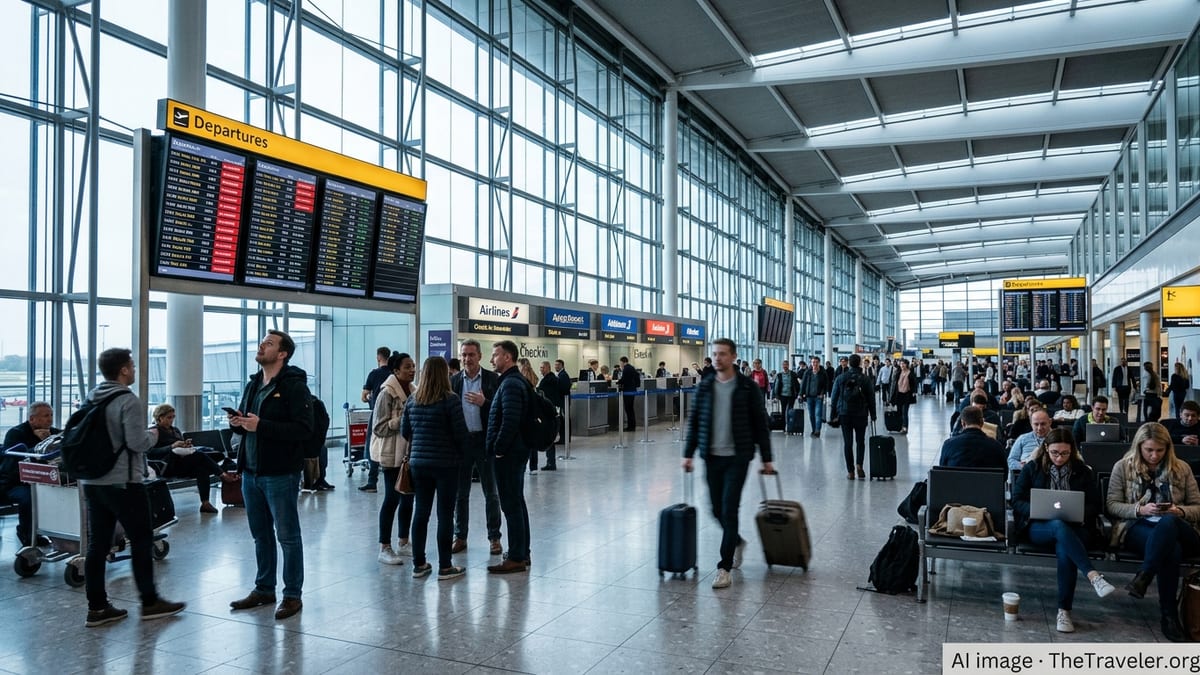
London’s Major Airports See Wave of Cancellations
Publicly available airport departure boards and flight-tracking data on March 24 indicate that London’s main gateways, including Heathrow, Gatwick, and London City, have recorded a concentrated wave of cancellations across transatlantic and European services. The disruption is centered on a cluster of more than 30 flights, many of them on core business and leisure routes that typically run at strong load factors.
British Airways and American Airlines, which jointly operate a dense network of flights between London and major US cities, are among the most visible carriers affected. Several departures to New York have been removed from schedules, while additional services to continental European destinations such as Berlin and Zurich have also been cut for the day. Gulf Air and other international airlines have cancelled links to Middle Eastern hubs including Dubai and Tel Aviv, curtailing onward connections for passengers bound for Asia, Africa, and Australasia.
The cancellations are spread across different times of day, which has created a rolling pattern of disruption rather than a single short-lived outage. Travelers arriving at terminals through the morning and into the afternoon are encountering departure boards peppered with “cancelled” notices on routes that usually offer multiple daily frequencies.
Routes to New York, Berlin, Zurich, Dubai, Tel Aviv, and Oslo Hit Hard
The impact is being felt most acutely on a set of strategically important routes that link London with financial centers, political capitals, and major transit hubs. Flight data shows that multiple services between London and New York have been cancelled, reducing capacity on one of the world’s busiest long-haul corridors. This is creating challenges for passengers seeking same-day rebooking options, as remaining flights are already heavily booked.
Short-haul travelers are also experiencing disruption. Cancellations between London and Berlin, Zurich, and Oslo have removed key options for business commuters and connecting passengers who rely on those flights to feed into wider European and intercontinental networks. In several cases, the cancelled services were scheduled to operate at peak morning or early evening times, magnifying the difficulty of finding same-day alternatives.
Routes to Dubai and Tel Aviv, which function as important gateways for onward travel to the Middle East and beyond, have likewise been affected. The loss of these services is especially significant for travelers booked on long, multi-leg itineraries, where missing the first segment often leads to missed connections further along the journey. For some passengers, rebooking may require changes to entire itineraries rather than simple one-flight substitutions.
Operational Pressures and Regional Instability Behind the Disruption
Published coverage in recent weeks has highlighted how a combination of operational challenges and regional instability has increased cancellation risk for some London services. Airlines flying to and from the Middle East, including Gulf Air and other regional carriers, have been adjusting schedules and issuing travel waivers in response to evolving security assessments and airspace restrictions. These measures have contributed to a more fragile operating environment on routes connecting London with Dubai, Tel Aviv, and neighboring hubs.
At the same time, European and UK carriers continue to face structural pressures that can quickly cascade into cancellations. Staffing constraints in air traffic control, aircraft availability issues, and the complex knock-on effects of earlier delays all raise the likelihood that flights may be proactively removed from the schedule to stabilize operations. In the case of London, where runway slots are scarce and schedules tightly packed, even modest disruptions can prompt airlines to consolidate or cancel frequencies on short notice.
Industry analyses have also drawn attention to strategic network adjustments being implemented by some full-service airlines. These changes, often framed as long-term optimization, can intersect with short-term operational issues to produce clusters of cancellations on specific city pairs. While not every removal from the departure board reflects a permanent cut, the pattern can be difficult for passengers to distinguish from temporary disruption linked to external events.
Knock-On Effects for Passengers and Regional Connectivity
The immediate consequence for passengers is a mix of extended waiting times, rerouting, and in some cases overnight stays. With more than 30 flights affected across London’s airports on the same day, available seats on remaining services have tightened quickly, especially on transatlantic and peak-time European routes. Some travelers are being rebooked via alternative hubs such as Frankfurt, Paris, Amsterdam, or Istanbul, elongating journeys by several hours.
For business travelers and those with time-sensitive plans, the loss of direct services to cities like New York, Berlin, and Zurich is particularly disruptive. Missed meetings, delayed project start times, and complications around visa windows or scheduled events are common risks when rebooking involves longer connections or next-day departures. Families and leisure travelers may also face extra costs for accommodation, meals, and ground transport when cancellations occur after they have already arrived at the airport.
Beyond individual itineraries, the disruption underscores the vulnerability of regional connectivity that depends on a limited number of daily flights. Cities such as Oslo, which rely on a small set of direct services to London for both point-to-point traffic and onward connections, can see their options sharply curtailed when even one or two rotations are removed. Over time, frequent clusters of cancellations can influence traveler confidence and encourage some passengers to favor alternative hubs perceived as more reliable.
What Travelers Can Do If Their Flight Is Affected
Given the current pattern of disruption, publicly available travel advice emphasizes the importance of monitoring flight status closely in the hours before departure. Passengers are encouraged to check official airline channels and airport displays rather than relying solely on booking confirmations issued days or weeks earlier. Same-day schedule changes are increasingly common when airlines seek to preempt operational difficulties or respond to external events.
For those whose flights are cancelled, consumer guidance notes that travelers departing from UK airports or flying with UK or EU carriers may be entitled to re-routing, refunds, and, in some circumstances, statutory compensation, depending on the cause and timing of the disruption. However, many recent cancellations linked to security concerns, airspace restrictions, or broader regional crises are classified as extraordinary circumstances, which can limit eligibility for compensation even when rebooking remains an option.
Specialists also highlight the value of flexible booking arrangements when traveling on routes currently experiencing heightened volatility, such as services to Dubai and Tel Aviv. Tickets that allow date changes with reduced or waived fees, as well as itineraries with slightly longer connections, can provide a buffer if one segment is altered or cancelled. Travel insurance policies that explicitly cover missed connections and schedule disruptions may offer additional protection, provided that travelers review coverage details carefully in advance.