

More news on this day
More than 20 flights operated by major carriers including LATAM, Azul, Emirates, Delta and American were cancelled on Monday across Brazil’s largest airports, disrupting long-haul routes to Dubai, Miami, New York and Lima as well as heavily used domestic links between São Paulo, Rio de Janeiro and Brasília.
Get the latest news straight to your inbox!
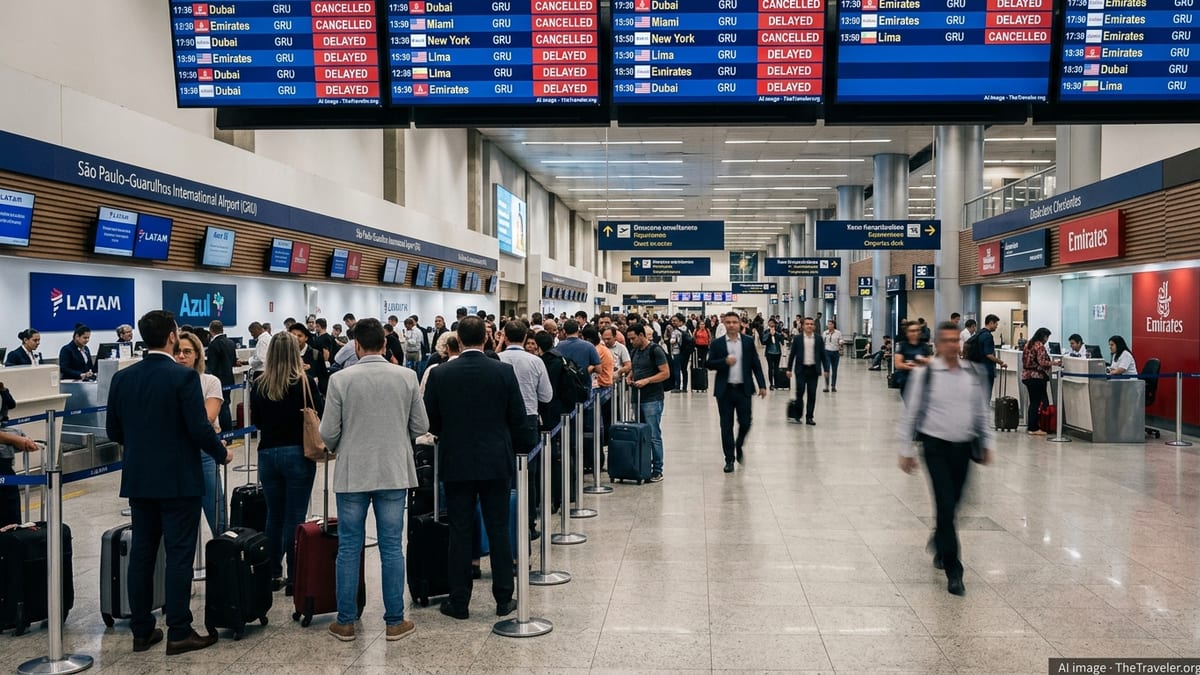
Major Carriers Pull Flights on Brazil’s Busiest Corridors
Publicly available airport departure boards and airline status pages on Monday showed clusters of cancellations affecting leading Brazilian and international airlines. LATAM and Azul recorded a noticeable number of scrapped departures at São Paulo–Guarulhos, São Paulo–Congonhas, Rio de Janeiro–Galeão and Brasília, while long-haul partners such as Delta Air Lines and American Airlines also withdrew selected services linking Brazil to the United States. Emirates services between Dubai and São Paulo, already operating on a reduced pattern after recent operational constraints in the Gulf region, were again among those hit.
The cancellations were concentrated on high-demand corridors. Brazil–United States traffic was particularly affected, with flights on São Paulo–Miami, Rio–Miami and São Paulo–New York routes removed from schedules for the day. Regional connectivity suffered as well, with services between Brazil and Lima trimmed, forcing some travelers to seek alternative routings via other South American hubs.
Domestic movements that connect passengers into these long-haul flights also saw disruptions. Reports from passenger tracking platforms indicated that several short-haul legs feeding Guarulhos and Galeão, especially from secondary cities, were cancelled or rescheduled with significant delays. This created a cascade of missed connections and rebookings across the day.
Airport operational data suggested that more than 20 individual departures and arrivals across the affected carriers were either cancelled outright or listed as disrupted within a 24-hour window, underscoring how quickly localized issues can ripple across Brazil’s dense air network.
Ripple Effects for Travelers in Dubai, Miami, New York and Lima
The impact of Brazil-origin cancellations extended far beyond the country’s borders. In Dubai, where Emirates connects South America with the Middle East and Asia, reduced operations to and from São Paulo left some travelers stranded or facing lengthy waits for the next available seat. Recent interruptions at Gulf hubs and temporary schedule adjustments have already tightened capacity on these routes, meaning same-day alternatives were limited.
In North America, Miami and New York bore the brunt of the changes. Miami International Airport, a primary gateway for Brazilian leisure and business travelers, saw multiple Brazil-bound and Brazil-originating services removed from the day’s schedule. New York’s John F. Kennedy International Airport also showed cancellations on joint operations involving LATAM and its U.S. partners, reflecting a wider pattern of cutbacks and last-minute schedule changes between the two countries.
Lima, a key connector between Brazil and the rest of Spanish-speaking South America, experienced knock-on effects as Brazilian carriers adjusted capacity. Reduced Brazil–Lima frequencies complicated itineraries for travelers continuing on to destinations in the Andes and Pacific coast. Passenger accounts shared on travel forums described reroutes via alternative hubs such as Bogotá, Santiago and Panama City as travelers tried to bypass disrupted Brazil–Peru links.
International travelers transiting through Brazil felt the disruption acutely. Missed onward flights, extended layovers and reissued tickets became recurring themes in user reports, underscoring the vulnerability of multi-leg itineraries when a single regional hub experiences a spike in cancellations.
Operational Strains and Network Rebalancing Behind the Disruptions
While each airline cited its own operational reasons in public updates, the pattern of cancellations in Brazil appears tied to a combination of network rebalancing, knock-on effects from recent disruptions in the Middle East, and ongoing efforts to align capacity with demand at the end of the southern summer travel peak. Aviation industry analyses published this month noted that long-haul carriers serving Dubai, Abu Dhabi and other Gulf hubs have been operating under constrained conditions after airspace closures and temporary airport disruptions earlier in March.
These constraints have contributed to irregular schedules and late-notice changes for connecting routes, including flights linking Dubai with São Paulo. In turn, Brazilian and U.S. partners that rely on predictable long-haul patterns for their connecting banks in São Paulo, Rio, Miami and New York have had to make short-term adjustments. That has manifested as same-day cancellations, consolidated flights and re-accommodations across alliance and codeshare networks.
Domestic carriers are simultaneously managing their own challenges. Data from airline capacity trackers show that Brazilian airlines have been fine-tuning frequencies on trunk routes such as São Paulo–Rio and São Paulo–Brasília to balance high demand with cost pressures and fleet utilization limits. When irregular operations coincide with already tight schedules, even a modest number of crew or aircraft availability issues can translate quickly into clusters of cancellations.
Industry commentators point out that, for global airlines, Brazil sits at a critical junction between North America, Europe and the Middle East. Any network stress that touches São Paulo or Rio can therefore have outsized consequences, as these hubs feed traffic not only to large domestic markets but also to onward long-haul sectors across three continents.
Passengers Face Rebooking Challenges and Limited Alternatives
Travelers affected by the latest cancellations reported a mix of automatic rebookings and lengthy negotiations at airport counters and via customer-service channels. On heavily trafficked routes between Brazil and Miami or New York, remaining seats on the same day were scarce, pushing some passengers onto flights one or more days later. Others turned to secondary gateways such as Orlando, Dallas, Atlanta or Houston, connecting onward to Brazil with different carriers.
On the Dubai corridor, alternatives were even more constrained. With Emirates and other Gulf-based carriers already operating modified schedules following recent disruptions, spare capacity on Brazil–Middle East links was limited. Some travelers described being rerouted via European hubs such as Lisbon, Madrid, Paris or Frankfurt, turning a typical one-stop journey into a multi-stop itinerary that added many hours to total travel time.
Within Brazil, cancellations on trunk routes forced passengers into later flights or, in a few cases, into alternate airports in the same metropolitan areas, such as shifting between Guarulhos and Congonhas in São Paulo or between Galeão and Santos Dumont in Rio. This created additional logistical challenges, including ground transfers and last-minute accommodation changes for those facing overnight delays.
Consumer advocates monitoring the situation noted that, while rebooking options generally remained available, the combination of limited spare capacity and high seasonal demand meant that passengers needed flexibility on dates, departure times and even origin or destination airports to secure viable alternatives.
What Travelers Flying To and From Brazil Should Expect Next
Travel data providers tracking Brazil’s major airports indicate that schedules for the coming days still show some adjustments on key international routes, particularly those involving connections through Gulf hubs and the busiest U.S. gateways. While most flights remain scheduled to operate, the recent spike in cancellations suggests that further short-notice changes cannot be ruled out as airlines continue to refine operations.
Route analysts observing Brazil’s outbound markets say carriers are likely to keep a close eye on demand and operational reliability before restoring any recently pulled frequencies. Flights linking São Paulo and Rio with Miami, New York and Dubai are expected to remain strategic priorities, but may see fine-tuning of departure times and days of operation as airlines seek to maximize aircraft and crew productivity.
Travelers planning imminent trips involving Brazil are being advised, in widely circulated guidance from travel firms and aviation specialists, to monitor flight status frequently, allow extra time for connections and consider travel insurance that covers missed connections and extended delays. Flexible tickets and loyalty status with operating carriers may also provide additional options if further disruptions occur.
For now, Brazil’s air transport system remains functional but fragile, with this week’s wave of cancellations on routes served by LATAM, Azul, Emirates, Delta, American and other airlines underscoring how swiftly regional and global shocks can converge to unsettle even the country’s most established international and domestic corridors.