

More news on this day
Air travel across northern Europe faced fresh disruption today as early operational data showed 33 flights cancelled and at least 517 delayed at Copenhagen, Reykjavik Keflavik, Paris Charles de Gaulle, London Heathrow and Amsterdam Schiphol, stranding passengers and tightening capacity on already busy spring routes.
Get the latest news straight to your inbox!
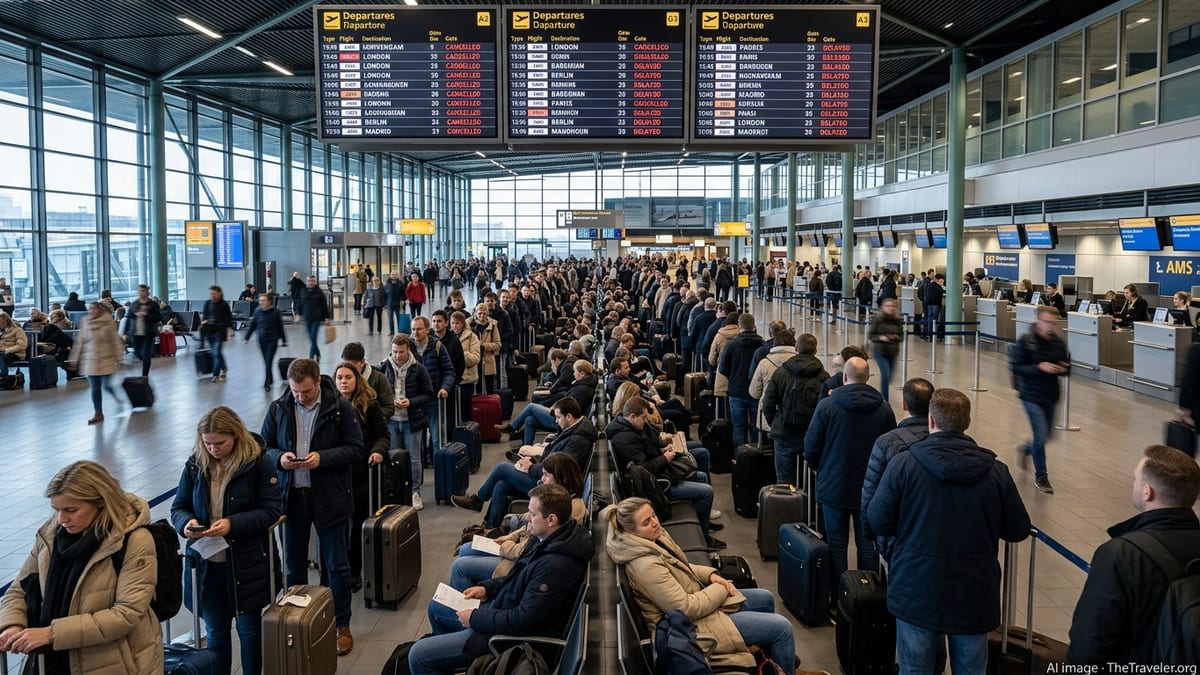
Operational Strains Hit Key Northern European Gateways
Publicly available flight-tracking dashboards for Thursday indicate that cancellations are concentrated at major transfer hubs handling a high volume of intra-European and long-haul connections. Amsterdam Schiphol and London Heathrow, which regularly rank among Europe’s busiest airports by daily movements, are again featuring prominently in disruption statistics, with secondary effects radiating to Copenhagen, Paris Charles de Gaulle and Keflavik in Iceland.
The reported pattern mirrors previous congestion spikes documented by Eurocontrol and airport punctuality reports, which show that Heathrow, Schiphol and Charles de Gaulle together handle thousands of flights per day in normal conditions. When even a relatively small share of movements is cancelled or delayed at such nodes, missed connections and aircraft rotations can quickly ripple through the wider network for the rest of the day.
Current disruption levels remain far below the mass shutdowns seen during historic events such as volcanic ash incidents or intense winter storms. However, the combination of targeted cancellations and widespread shorter delays is proving enough to leave passengers stranded at intermediate hubs, particularly those on tightly timed transfers or traveling on complex multi-leg itineraries.
Weather, Capacity and Knock-On Effects Across Europe
Weather remains a recurring backdrop to Europe’s aviation reliability this season, particularly at northern airports exposed to late-winter conditions. Earlier in the year, heavy snow and strong winds at Schiphol triggered days of sharply elevated cancellation rates, with ground-handling and de-icing constraints reducing runway throughput and forcing airlines to trim schedules. Similar conditions have periodically affected Copenhagen and other Scandinavian gateways, where winter resilience is generally high but not immune to prolonged or intense storms.
Industry data for recent months also highlights structural capacity pressures in European air traffic management. Eurocontrol’s network reports show that both route and airport-related delays continue to account for hundreds of thousands of minutes of disruption in a typical month, even without extreme weather or large-scale airspace closures. When routine constraints collide with localized storms, technical issues or staffing shortages, operators may opt to cancel a modest number of flights pre-emptively in order to preserve the rest of the schedule.
At Keflavik, Iceland’s main international gateway, the impact of any schedule change is magnified by the airport’s role as a transatlantic bridge. Airlines have previously used Icelandic hubs to bank arrivals and departures within tight time windows, meaning that relatively small timing shifts on inbound flights can cascade into missed onward connections to North America or continental Europe.
Stranded Passengers Face Long Queues and Limited Rebooking Options
For travelers, the most visible consequence of today’s disruptions is extended waiting time in terminals as airlines work through rebooking backlogs. Reports from recent disruption episodes at Schiphol and other European hubs have described long lines at airline service desks, with some passengers facing overnight stays nearby when seats on later departures prove scarce. Similar scenes are likely to play out in pockets today, especially for those traveling on popular city pairs or during peak hours.
The current pattern of 33 cancellations spread across multiple airports and more than 500 delayed flights also constrains the usual fallback of rerouting via alternative hubs. When several of Europe’s main connection points experience concurrent schedule stress, the available pool of seats for same-day re-accommodation shrinks quickly, even if total cancellation numbers appear modest at first glance.
Passengers with separate tickets for onward travel or self-arranged connections are particularly vulnerable, as consumer protections in many jurisdictions do not always extend to independently booked segments. Recent experiences shared in public forums indicate that these travelers can face higher out-of-pocket costs for last-minute replacement flights or extra nights of accommodation when disruption strikes mid-journey.
Airlines Adjust Schedules While Airports Push Resilience Measures
Airlines operating through Heathrow, Schiphol, Charles de Gaulle and other affected hubs have increasingly turned to targeted schedule thinning as a way to maintain operational stability during challenging periods. Public schedule data from earlier weather-related episodes shows that some carriers opted to cancel clusters of short-haul services while preserving long-haul and key business routes, in order to make the most efficient use of limited slots, crews and aircraft.
Airports and national aviation authorities across Europe have simultaneously promoted a range of resilience measures, from investments in de-icing capacity and snow-clearance equipment to refinements in slot coordination and collaborative decision-making with airlines and air navigation service providers. Punctuality reports from industry bodies indicate that these efforts have helped improve on-time performance at many major hubs over the past year, although capacity remains tight and vulnerable to shocks.
Despite those improvements, the latest round of cancellations and delays underscores how easily interconnected networks can be destabilized when several hubs experience issues at once. With demand for travel through northern Europe still strong, even temporary disruptions can have outsized effects on passengers who depend on precise connections to reach destinations in Asia, North America and within the Schengen area.
What Travelers Can Expect in the Coming Days
Looking ahead to the next 24 to 48 hours, operational data and recent patterns suggest that residual delays are likely to persist even if no new triggering event emerges. Aircraft and crews displaced by today’s cancellations will need time to be repositioned, and some late-evening rotations may be cut to allow schedules to reset ahead of the weekend.
Published guidance from airlines and airports during previous disruption episodes consistently emphasizes the importance of checking flight status shortly before leaving for the airport and making use of carrier apps, text alerts and airport departure boards. Many carriers have also introduced more flexible rebooking options during periods of sustained operational stress, allowing travelers to move flights at low or no additional cost when disruptions are forecast.
For those with imminent departures from Copenhagen, Keflavik, Paris Charles de Gaulle, London Heathrow or Amsterdam Schiphol, current conditions point to a day of slower-than-normal processing, possible gate changes and occasional cancellations rather than a complete halt to operations. Travelers with tight connections may wish to prepare for contingencies, as even modest schedule variations can be enough to sever links in Europe’s dense but sensitive hub-and-spoke network.