

More news on this day
Travelers moving through Thailand are facing renewed uncertainty as Gulf Air, Qatar Airways, and several other carriers cancel or reshape flights linking Bangkok and other Asian gateways with Doha, Tel Aviv, and onward global routes, amid ongoing regional tensions and airspace restrictions in the Gulf and Eastern Mediterranean.
Get the latest news straight to your inbox!
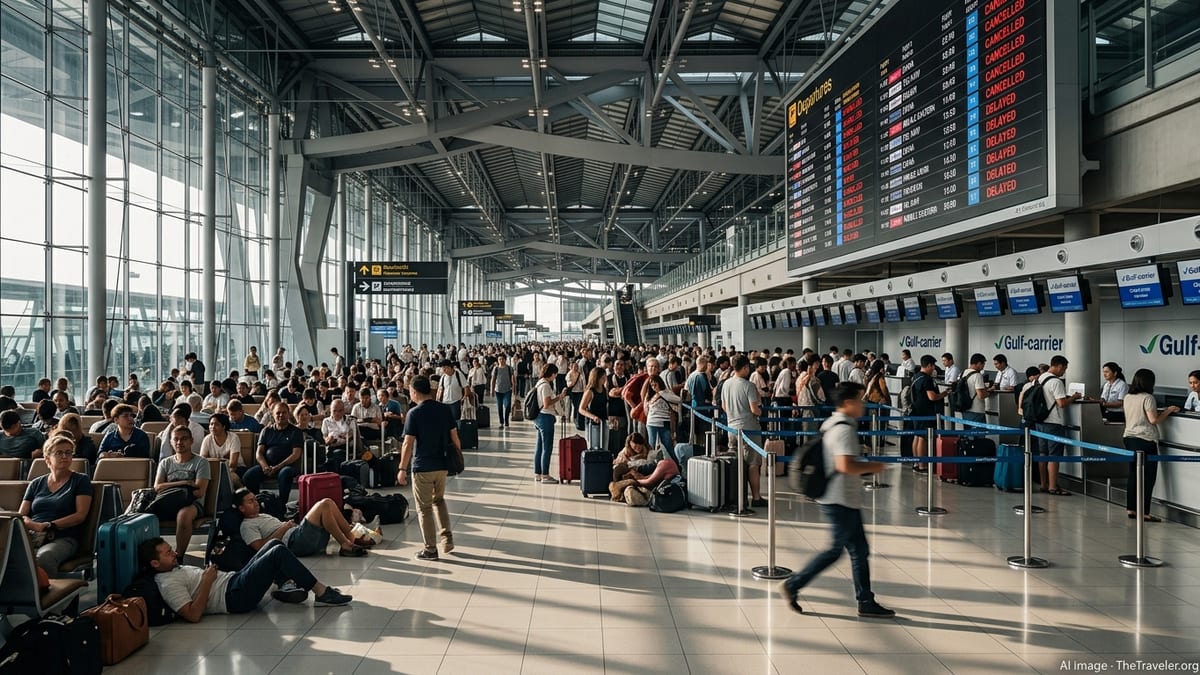
Regional Conflict Keeps Pressure on Key Air Corridors
Publicly available information shows that the continuing conflict involving Iran, Israel, and Gulf states has kept pressure on major aviation hubs, particularly Doha and Tel Aviv. Airspace closures and restricted operations around Qatar and Israel since late February 2026 have repeatedly disrupted long-haul connections that rely on these hubs as key transit points between Asia, Europe, and the Americas.
Reports indicate that Qatar’s Hamad International Airport has been operating under constrained conditions after Iranian missile and drone activity in the region, with Qatari airspace subject to periodic closures and controlled reopenings. These restrictions have forced airlines either to suspend operations entirely or to run sharply reduced schedules in and out of Doha, limiting options for passengers starting or ending journeys in Thailand.
In Israel, heightened security conditions and damage concerns around Ben Gurion Airport near Tel Aviv have contributed to a reduction in departures and arrivals. International coverage notes that several global airlines have already suspended or curtailed Tel Aviv services, creating additional pressure on alternative routes through the Gulf and Southeast Asia as travelers look for workarounds.
Together, these constraints on Doha and Tel Aviv are reverberating across Asia-facing networks. Routes linking Bangkok and other Thai cities to the Middle East, Europe, and North America via Gulf hubs have become particularly vulnerable, with even minor adjustments at one end of the network cascading into cancellations and last-minute schedule changes thousands of kilometers away.
Gulf Air, Qatar Airways and Others Trim Thailand Services
Thailand has emerged as one of the most visible flashpoints for the latest disruptions. Flight tracking data, airline schedule notices, and traveler reports all point to a series of cancellations involving Gulf Air, Qatar Airways, and other regional and European carriers serving Bangkok and resort destinations popular with holidaymakers and long-haul transit passengers.
Qatar Airways, which normally operates multiple daily services between Doha and Bangkok and connects Thai travelers to an extensive global network, has been running a curtailed interim schedule. Online advisories and passenger updates describe a pattern of rolling cancellations and limited-capacity flights, with some services from Bangkok to Doha removed from the schedule or pushed several days later as the airline balances safety considerations with scarce airspace capacity.
Gulf Air, which uses Bahrain as a connecting hub for routes between Asia and Europe, has also adjusted operations, including cancellations on some services touching Thailand and neighboring countries. In several cases, travelers have reported cancellations affecting journeys that were meant to connect through Doha or other Gulf hubs, leaving them to piece together new itineraries via alternative airports such as Dubai, Abu Dhabi, or Hong Kong.
Additional disruption has come from European and Asian airlines that either overfly the Gulf or serve destinations such as Doha and Tel Aviv directly. Flight operations analyses and travel advisories published in recent days highlight suspensions or timetable cuts on routes to key Middle Eastern cities, indirectly reducing the number of available seats for Thailand-based travelers heading to Europe, North America, or onward to Israel.
Dozens of Cancellations and Stranded Passengers in Bangkok
The practical impact of these changes has been felt most acutely at Bangkok’s Suvarnabhumi Airport, where travelers have shared accounts of sudden cancellations, multi-day delays, and difficulty securing alternative bookings. Social media posts and travel forums describe passengers whose flights from Bangkok to Doha were canceled within hours of departure, sometimes after earlier rebookings had already pushed their travel plans back by several days.
Several accounts describe being rebooked on new flights only to have those services later disappear from the schedule as airlines continued to refine interim timetables. Some travelers in Thailand reported turning to competing carriers such as regional Asian or European airlines to escape mounting uncertainty, often at significantly higher last-minute fares and with longer, more complex routings.
The effects are not limited to passengers bound for Doha. Cancellations affecting connections onward to Tel Aviv have disrupted travel for visitors, returning residents, and business travelers who had planned to transit the Gulf from Bangkok. With Tel Aviv services already constrained by the security situation, the loss of intermediate legs from Thailand has further reduced options, particularly for those who booked multi-stop itineraries months in advance.
Travelers in resort areas in southern Thailand have also reported scrambling to reach Bangkok or other regional hubs early amid fear that further cuts could leave them without a viable route home. In some instances, passengers have opted to purchase entirely new tickets via alternate hubs in East Asia rather than wait for confirmation of replacement flights through Doha or other Gulf airports.
Airlines Publish Flexible Policies but Capacity Remains Tight
In response to the extended disruption, airlines linked to the region have rolled out or extended flexible travel policies. Passenger guidelines published by Qatar Airways outline eligibility for refunds, date changes, or re-routing for those booked on affected flights over a defined period, and similar measures have been announced by other carriers serving the Gulf and Eastern Mediterranean.
Despite these policies, passengers report that redeployment options are constrained by limited available seats on remaining services. With some carriers operating reduced frequencies and others suspending operations altogether on select Middle East routes, competition for seats from Thailand to Europe or North America has intensified, particularly in the days immediately following major schedule updates.
Travel agents and online booking platforms are advising customers to check for alternative routings that avoid current hotspots, such as itineraries via East Asian hubs, South Asia, or the Indian Ocean. However, the time-sensitive nature of many journeys, combined with visa requirements and higher fares, means that not all travelers can easily switch to longer or less direct itineraries.
For some travelers whose trips start or end in Thailand, the most pragmatic option has been to postpone journeys entirely. Airlines’ waiver policies for affected dates have made deferral more feasible for certain ticket types, but those on promotional or highly restricted fares may still face fees or partial losses, depending on individual conditions of carriage.
What Thailand-Bound and Transit Travelers Should Expect Next
Looking ahead, aviation analysts caution that the situation remains fluid, with further adjustments likely as security assessments evolve and regional authorities update airspace permissions. Interim schedules filed by airlines for late March indicate a cautious ramp-up in some markets but continued suspensions or reduced frequencies on routes most exposed to the conflict and related missile activity.
Thailand-based travelers planning itineraries that involve Doha, Tel Aviv, or nearby hubs should be prepared for ongoing volatility. Industry guidance suggests that travelers monitor their bookings closely in the 24 to 72 hours before departure, using official airline channels and airport notifications to track any last-minute changes or equipment swaps that could signal further disruption.
Experts also recommend allowing longer connection times when itineraries do involve the Gulf or Eastern Mediterranean, as congested operations and ad hoc schedule reshuffles can increase the risk of missed onward flights. Where possible, booking through a single ticket and carrier alliance can simplify rebooking options if irregular operations occur.
For now, Thailand remains open and fully operational as an origin and destination market, but its heavy reliance on long-haul connections through Gulf and European hubs means it will continue to feel the knock-on effects of any instability in Doha, Tel Aviv, and surrounding airspace. Travelers are being encouraged by publicly available advisories to remain flexible with dates and routings, and to budget extra time and contingency funds as the regional aviation picture continues to shift.