

More news on this day
Travelers across South Korea and on long haul routes to the Middle East, North America and the Pacific are facing mounting disruption this week as Korean Air, Qatar Airways, Delta Air Lines and several regional carriers cancel or sharply reduce more than 18 flights, forcing last minute rebookings and stranding passengers on routes linking Seoul, Busan, Jeju, Incheon, Guam, Doha, Seattle and other major hubs.
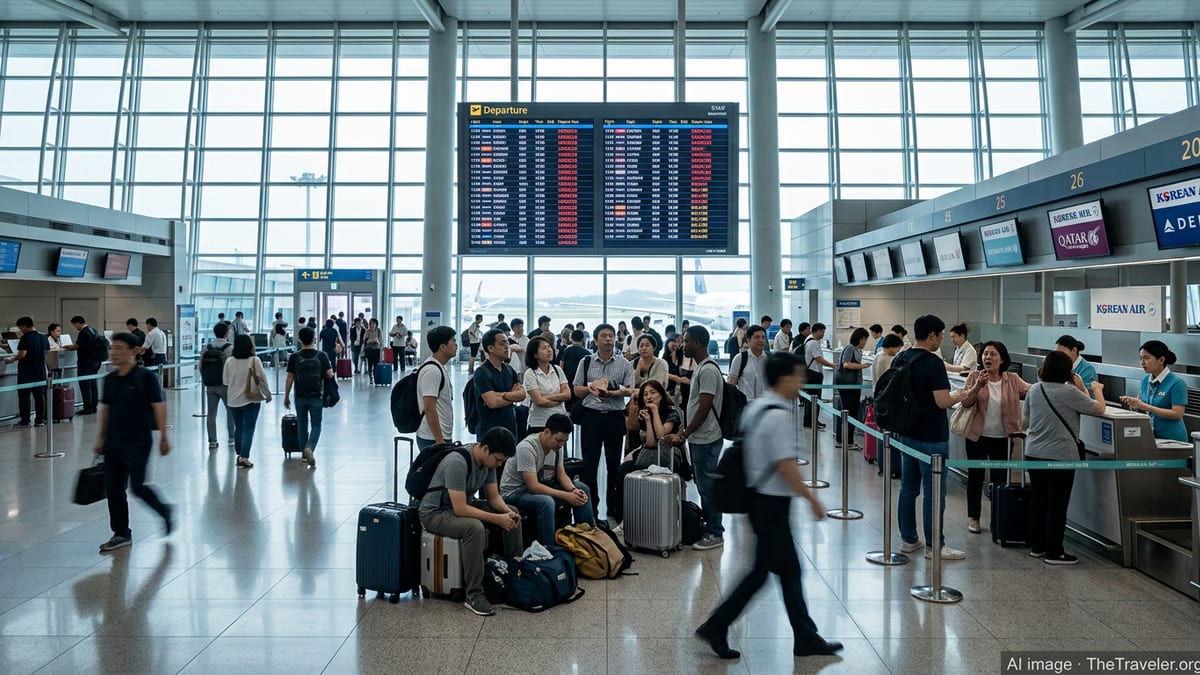
Limited Schedules and Cancellations Hit Major Korean Gateways
South Korea’s main international gateway, Incheon International Airport near Seoul, is bearing the brunt of the latest wave of cancellations and service cuts, with both Korean and foreign carriers trimming frequencies or scrubbing individual departures. Industry trackers and airport schedule data on March 10 show a series of short notice cancellations and downgraded operations on routes that normally carry heavy business and leisure traffic into the country.
Korean Air has quietly withdrawn or consolidated a number of domestic and regional flights, particularly on high frequency sectors between Seoul and Busan, Jeju and other Korean cities. Several of these flights are marketed under codeshare agreements with Delta Air Lines and other partners, meaning passengers booked with US or European carriers can find their itineraries disrupted even if their ticket is not on Korean Air stock. Real time status boards on Tuesday highlighted gaps in the usual shuttle pattern on Seoul Busan and Seoul Jeju routes, with some flights removed from sale or listed as canceled.
Jeju, a key leisure destination for Korean and international travelers, has also seen its schedule trimmed. Low cost brands such as Jeju Air, Air Busan and Air Seoul, which funnel passengers into Incheon and Gimpo for long haul onward connections, have reduced or reshuffled flights as they respond to safety reviews, maintenance checks and the wider downturn in regional demand. For travelers planning tight domestic connections into long haul departures from Incheon, these last minute changes are creating fresh uncertainty.
In Busan, South Korea’s second largest city, cancellations and aircraft swaps are affecting both intra Korea services and international links. Some Korean Air operated flights from Busan to Seoul are being consolidated, with passengers shifted onto fewer departures and warned to expect congested check in counters and longer queues at Gimhae Airport. The disruption is being compounded by rolling schedule changes that often appear only a day or two before departure.
Qatar Airways Cuts Deep Into Doha Seoul and Beyond
The most visible long haul disruption connected to South Korea involves Qatar Airways, which continues to operate only a limited schedule into and out of Doha after an airspace closure in the Gulf region upended its global network this month. The carrier has publicly confirmed a sharply reduced roster of relief flights through at least March 12, including a single daily service linking Doha and Seoul Incheon on certain days instead of its usual multi daily operation.
This has had a knock on effect across the airline’s extensive Asian and North American network. Passengers booked on itineraries from Seoul or Busan to destinations such as Seattle, Dallas, Toronto or European capitals via Doha are finding their flights canceled or heavily retimed, with many being offered seats days later than originally planned. Travel agents report that some Koreans returning from the Middle East have been stranded in Doha for days as they wait for scarce seats on the reduced services back to Incheon.
On Monday and Tuesday, Qatar Airways confirmed it would continue to prioritize so called relief flights on trunk routes including Doha to Seoul, Bangkok, Kuala Lumpur and several major European and North American cities, while warning that capacity will remain significantly below normal. Passengers are being urged to monitor their booking status frequently, as flights that appear “scheduled” on global distribution systems may still be subject to late cancellation depending on airspace restrictions and operational conditions.
The situation has created a complex web of rebookings for South Korea bound travelers. Some are being rerouted by Qatar Airways onto partner airlines operating over alternative hubs in East Asia, while others are choosing to cancel and rebook altogether on competing carriers through Seoul, Tokyo or other transit points. With the Middle East security outlook still volatile, airlines and governments are advising that the disruption could last for several more weeks.
Delta and Transpacific Travelers Feel the Ripple Effects
Delta Air Lines, which operates its own flights between the United States and Seoul and also relies heavily on its joint venture with Korean Air, is seeing its customers caught up in the turmoil even where Delta aircraft are still operating as scheduled. Many Delta coded services within Asia, and some onward connections from Incheon to destinations such as Guam or regional Japanese cities, are actually operated by Korean Air metal. When Korean Air cancels or consolidates these flights, Delta passengers can suddenly find a key link in their itinerary removed.
Transpacific routes between Seoul and cities including Seattle, Minneapolis and Atlanta remain broadly intact, but are subject to schedule adjustments and occasional last minute equipment changes as airlines juggle fleets to cover disrupted segments elsewhere. For instance, aircraft that might normally be assigned to Seoul Seattle rotations can be redeployed to absorb demand on alternative routes when Middle East connections fall away. Travel advisers say that while outright cancellations on the core US Korea nonstops remain limited, travelers should brace for irregular operations, including delays and rebookings onto partner airlines.
On the US West Coast, Seattle Tacoma International Airport is seeing a particular concentration of affected itineraries because of its role as a hub for both Delta and other carriers that feed traffic onto Korean Air and alternative transpacific links. Some passengers who were originally booked to travel between North America and South Korea via Doha on Qatar Airways are now being rerouted through Seoul or Seattle, adding extra connections and travel time. Others are opting to bypass the Middle East altogether and rebook entirely on transpacific options operated by Korean Air, Delta or competing Asian airlines.
Guam, which depends heavily on air links from South Korea and Japan for its tourism industry, is another notable pressure point. Reduced frequencies from Korean carriers, combined with cancellations and aircraft substitutions, have made it harder for Korean travelers to secure reliable itineraries to and from the island. Industry observers warn that if disruptions in the wider region continue, Guam’s visitor arrivals from South Korea could soften further in the coming weeks.
What Affected Travelers Need to Do Right Now
For travelers with imminent departures touching South Korea, Doha or any of the impacted hubs, the most urgent step is to confirm the real time status of every individual flight segment rather than relying on an original booking confirmation. Airlines including Korean Air, Qatar Airways and Delta are updating their schedules frequently, and routes that look normal several days out can still be cut or retimed within 24 to 48 hours of departure.
Passengers on itineraries involving codeshares should pay particular attention. A flight marketed with a Delta or other foreign carrier code may in reality be operated by Korean Air or another regional airline whose schedule has been reduced. In those cases, only the operating carrier’s latest update reflects the true status of the service. Travel agents recommend checking both the marketing airline and the operating airline’s tools, and enabling alerts in mobile apps where available.
Where flights have already been canceled, most airlines are offering a mix of free date changes, rerouting on alternative services where capacity allows, and refunds in cases where no reasonable alternative is available. Policies vary by carrier and fare type, so travelers are being urged to review the latest waiver conditions and to document all communication with airlines and intermediaries. Given the scale of the disruption, call center wait times remain long, and some passengers report more success contacting airlines through local offices or social media channels.
Looking ahead, industry analysts say it may take several weeks for schedules to stabilize across the South Korea Middle East and transpacific markets. Until then, travelers planning journeys through Seoul, Busan, Jeju, Incheon, Doha, Seattle or Guam are being advised to build in longer connection times, stay flexible on dates where possible and avoid making nonrefundable ground arrangements that depend on tight flight connections.