

More news on this day
Hundreds of passengers were left stranded across the United Arab Emirates, Egypt, Afghanistan and neighboring countries this week as a cluster of regional carriers canceled 12 flights and delayed at least 17 more, disrupting travel through key hubs in Abu Dhabi, Cairo, Kabul and beyond.
Get the latest news straight to your inbox!
Wave of Disruptions Hits Abu Dhabi, Cairo and Kabul
Published coverage from aviation and travel outlets indicates that Royal Jordanian (RJA), EgyptAir (often abbreviated MSR in industry schedules) and flydubai (FDB) were among the carriers affected as regional airspace restrictions and operational constraints forced a new round of cancellations. These latest schedule cuts followed weeks of instability in Middle Eastern skies that have already led to thousands of disrupted journeys.
Abu Dhabi and Cairo, two of the region’s busiest transfer points, again featured prominently in the disruption data. Travel trade reporting for early April highlighted clusters of cancellations and extended delays on flights linking these hubs with destinations across the Gulf, North Africa and South Asia, including services to and from Kabul that are particularly exposed to changing security and overflight conditions.
At Kabul’s airport, delay statistics compiled by aviation trackers showed a pattern of late and retimed departures on regional services, including those routed via Gulf and Egyptian hubs. When even a limited number of departures are canceled outright, the knock-on effect can leave passengers waiting many hours for the next available seat on alternative routings.
The combined impact of 12 outright cancellations and 17 delayed flights may appear modest compared with earlier mass groundings, yet analysts note that these incidents are landing on an already stretched system, where reduced schedules and fragile routing options leave little slack to absorb fresh shocks.
Royal Jordanian, EgyptAir and flydubai Grapple With Volatile Airspace
Publicly available airline notices and industry summaries show that Royal Jordanian has been operating under varying degrees of constraint since widespread airspace closures began affecting Jordan and several neighboring states in late February and early March. The carrier has warned customers to expect schedule changes on routes touching conflict-adjacent airspace, including services that rely on Abu Dhabi and Cairo for onward connectivity.
EgyptAir, designated by the code MSR, has taken a similarly cautious approach. Reporting from Egyptian media in March detailed how the airline initially pulled back from multiple routes to the United Arab Emirates, then began a phased restoration of services to Abu Dhabi and other Emirati cities as conditions allowed. The gradual nature of that resumption underscores how quickly fresh security alerts or overflight restrictions can trigger renewed cancellations.
Flydubai, known by its code FDB, has been recalibrating its network around both operational and regulatory limitations. The carrier’s public operational updates in recent weeks have pointed to a patchwork of resumptions and suspensions, from temporary halts on European routes linked to airport works to reduced frequencies across parts of the Middle East. Kabul has been a particular focus in earlier disruption summaries, where flydubai’s flights have been cited among services facing extended irregular operations.
For passengers, the different commercial and regulatory environments in which these airlines operate can translate into varied options for rebooking, refunds or re-routing. Some carriers have expanded fee waivers and flexibility windows, according to travel agency advisories, while others continue to handle changes more narrowly on a case by case basis when flights are delayed rather than canceled.
Knock-on Effects Across Regional and Long Haul Networks
Travel industry reporting this week stresses that the cancellations and delays at Abu Dhabi, Cairo and Kabul are rippling far beyond the immediate region. With Abu Dhabi and Cairo serving as connection points between Europe, Africa, Asia and North America, a single canceled leg can unravel complex itineraries, leaving travelers out of position for later long haul segments.
Data compiled by specialist aviation outlets for early April highlighted several hundred delays and more than a dozen cancellations in a single day across major Middle Eastern airports, including Cairo and Dubai, with secondary hubs such as Abu Dhabi and Kuwait City also affected. While many of these disruptions involved other airlines, they illustrate the network-wide fragility into which the latest RJA, MSR and FDB schedule cuts have landed.
Passengers traveling onward to cities as far apart as Paris, Amsterdam, Jeddah and Mumbai have reported, through public forums and local media accounts, missed connections after initial flights from Abu Dhabi, Cairo or Kabul departed late or were withdrawn from the schedule. Even when airlines are able to rebook customers on later departures, capacity constraints on already reduced schedules can mean waits of 24 hours or more.
The situation is made more complex by ongoing airspace restrictions over several countries in the wider region. These limitations force airlines to adopt longer routings that burn more fuel and reduce the number of daily rotations crews and aircraft can realistically operate, leaving networks less able to bounce back quickly once irregular operations begin.
Travelers Face Uncertainty as Recovery Remains Uneven
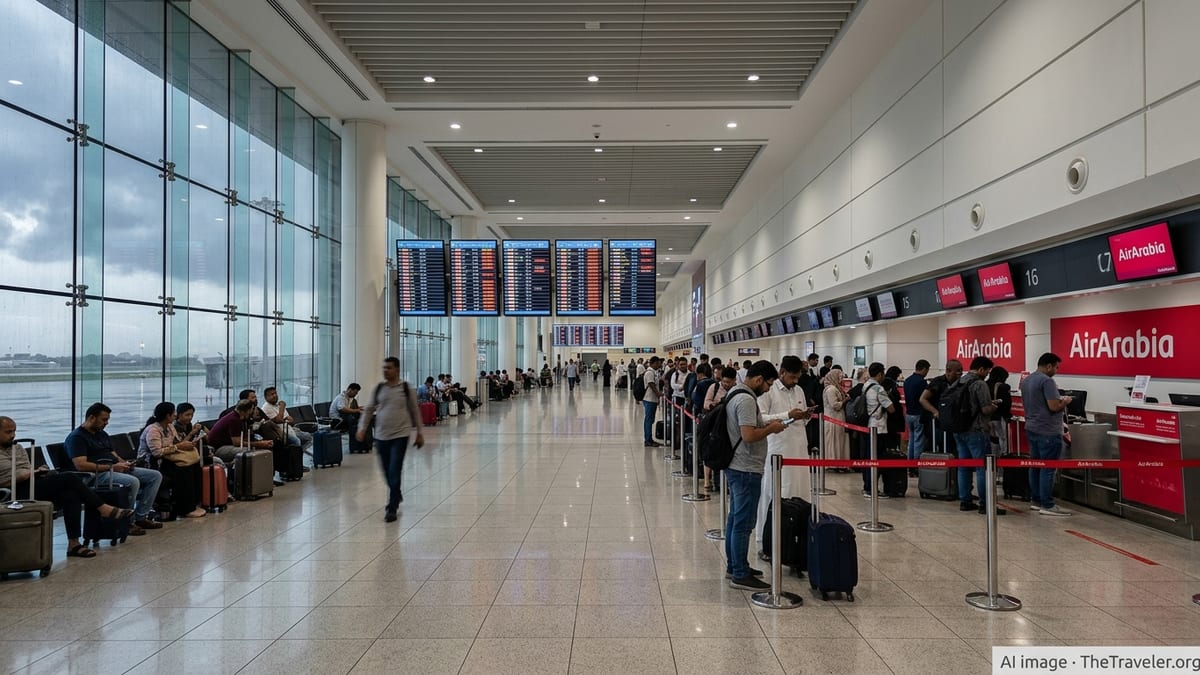
For many travelers, the immediate impact of the latest cancellations and delays is felt in crowded terminals and shifting departure boards. Publicly available footage and written accounts from recent weeks describe passengers sleeping in airport seating areas, queuing for rebooking assistance and refreshing mobile apps for updated departure times at Abu Dhabi and Cairo in particular.
Aviation analysts cited in regional coverage suggest that the pattern now emerging is one of rolling, localized disruptions rather than a single, time limited shutdown. Airlines such as Royal Jordanian, EgyptAir and flydubai may announce limited resumptions on key routes one week, only to retreat or trim frequencies the next as security assessments or airspace permissions change.
This volatility complicates planning for both leisure and business travelers, especially those connecting through hubs like Abu Dhabi to reach destinations in Europe or North America, or using Cairo and Kabul as gateways to Africa or Central Asia. Travel advisers have increasingly recommended building in longer connection windows and considering flexible or refundable fares, even when base ticket prices are higher.
With regional conditions still fluid, industry observers note that further short notice cancellations or extended delays cannot be ruled out. For now, the passengers stranded by the latest set of grounded and late running flights across the UAE, Egypt and Afghanistan are an acute illustration of how even a relatively small number of disrupted services can cascade through a region where aviation remains on edge.