

More news on this day
Air travel across Australia has been thrown into renewed turmoil as widespread delays and cancellations at Sydney, Melbourne, Brisbane, and Canberra airports stranded more than 30,000 passengers and disrupted both domestic and international airline operations.
Get the latest news straight to your inbox!
Major Hubs Struggle As Disruptions Cascade Nationwide
Reports from aviation data trackers and local media indicate that more than 160 flights were delayed or cancelled in a single day across Australia’s east coast network, centering on Sydney, Melbourne, Brisbane, and Canberra. The disruption has rippled through connecting services, magnifying the impact well beyond the four cities.
At Sydney and Melbourne, where domestic and international operations are closely intertwined, ground delays quickly translated into missed departure slots and rolling schedule changes. Brisbane and Canberra, which handle a mix of business and leisure traffic, experienced sharp spikes in queues at check in, security, and boarding as airlines attempted to re accommodate passengers onto later services.
Publicly available flight boards showed waves of delayed services across the morning peak and into the afternoon, with cancellations clustering on high frequency domestic routes such as Sydney to Melbourne, Sydney to Brisbane, and Canberra connections into the larger hubs. The peak hour congestion left many travelers waiting hours for information and alternative options.
Travel industry analysts note that Australia’s tightly timed east coast corridor is particularly vulnerable once disruptions reach a certain scale. Aircraft and crews are cycled through multiple sectors per day, so a cancelled or heavily delayed early flight can reverberate through the schedule, affecting passengers who are nowhere near the original problem airport.
Qantas, Virgin and Partner Airlines Hit on Key Routes
According to published coverage and live tracking data, flagship carrier Qantas and rival Virgin Australia have borne the brunt of the disruption, alongside their low cost and codeshare partners. Domestic sectors on Boeing 737 and Airbus A320 family aircraft have been especially affected, as these jets operate many of the country’s busiest city pairs.
Services linking Sydney and Melbourne, one of the world’s most heavily trafficked routes, experienced some of the highest concentrations of delays and cancellations. Brisbane connections to both cities also saw repeated pushbacks and aircraft swaps as carriers attempted to keep at least part of their schedules moving.
International operations have not been spared. Long haul and regional flights routed through the affected hubs, including services operated in partnership with overseas carriers, faced departure delays and missed connections. Passengers flying onward to destinations in Asia, the Pacific, North America, and Europe were among those stranded after missing tightly timed transfers.
Publicly available timetable information shows that even a small cluster of cancellations on trunk domestic legs can undermine the complex web of onward connections. With many overseas flights departing late evening, delays of several hours on earlier domestic segments can make it impossible for travelers to reach their international gates in time.
More Than 30,000 Passengers Facing Long Queues and Limited Options
Estimates drawn from typical passenger loads on narrow body aircraft suggest that the 164 or more delayed and cancelled flights could equate to well over 30,000 affected travelers across the network. Many have been forced to rebook for later in the day or even on subsequent dates where seats allow.
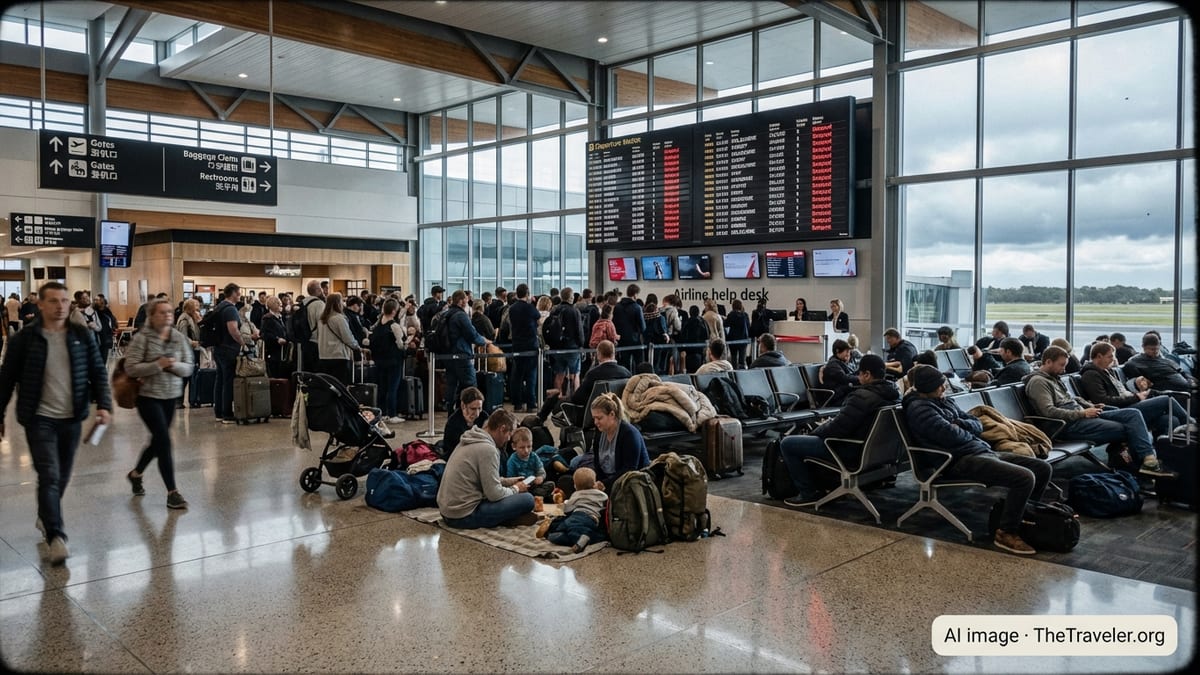
Scenes described in local reporting and social media posts show crowded terminal halls, with lines stretching from check in counters through to customer service desks as travelers sought new itineraries, meal vouchers, or accommodation. Families beginning school holiday trips, business travelers on tight schedules, and international visitors all appeared caught up in the disruption.
For some passengers, missed connections mean extended unplanned stays in gateway cities, with hotel availability and last minute prices emerging as additional challenges. Others have opted to switch modes on shorter routes, turning to interstate rail or long distance coaches between Canberra, Sydney, and regional centres to avoid the uncertainty of getting a standby seat.
Consumer advocates point out that while airlines typically provide rebooking assistance and, in some circumstances, care and support on the ground, heavily disrupted days can stretch these systems close to breaking point. Travelers are being urged to keep all receipts and documentation related to the disruption in case they are eligible for refunds or partial compensation under fare rules or local regulations.
Weather, System Strain and a Stretched Aviation Network
While the precise trigger for the current wave of delays and cancellations varies by service and carrier, the pattern fits a broader trend of strain in Australia’s aviation network. Recent official monitoring reports have highlighted elevated cancellation and delay rates on busy east coast routes over the past two years, particularly during periods of adverse weather or peak demand.
Strong winds, low cloud, and fog at Sydney or Canberra can significantly reduce runway capacity, forcing air traffic controllers to slow arrivals and departures. That in turn compels airlines to trim schedules at short notice, often within the seven day window that classifies a change as a cancellation for reporting purposes.
In parallel, the industry is still managing the aftershocks of the pandemic era, including staffing bottlenecks among pilots, cabin crew, engineers, and ground handlers. Even as passenger volumes have recovered and in some cases surpassed 2019 levels, additional aircraft and trained crews have not always kept pace, leaving little margin when operational pressures mount.
Analysts have also drawn connections between recent global technology outages affecting airlines and airports and the vulnerability of modern aviation to IT disruptions. While the latest Australian event appears driven primarily by local operational factors, the broader context underlines how quickly disruptions can escalate when multiple stressors converge.
What Travelers Can Do If They Are Affected
Travel advisers note that passengers holding tickets on affected airlines should first check their flight status via official airline apps or airport departure boards before heading to the airport. Many carriers are enabling free same day changes or waiving some fees for those booked on disrupted services, although specific options depend on the fare purchased and seat availability.
Where possible, travelers are encouraged to accept rebooking onto the next available flight, even if it departs from a nearby alternative airport, in order to secure a confirmed seat. For those who no longer wish to travel, some fare types may allow credit vouchers or partial refunds, but conditions vary widely between airlines and ticket classes.
Passengers connecting to international flights face additional complexity, particularly when separate tickets or multiple airlines are involved. In such cases, customer advocates recommend contacting all relevant airlines as soon as a delay becomes apparent, documenting all interactions, and exploring travel insurance coverage where applicable.
With further knock on disruptions possible as airlines work to reset schedules over coming days, regular checks of itineraries and flexible planning remain essential for anyone flying in or out of Sydney, Melbourne, Brisbane, or Canberra in the near term.