

More news on this day
Fresh rounds of delays and cancellations across China’s largest airports are stranding passengers in growing numbers, as a dense domestic network collides with spring weather, tight slot controls and lingering operational bottlenecks.
Get the latest news straight to your inbox!
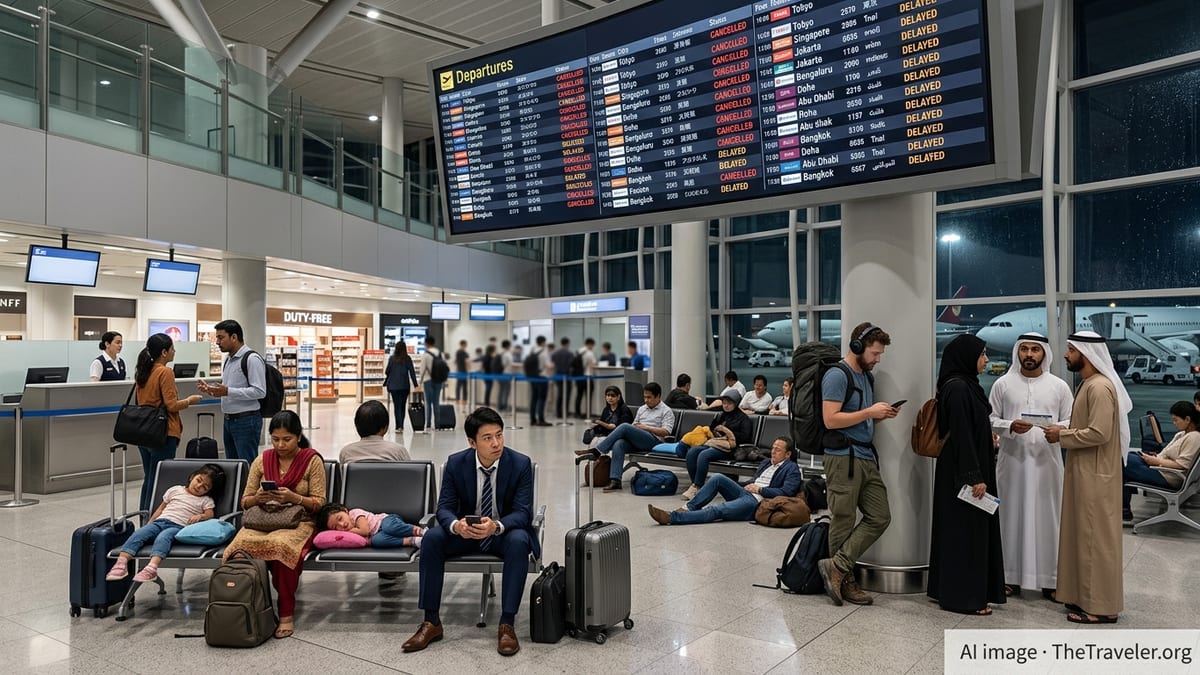
Wave of Disruptions Hits Key Chinese Gateways
Recent flight-tracking data and published coverage indicate that China’s main aviation gateways have entered another turbulent period, with disruption concentrated at large coastal and inland hubs such as Beijing, Shanghai, Guangzhou, Shenzhen, Chengdu and Kunming. Aggregated data cited by travel industry outlets and aviation analysts for early April show more than 1,500 flights delayed and over 100 canceled in China alone over a short span, contributing to packed departure halls and missed connections across the country.
Reports highlight Beijing’s dual-airport system as a particular pressure point. Beijing Daxing International Airport has faced a “domestic travel crisis,” with clusters of cancellations and cascading delays affecting connections to cities including Shenyang, Chengdu, Guangzhou and Kunming. At the same time, Beijing Capital International continues to shoulder significant legacy traffic, meaning even isolated technical or staffing issues can ripple across large portions of the national network.
In southern China, congestion at Shenzhen and Guangzhou has been amplified by adverse weather conditions affecting visibility and runway capacity on some days. Regional coverage describes thunderstorms and fog contributing to slowdowns at these already busy hubs, feeding into a wider Asia Pacific pattern of disruption that also affects airports in Japan, South Korea, India and Singapore.
Smaller but strategically important hubs have not been spared. Travel-focused outlets report that airports in Nanjing, Changsha and Chengdu have all recently registered clusters of cancellations and delays, compounding the difficulties for passengers trying to bypass the largest gateways in favor of secondary cities.
From Isolated Delays to Systemic Gridlock
While the number of outright cancellations on some days appears modest compared with total scheduled movements, aviation analysts point out that even a few dozen lost rotations can create systemwide headaches in China’s tightly woven network. Recent tallies show, for example, more than 40 cancellations and 150 delays in a single period across carriers such as China Eastern, Air China, XiamenAir and Hainan Airlines, affecting operations at Shanghai, Beijing, Nanjing, Chengdu and Changsha.
Industry commentary notes that domestic schedules have been rebuilt aggressively since the peak of the pandemic, leaving limited slack in aircraft and crew deployment. In this environment, an initial disruption at a hub airport can rapidly evolve into a rolling wave of missed slots, duty-time constraints and aircraft positioning challenges, with each missed departure further eroding the system’s ability to recover.
Regional data from late March and early April across Asia Pacific underline the scale of the challenge. Several recent days have seen more than 3,000 flights delayed and well over 100 canceled in the broader region, with China frequently identified among the hardest-hit markets. Analysts describe the pattern as a symptom of underlying structural strain, where air traffic growth, infrastructure constraints and weather volatility combine to test hub operations.
Some aviation specialists argue that regulatory frameworks have not entirely kept pace with this new reality. Public commentary referencing Civil Aviation Administration of China policies has called for faster progress on measures such as slot-swapping reforms, which could give airlines greater flexibility to reroute aircraft and crews when delays begin to cascade.
Passenger Experience in Overstretched Terminals
For travelers on the ground, the statistics translate into long queues, scarce information and uncertainty about when journeys will resume. Coverage from travel news platforms describes scenes of crowded concourses at Beijing Daxing, where passengers on multi-leg domestic itineraries have struggled to secure rebookings when a first segment is canceled and onward connections are already full.
At other hubs, particularly in southern China, terminal congestion has reportedly been intensified by adverse weather that slows ground operations and lengthens turnaround times. Passengers waiting inside terminals in cities such as Shenzhen and Guangzhou face rotating waves of delay notifications as thunderstorms or low cloud periodically close runways or restrict approach paths.
Observers note that China’s newer mega-hubs can pose additional challenges for stranded travelers simply because of their scale and location. Beijing Daxing, situated outside the city core and designed as a vast transfer facility, can leave passengers facing extended journeys back into town if they abandon their trips, while those who stay may contend with fatigue from repeatedly moving between check in, transfer and customer service areas.
Publicly available advice from consumer advocates and travel industry experts emphasizes the importance of documentation in such situations. Passengers are urged to retain boarding passes and request formal delay or cancellation certificates from carriers, which can support later claims with insurers or, in some jurisdictions, compensation and reimbursement processes.
Knock On Effects for Regional and International Travel
The current disruption inside China is spilling beyond its borders, complicating travel patterns across Asia Pacific and on some long haul routes. Reports from regional aviation trackers show that on days when storms or operational issues hit Chinese hubs, neighboring airports in Japan, South Korea, India, Southeast Asia and the Middle East quickly feel the impact as missed connections and equipment shortages propagate through shared networks.
Data compiled by specialized flight analytics platforms in early April point to several days where more than 3,600 flights were delayed and hundreds canceled across major Asia Pacific hubs, with Shenzhen and Guangzhou identified among the heaviest affected. When departures from these Chinese hubs cannot operate on time, onward services from transit points such as Tokyo, Seoul, Singapore and Delhi may depart with large numbers of no show passengers or require last minute rebooking efforts.
International itineraries that rely on domestic Chinese feeder flights are particularly vulnerable. If a traveler cannot reach a coastal gateway like Shanghai or Guangzhou in time for an overnight long haul departure, there may be no same day alternative, forcing unplanned overnight stays and costly itinerary changes. Financial analysis from travel and finance publications has warned that repeated episodes of mass disruption could ultimately push up regional fares as airlines attempt to recover higher operating and disruption management costs.
The ongoing recovery in outbound Chinese tourism also hangs in the balance. While passenger numbers have climbed compared with pandemic-era lows, repeated episodes of large scale delay and cancellation risk undermining traveler confidence, especially among those planning complex multi country itineraries that depend on reliable domestic feeder flights.
How Travelers Are Adapting to Continued Uncertainty
In response to the latest turbulence, travel planners and consumer advocates are updating their guidance for itineraries involving Chinese hubs. Recommendations circulating through public advisories and travel media encourage passengers to build longer connection buffers, especially during peak travel periods or seasons associated with convective storms and heavy fog.
Travel agencies and corporate travel managers are also revisiting routing strategies. Some are shifting higher value or time sensitive travelers to flights that minimize dependence on multiple domestic segments within China, favoring nonstop or single connect options where feasible. Others are spreading risk by using a mix of hubs so that disruption at one airport does not strand entire groups.
At the same time, there is growing attention to passenger rights and support frameworks. International coverage of recent Asia Pacific disruption has highlighted the varying levels of protection available depending on where a journey originates and which carriers are involved. Travelers departing from European airports, for example, may have access to compensation rules that do not apply on purely domestic Chinese itineraries, underscoring the importance of understanding the regulatory landscape before departure.
With weather volatility, infrastructure constraints and complex geopolitics all feeding into Asia’s aviation system in 2026, industry observers widely expect further episodes of disruption through the year. For now, China’s latest wave of flight chaos is serving as a stress test for airlines, regulators and passengers alike, revealing how fragile even the most modern hub networks can be when multiple pressures collide.