

More news on this day
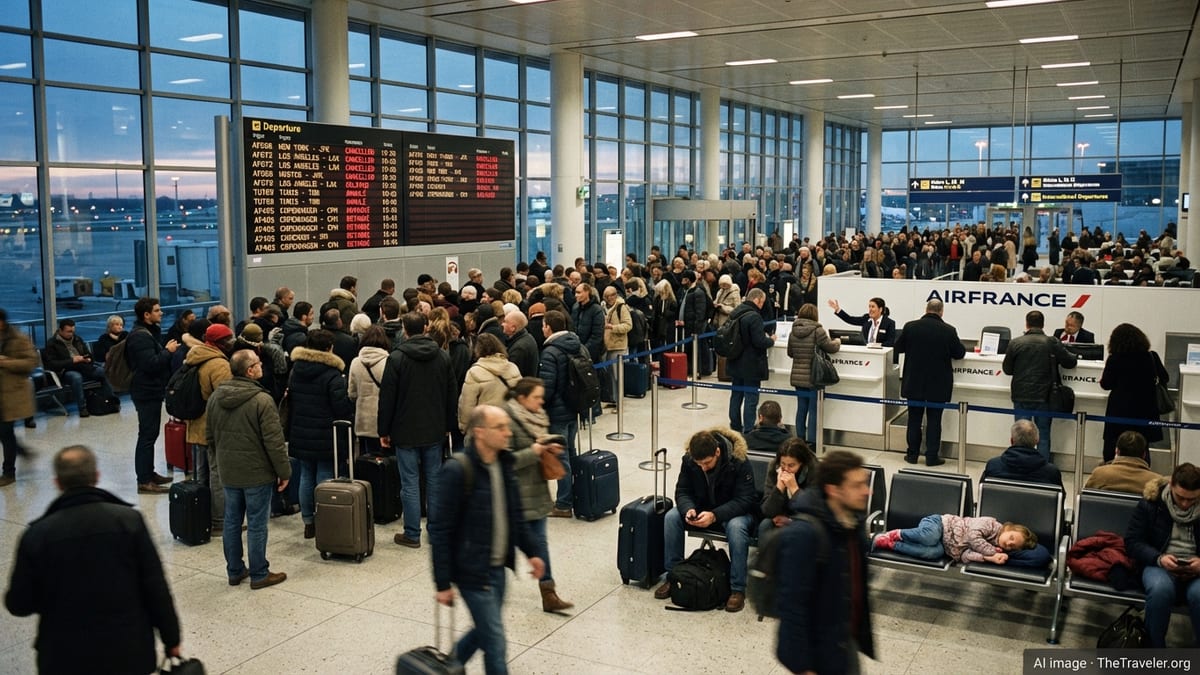
Hundreds of travellers across France faced long queues, rolling delay estimates and missed connections today as major hubs in Paris, Lyon, Marseille and Nice collectively logged 538 delayed flights and 21 cancellations, disrupting operations at Air France, Vueling, Transavia France, Lufthansa, Ryanair and several other carriers.
Get the latest news straight to your inbox!
Major French Hubs Grapple With Knock-On Disruptions
Publicly available flight tracking data for Sunday, 12 April 2026 indicates a significant build-up of delays at Paris Charles de Gaulle and Paris Orly, with disruption quickly rippling into regional gateways at Lyon Saint-Exupéry, Marseille Provence and Nice Côte d’Azur. The four airports together registered 538 delayed departures and arrivals, alongside 21 cancelled services, affecting both domestic and international routes.
Reports indicate that the pattern has been delay-heavy rather than cancellation-driven, mirroring disruption trends seen at major airports in North America and Canada in recent days. Airlines largely kept their schedules in place but struggled to operate flights on time, creating long waiting times in terminals and complicating connections for passengers using Paris as an intercontinental transfer hub.
While no single cause has been identified for today’s disruption, recent coverage of operations in France has highlighted a combination of air traffic control staffing constraints, airline crew availability, and seasonal weather systems as recurring pressure points. These factors frequently interact, turning minor timetable slippage into large waves of late-running services across the network.
The timing of today’s delays, arriving at the start of the busy spring travel period, raised particular concern for travellers heading to and from France for holidays and major events. Crowded departure halls, lines at security and customer service counters, and uncertainty around departure times were widely reported by passenger-tracking dashboards and aviation monitoring platforms.
Air France, Vueling, Transavia France And Partners Hit Hard
The disruption has been felt most acutely by carriers with dense short-haul networks in and out of France. Air France and its low-cost subsidiary Transavia France saw a series of delayed rotations on core domestic links between Paris and cities such as Lyon, Marseille and Nice, as well as on popular leisure routes to Spain, Portugal and North Africa.
Published operational summaries show that Vueling, Lufthansa, Ryanair and other European airlines operating into French territory also faced late-running services, particularly on cross-border routes linking France with major hubs in Germany, Italy, Spain and the United Kingdom. In many cases, delays in France then fed into onward networks, creating further knock-on effects for passengers connecting beyond Europe.
For Air France, which recently restructured parts of its domestic operation around Paris Charles de Gaulle and its Transavia France arm, today’s disruption underscores the continued fragility of tightly timed short-haul schedules. Even modest delays on morning departures can cascade through the day as aircraft and crews rotate through multiple French cities.
Low-cost carriers such as Ryanair and Vueling, which typically schedule fast turnarounds at congested airports, faced similar pressure. When arrival delays collide with constrained ground handling capacity, aircraft can be held at gates longer than planned, limiting flexibility to recover punctuality later in the day.
Passengers Face Long Queues, Missed Connections And Rebookings
Across the affected airports, passengers encountered the familiar hallmarks of a delay-heavy operating day: crowded check-in zones, extended waits at security, and departure boards filled with rolling estimates. At Paris Charles de Gaulle in particular, the volume of disrupted flights complicated onward travel for long-haul passengers connecting from Europe to Africa, Asia and the Americas.
According to consumer-facing flight-status platforms, some travellers arriving late into Paris, Lyon, Marseille and Nice missed onward connections and were forced to seek rebooking onto later services. Accommodation and meal vouchers depended on individual airline policies and whether disruptions were classified as extraordinary circumstances or operational issues.
Travel industry guidance continues to stress that passengers should check airline apps and airport information screens frequently on days with elevated disruption, as estimated departure times can change multiple times. Many airlines, including major European network carriers, have expanded use of digital notifications to alert passengers to gate changes, rebookings and refund eligibility where applicable.
EU261 rules remain an important framework for passengers departing from or arriving in the European Union with an EU carrier. Under that regulation, travellers may be entitled to care, re-routing or financial compensation depending on the length of delay, distance flown and the underlying cause of the disruption. However, each case is assessed individually, and weather or air traffic control restrictions can limit compensation options even when delays are lengthy.
France’s Air Network Under Sustained Operational Strain
Today’s disruption comes against a backdrop of recurring strain across France’s air transport system during the current travel season. Earlier in April, industry-focused reporting documented sizeable numbers of delayed and cancelled flights at Charles de Gaulle, Orly and Nice on several days, linked to a mixture of staffing constraints and unsettled weather patterns across Western Europe.
The dense mesh of domestic and short-haul European routes that converge on Paris, Lyon, Marseille and Nice makes the French network particularly vulnerable to knock-on effects. Aircraft operating a morning flight from one regional city may be scheduled to continue on to another destination after a short turnaround; any delay to the first leg can reverberate through the rest of the aircraft’s day.
Analysts also note that the gradual shift of some domestic routes from full-service carriers to low-cost subsidiaries creates both opportunities and challenges. While simplified operations and higher seat density can improve efficiency, point-to-point low-cost networks often have fewer built-in buffers and backup aircraft, making it harder to absorb disruption when something goes wrong.
Internationally, today’s problems in France form part of a wider pattern of congestion and delay observed across global aviation hubs. Recent travel-industry reports have highlighted similar spikes in late-running flights at major airports in the United States, Canada and Germany, suggesting that staffing, infrastructure and weather-related challenges remain widespread as demand for air travel stays high.
What Travellers Can Do If Flying To Or From France
With delays and a smaller number of cancellations affecting hundreds of flights, travel advisers are urging passengers scheduled to fly to or from France to adopt a cautious approach. The most consistent recommendations are to monitor flight status regularly via official airline channels, arrive at the airport earlier than usual during peak periods, and build generous connection times into itineraries that transit through French hubs.
Passengers already affected by today’s disruption are being guided, through publicly available airline information, to request rebooking on the next available flight or to explore refund options where travel is no longer practical. Many European and international airlines now allow certain changes to be processed online or through mobile apps, reducing the need to queue at airport service desks.
For future trips, consumer rights organisations often suggest booking longer layovers when connecting through busy hubs such as Paris Charles de Gaulle, especially during seasons when weather or industrial action are more likely. They also highlight the value of travel insurance policies that explicitly cover delays, missed connections and additional accommodation costs.
As French airports work through today’s backlog, operational data over the coming days will show whether the network can return quickly to normal or whether further waves of delay will continue to affect travellers across Paris, Lyon, Marseille, Nice and beyond.