

More news on this day
Domestic air travel across Japan faced major disruption today as publicly available data showed 1,142 flights delayed and at least 20 cancelled across key hubs including Osaka, Tokyo, Fukuoka, Miyazaki, Shizuoka, and Aomori, stranding hundreds of passengers and rippling through the networks of All Nippon Airways, Japan Airlines, ANA Wings, Skymark, Solaseed, Oriental Air Bridge, and several smaller carriers.
Get the latest news straight to your inbox!
Major Hubs From Osaka to Tokyo Hit by Systemwide Delays
Operational data and live tracking services on April 4 indicate that Osaka and Tokyo, Japan’s busiest aviation gateways, experienced the brunt of the delays, with a steady build-up of late departures through the morning peak that never fully cleared during the day. As aircraft rotated through tight domestic schedules, even modest hold times accumulated into lengthy knock-on delays affecting routes across Honshu, Kyushu, and northern Japan.
At Tokyo’s Haneda and Narita airports, the dense web of high-frequency shuttles to Fukuoka, Sapporo, and other regional cities left little room to absorb disruption. Flight-tracking dashboards showed departure boards increasingly dominated by late-running services, pushing some aircraft well beyond scheduled turnaround windows and forcing airlines to reshuffle aircraft and crews.
In Osaka, both Itami and Kansai International Airport saw similar congestion, with crowded mid-day departure banks particularly affected. Publicly available schedule comparisons suggest that a large share of the delays accumulated on trunk routes linking Osaka with Tokyo, Fukuoka, and smaller regional airports, amplifying the impact on passengers connecting between domestic services.
Across the two metropolitan areas, the result was a sustained deterioration in on-time performance that left many travelers facing rolling delays, missed connections, and extended waits inside terminals as airlines attempted to re-sequence flights without triggering further cancellations.
Regional Airports From Fukuoka to Aomori Feel the Ripple Effect
The disruption was not confined to Japan’s largest hubs. Fukuoka, one of the country’s busiest regional airports, reported a growing tally of late arrivals and departures as delayed aircraft from Tokyo and Osaka rotated into Kyushu services. This pushed back onward flights to secondary cities and resort destinations, leaving passengers facing uncertain departure times even on routes that were still operating.
Further east, Miyazaki and Shizuoka also experienced extended delays as domestic rotations faltered. These airports rely heavily on timely arrivals from major hubs to feed limited daily services, so even short upstream hold times translated into lengthy waits for passengers at smaller terminals with fewer alternative options.
In northern Japan, Aomori was among the regional airports affected as late-running aircraft from Osaka and Tokyo disrupted tightly sequenced schedules. Publicly available route data shows that such services often operate only a handful of times per day, increasing the risk that a single delayed inbound aircraft can compromise the entire day’s operation on a given route.
Across these regional facilities, the pattern was similar: limited spare capacity, small fleets dedicated to specific city pairs, and crews rostered on narrow time margins combined to magnify delays once they were introduced, contributing to the nationwide total of 1,142 delayed flights.
Multiple Carriers Impacted Across Domestic Networks
The disruption cut across Japan’s competitive domestic airline market. All Nippon Airways and Japan Airlines, which operate the country’s largest domestic fleets and maintain dense shuttle schedules between major cities, accounted for a significant volume of the affected flights. Their regional subsidiaries, including ANA Wings and J-Air, were also heavily exposed as they rely on hub-to-spoke connections from Tokyo and Osaka to serve smaller destinations.
Low-cost and hybrid carriers such as Skymark and Solaseed were caught in the same pattern, with their point-to-point networks intersecting crowded airspace and shared airport infrastructure. Publicly available performance statistics for recent months underline how sensitive these tightly planned operations can be to sudden congestion when aircraft are scheduled for multiple legs per day with minimal buffers.
Smaller regional operators, including Oriental Air Bridge and other niche carriers serving remote islands and coastal communities, were also affected as disrupted handovers at major hubs cascaded into later-than-planned departures on thinly served routes. For passengers relying on these flights for essential travel, the loss or delay of even a single rotation can mean long rebooking times and limited alternatives.
While the precise breakdown of delays by airline was still emerging, aggregated aviation data showed that virtually every major domestic operator in Japan recorded degraded punctuality metrics during the course of the day, demonstrating the interconnected nature of the country’s air transport system.
Limited Cancellations but Extensive Knock-On Disruption
Despite the severity of the disruption, cancellation numbers remained relatively contained compared with the scale of the delays. Publicly available flight statistics for April 4 pointed to at least 20 services being scrubbed outright, a small fraction of the more than one thousand delayed operations nationwide but a significant concern for those passengers who lost their seats entirely.
Aviation analysts note that Japanese carriers often prioritize operating flights with substantial delays rather than cancelling outright, in order to preserve connectivity on key domestic corridors and reposition aircraft for later rotations. That strategy can help limit the number of stranded aircraft and crew but may leave travelers waiting for hours in terminals as airlines work through accumulated backlogs.
For passengers whose flights were cancelled, options depended heavily on route and carrier. On busy trunk routes between Tokyo, Osaka, and Fukuoka, alternative departures were sometimes available later in the day, albeit often fully booked or heavily sold. On thinner routes to airports such as Miyazaki, Shizuoka, and Aomori, same-day rebooking choices were more constrained, particularly for those needing to make onward international connections.
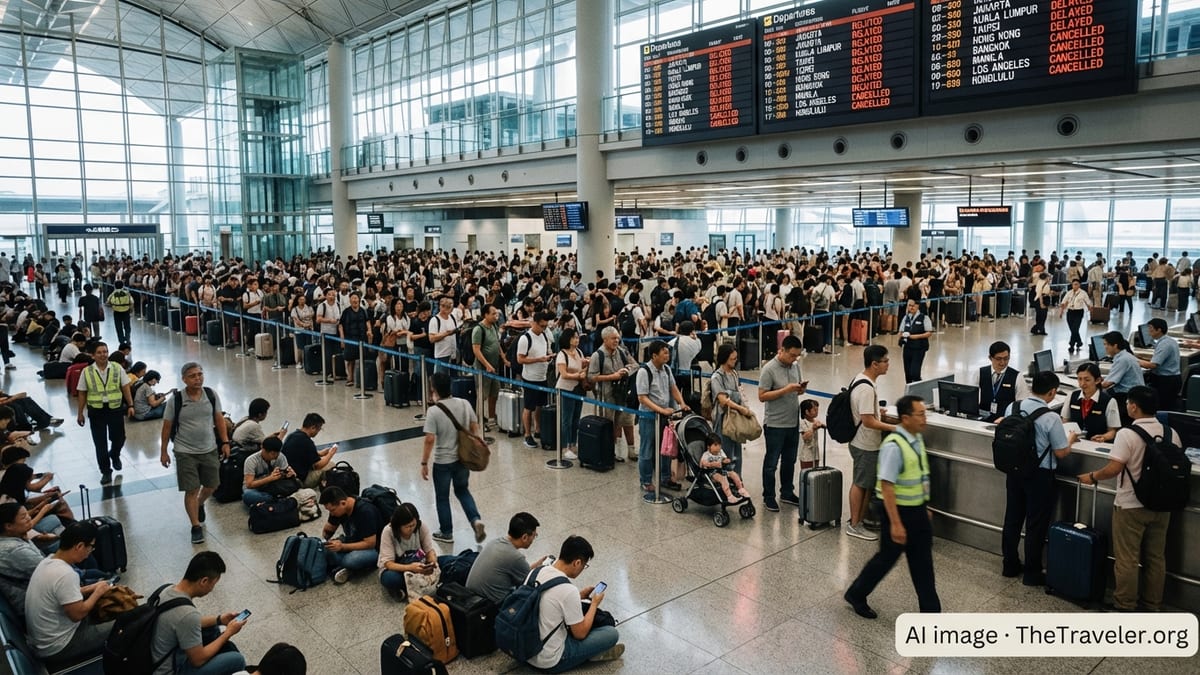
With both delayed and cancelled services feeding into already crowded airports, reports from publicly accessible travel forums described congested check-in areas, long queues at rebooking counters, and growing frustration among travelers attempting to adjust their plans at short notice.
Travelers Urged to Monitor Schedules as Networks Recover
As evening approached in Japan, live tracking services showed incremental improvements in departure punctuality at some airports, but the scale of accumulated delays suggested that knock-on effects could extend into late-night rotations and early-morning departures on April 5. Aircraft and crew displaced by the day’s disruptions are expected to require schedule adjustments before operations can fully normalize.
Publicly available guidance from airlines and aviation portals consistently encourages passengers in such situations to monitor flight information screens, carrier mobile applications, and airport announcements closely on the day of travel. Same-day schedule changes and equipment swaps are common tools used by airlines to recover from systemwide delays, and these adjustments may not be reflected in tickets issued days or weeks earlier.
For travelers with flexible plans, aviation commentators often recommend building additional time into itineraries that rely on domestic connections in Japan, especially during peak seasons when airports in Tokyo, Osaka, and Fukuoka operate near capacity for large portions of the day. The latest disruption illustrates how quickly modest timetable pressure can escalate when multiple hubs experience delays simultaneously.
With 1,142 delayed flights and 20 cancellations recorded across Japan’s domestic network today, the episode serves as a reminder of both the scale and the vulnerability of one of the world’s busiest and most interconnected short-haul aviation markets.