

More news on this day
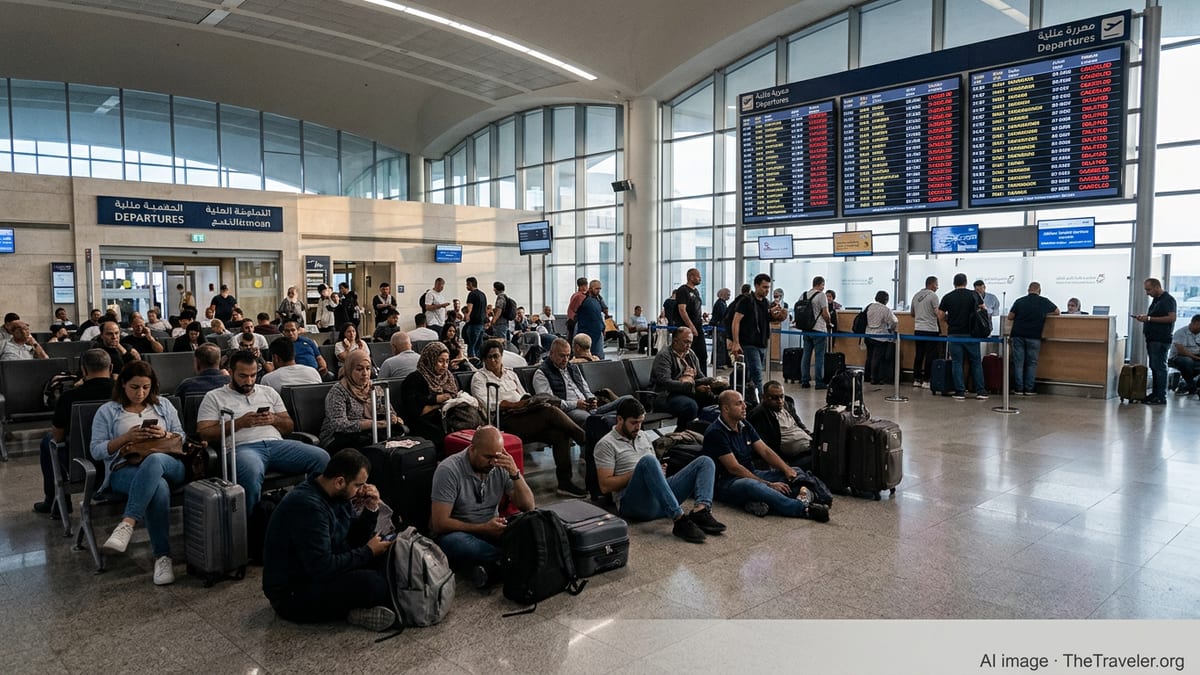
Hundreds of passengers were left stranded at Queen Alia International Airport in Amman on Tuesday as a wave of nine flight delays and 78 cancellations rippled through Royal Jordanian and multiple international carriers, following Jordan’s decision to impose nightly restrictions on its airspace amid escalating regional tensions.
Nightly Airspace Closure Throws Schedules Into Disarray
Jordan’s Civil Aviation Regulatory Commission introduced a partial nightly closure of the country’s airspace beginning Monday evening, suspending all inbound, outbound and transit flights from 6 p.m. to 9 a.m. local time. The measure, described by officials as both temporary and precautionary, is a response to rapidly evolving security conditions across the region and follows a risk assessment carried out under international aviation safety standards.
While authorities stressed that the move is intended to safeguard passengers and crews, the immediate impact was felt most acutely at Queen Alia International Airport, the kingdom’s main gateway. With aircraft grounded or rerouted, departure boards quickly filled with red annotations as Royal Jordanian, regional operators and long-haul carriers from Europe and Asia scrambled to rework their schedules.
By mid-morning on Tuesday, airport sources and airline updates indicated that at least nine flights were officially delayed, while 78 services had been canceled outright across regional and intercontinental routes. The disruption affected both origin-and-destination traffic to Amman and transit passengers who use the airport as a connecting hub between Europe, the Gulf and Asia.
The nightly shutdown followed a weekend in which Jordan had already been operating at reduced capacity, with officials reporting that Queen Alia handled about 120 flights on Sunday, roughly 60 percent of its normal traffic, as several foreign carriers opted to suspend services to the wider region.
Stranded Passengers Face Long Queues and Sparse Information
Inside Queen Alia’s main terminal, the operational decision translated into human drama. Families returning from holidays, business travelers heading to Gulf capitals and students trying to reach European universities found themselves camped out on the polished floors and clustered around charging stations as departure times slipped further into uncertainty.
Many passengers reported long waits at airline service desks, with limited staff struggling to rebook hundreds of disrupted journeys onto a shrinking pool of available seats. With nighttime departures effectively wiped out during the closure window, the remaining daytime flights quickly filled, leaving some travelers told they might not secure an alternative seat for at least 24 to 48 hours.
“The screens just kept changing from ‘on time’ to ‘delayed’ and then ‘canceled,’ and no one could say if we would leave today or tomorrow,” said one traveler attempting to connect from Amman to a major European hub. Others voiced frustration over receiving emails and app notifications about schedule changes only after they had already arrived at the airport to check in.
Airport retailers and food outlets saw an unexpected surge as passengers tried to make the best of the wait, but fatigue was evident among those with young children and elderly relatives. Some travelers opted to leave the airport and seek hotel rooms in Amman, while others, particularly those on tighter budgets or with imminent onward connections, chose to stay in the terminal in case a last-minute seat opened up.
Royal Jordanian and Global Carriers Scramble to Adjust
Royal Jordanian, the national flag carrier and the largest operator at Queen Alia, found itself at the heart of the scheduling turmoil. The airline had said days earlier that its flights were operating normally despite regional tensions, but the subsequent airspace restrictions forced a rapid reassessment of its network. Services to key regional destinations and major European hubs were among those most affected by cancellations and retimings.
International airlines that use Amman as a regional foothold or technical stop also bore the brunt of the changes. Several Gulf, European and Asian carriers had already curtailed operations in the wider Middle East following broader airspace closures and reroutings linked to the latest flare-up between Iran, Israel and the United States. Jordan’s decision to introduce a nightly no-fly window added another layer of complexity to flight planning.
Some airlines opted to consolidate multiple frequencies into a single daytime service, while others rerouted aircraft to alternative hubs, leaving passengers in Amman reliant on tight daytime connections or indirect routings. Aviation analysts noted that widebody aircraft and long-haul routes were particularly vulnerable to disruption, as they typically rely on overnight departure or arrival slots to synchronize with global banked schedules.
Carriers and travel agents reported a sharp uptick in calls and messages from concerned customers seeking clarity on whether upcoming flights would operate. Flexible rebooking policies were rolled out across many networks, offering date changes or refunds, though the immediate challenge remained a shortage of physical seats at peak daytime hours.
Regional Tensions Drive Precautionary Safety Measures
The disruption in Amman is one localized manifestation of a much wider aviation shockwave that has rippled across the Middle East in recent days. Following a large-scale joint attack on Iran by the United States and Israel and subsequent retaliatory strikes on military targets in Israel and several Gulf countries, including Jordan, multiple states in the region either closed their airspace entirely or imposed stringent restrictions.
Regulators and aviation authorities have repeatedly framed these moves as precautionary, aimed at mitigating risk to civilian aircraft from potential missile activity, debris or misidentification amid heightened military operations. Jordan’s nightly closure, while less sweeping than full 24-hour shutdowns elsewhere, effectively removes a critical east-west corridor from airlines’ night-time options and places additional pressure on already congested daytime routes.
Aviation experts say such decisions, while disruptive, follow established international risk-assessment protocols that prioritize safety over commercial or convenience considerations. For Jordan, a country that has sought to position itself as a stable travel and tourism hub, the calculus now involves balancing immediate security imperatives with the need to maintain connectivity and traveler confidence.
Industry observers note that the situation remains fluid. On Tuesday evening, Jordanian authorities announced the reopening of the country’s airspace to civil aviation following a fresh risk review, while warning that operational adjustments and schedule changes would likely continue as airlines recalibrate and as regional dynamics evolve.
What Travelers Through Amman Should Do Next
With airlines still digesting the impact of the nightly closures and subsequent reopening, officials and consumer advocates are urging passengers to be proactive. Travelers booked to fly to, from or through Amman in the coming days are advised to monitor their flight status frequently via airline apps and official channels, as departure times and routings may change at short notice.
Jordan’s aviation authorities have emphasized that passengers affected by cancellations or significant delays are entitled to seek alternative flights and, in many cases, refunds or assistance in line with carrier policies and international aviation rules. Travelers are being encouraged to document all communications with airlines and to keep boarding passes and booking confirmations in case they need to file formal complaints.
For those already in Amman, travel agents and airline ticket offices in the city center are reporting heavy demand but may be able to offer more flexible rerouting options than those available at crowded airport counters. Passengers with tight connections onward to North America, Europe or Asia are being told to allow extra buffer time or to consider postponing nonessential trips until schedules stabilize.
Despite the turmoil, both Jordanian officials and aviation experts stress that the measures are designed to ensure that when flights do operate, they do so under the safest possible conditions. For now, however, hundreds of travelers at Queen Alia International Airport remain a visible reminder of how quickly geopolitical tensions in the region can upend even the best-laid travel plans.