

More news on this day
Hundreds of travelers were left stranded at Amman’s Queen Alia International Airport after a fresh wave of disruption saw 28 flights canceled and at least 27 delayed on key regional routes connecting Jordan with Cairo, Doha, Damascus, Beirut, Baghdad, and other Middle Eastern hubs.
Get the latest news straight to your inbox!
Severe Disruptions Hit Regional Flight Network
Published coverage and live flight-tracking data indicate that operations at Queen Alia International Airport came under acute strain as airlines adjusted schedules in response to the wider regional security crisis that has roiled Middle East aviation since late February. The latest disruptions concentrated heavily on short- and medium-haul services linking Amman with major Arab capitals, amplifying an already fragile situation for passengers attempting to move in and out of Jordan.
Flights to and from Cairo, Doha, Damascus, Beirut, and Baghdad, along with additional services to Gulf and Levant destinations, accounted for the bulk of the 28 cancellations and 27 delays recorded over the affected period. While some aircraft eventually departed or arrived after extended ground holds, others were scrubbed entirely, contributing to mounting congestion in departure halls and around airline service counters.
The disruptions at Amman coincide with broader patterns across the region, where airspace closures, rerouted flight paths, and constrained capacity have become common. Aviation and travel analyses describe a cascading effect in which even airports not directly affected by military activity or physical damage face knock-on delays as carriers reshuffle fleets and crews.
Multiple Airlines Forced to Cut or Reroute Services
Royal Jordanian, the country’s flag carrier and the largest operator at Queen Alia International Airport, has borne a significant share of the schedule upheaval. Publicly available timetables and tracking services show a mix of cancellations and extended delays on its high-frequency routes to Cairo, Beirut, and Baghdad, as aircraft repositioning and altered routings add complexity to day-to-day operations.
Other major regional and international brands have also been affected. Services operated by Saudia, Emirates, Flynas, and Egypt Air experienced cancellations or substantial delays on flights linking Amman with Saudi Arabia, the United Arab Emirates, and Egypt. Airlines have increasingly resorted to last-minute adjustments, including swapping aircraft types, consolidating services, or pushing departures into less congested windows, in an effort to keep at least a skeleton network running.
In some cases, flights that did operate followed lengthened routings to avoid closed or restricted airspace, particularly over conflict zones and sensitive border regions. These detours have added flying time, increased fuel burn, and complicated aircraft rotations, further tightening capacity and limiting the ability of airlines to quickly rebook passengers from canceled services.
Passengers Face Long Queues, Uncertain Itineraries
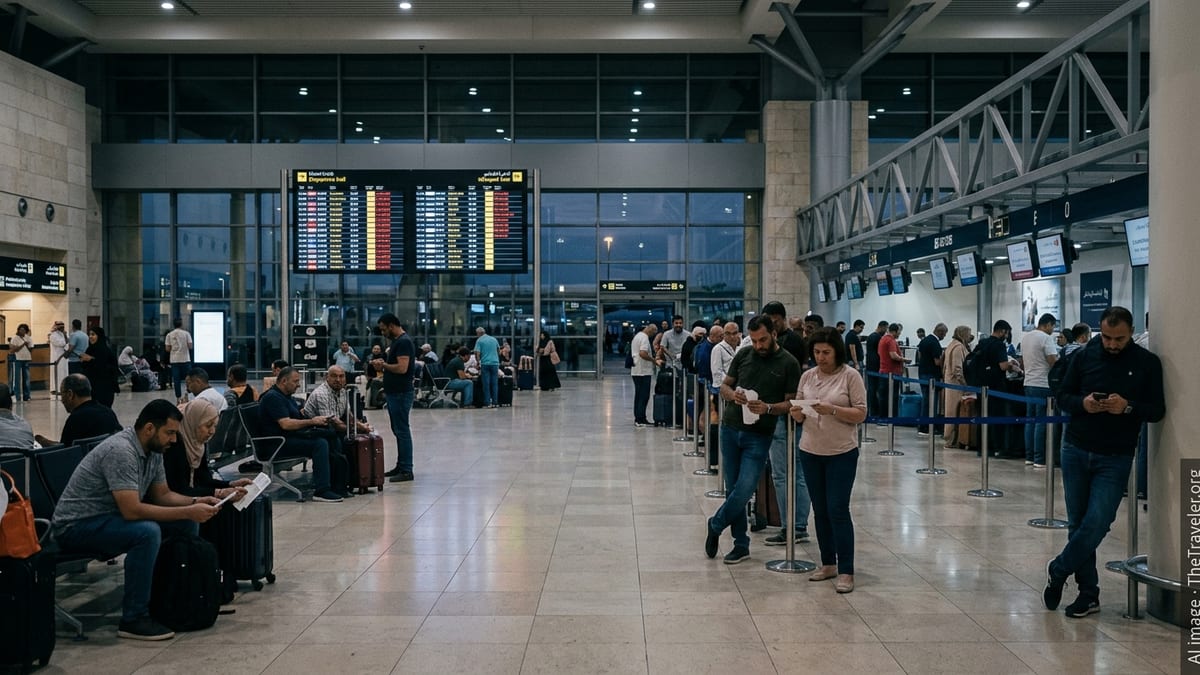
The operational turbulence has translated into a difficult experience on the ground for passengers at Queen Alia International Airport. Images circulating in regional media show crowded departure halls, with travelers clustering around departure boards listing multiple cancellations and long delays. Lines at ticketing and transfer counters reportedly stretched across parts of the terminal as people attempted to rebook, reroute, or secure refunds.
Accounts shared on social platforms by stranded travelers describe missed onward connections, extended overnight stays in Amman, and last-minute scrambles to find hotel rooms or alternative transport. Some passengers traveling for work or family emergencies reported particular frustration as successive rebooked flights were themselves delayed or canceled, eroding confidence in published schedules.
While standard practice in the aviation industry is for airlines to provide meal vouchers, hotel accommodation, or alternative itineraries in cases of lengthy disruption, the scale and regional nature of the current crisis have made consistent assistance more challenging. Travelers reported being advised to monitor airline apps and airport screens closely, as departure times shifted repeatedly with little notice.
Regional Conflict and Airspace Constraints Drive Ongoing Volatility
The latest wave of disruptions in Amman cannot be viewed in isolation. Analysts tracking Middle East aviation point to the continuing Iran-related conflict and associated security measures as central drivers of instability across regional airspace. In recent weeks, multiple states have temporarily closed or restricted portions of their airspace, while several major Gulf hubs have handled large volumes of cancellations, diversions, and repatriation flights.
Economic and aviation assessments suggest that the cumulative impact of these restrictions has resulted in thousands of canceled flights across the wider region, stranding or delaying hundreds of thousands of passengers. For Jordan, which serves as an important connector between the Levant, the Gulf, and longer-haul routes to Europe and Asia, even partial disruptions at neighboring hubs or overflight corridors can quickly ripple into local schedules.
Industry observers note that airlines are attempting to balance safety considerations with the need to maintain essential connectivity, especially for residents, migrant workers, and transit passengers. However, as long as airspace closures and military activity continue to reshape usual flight paths, airports like Queen Alia are expected to see intermittent waves of cancellations and delays.
Uncertain Outlook for Travelers Planning Near-Term Trips
For passengers with upcoming trips through Amman, the situation remains fluid. Public travel advisories and airline notices emphasize the importance of monitoring booking status frequently, especially for departures and arrivals scheduled in the coming days between Amman and regional hotspots such as Cairo, Doha, Beirut, Damascus, and Baghdad.
Travel industry guidance recommends that passengers leave extra time for connections, avoid tightly timed itineraries when transiting through Queen Alia International Airport, and ensure that contact details are up to date in airline reservations so that schedule changes can be communicated quickly. Flexible ticket policies introduced in response to the regional crisis may allow some travelers to rebook to later dates or alternative routes, subject to availability.
As the broader Middle East aviation network continues to adjust to the shifting security landscape, further short-notice disruptions remain possible. For now, the recent wave of cancellations and delays in Amman underlines how swiftly regional tensions can cascade into everyday travel plans, leaving hundreds of passengers unexpectedly grounded despite the resumption of limited operations elsewhere in the region.