

More news on this day
Passengers at Amman’s Queen Alia International Airport are facing a new wave of last-minute cancellations and delays as Royal Jordanian, Gulf Air, Qatar Airways, and Saudia contend with fast-changing airspace restrictions and security concerns across Bahrain, Iraq, Syria, Lebanon, the United Arab Emirates, and Egypt.
Get the latest news straight to your inbox!
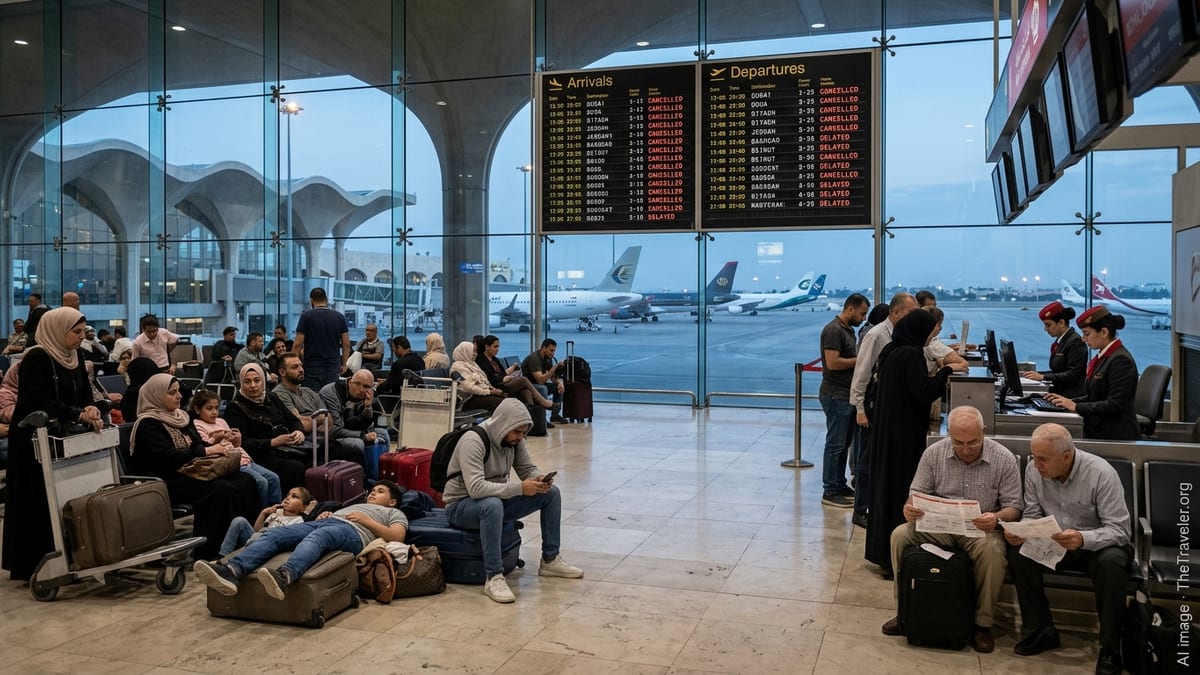
Regional Tensions Trigger Sudden Cancellations in Amman
Published coverage and aviation advisories indicate that Queen Alia International Airport, a key hub for travel between Europe, the Gulf, and the Levant, has seen a spike in disrupted departures and arrivals in recent days. While Jordan’s airspace has not been subject to a full closure, recent conflict-related restrictions and nighttime curfews on certain routes have made it increasingly difficult for airlines to maintain scheduled operations.
Royal Jordanian, the national carrier, has been adjusting its network as conflict-zone bulletins and notices to air missions continue to warn of heightened risk over Bahrain, Iraq, Syria, and parts of Lebanon and the Gulf. Regional observers report that flights linking Amman with major Gulf and Levant cities have been especially vulnerable to short-notice changes as carriers reroute around closed or restricted airspace.
Commercial travel alerts and traveler reports point to a pattern of same-day cancellations on multi-leg itineraries involving Amman. Passengers connecting between Europe or North America and destinations such as Dubai, Doha, Riyadh, Jeddah, Baghdad, and Beirut via Queen Alia are among those most exposed, often learning of cancellations only hours before departure as airlines react to new restrictions or extended curfews along their planned flight paths.
Although the terminal at Queen Alia remains open and operational, the airport is increasingly functioning as a buffer between relatively stable Jordanian operations and a wider regional network still in flux. This has left many transit passengers stranded airside, waiting for replacement flights or diversions that align with evolving overflight permissions.
Airspace Closures Across Bahrain, Iraq, Syria, and Lebanon
Across the wider region, a patchwork of closures and restrictions is driving much of the disruption seen at Queen Alia. Recent conflict-zone bulletins for the Middle East outline continued closures of Iraqi and Syrian airspace, along with significant restrictions over Bahrain and parts of Lebanon. These measures follow a series of military escalations involving Iran, Israel, and United States forces that have reshaped aviation risk assessments across the Gulf and Levant.
In Iraq and Syria, complete or near-complete airspace closures have forced airlines to abandon traditional east–west corridors that once provided efficient routing between Europe, the Gulf, and South Asia. Operators that previously overflew these states from Amman now face lengthy detours or must cancel certain services altogether. This has had a cascading effect on carriers such as Royal Jordanian, Gulf Air, Qatar Airways, and Saudia, all of which rely on these corridors for regional connectivity.
Reports on Bahrain note that operations at Bahrain International Airport and within national airspace have been subject to extended suspensions and heightened security measures. Gulf Air, headquartered in Bahrain, has been particularly affected, repeatedly adjusting schedules and, in some cases, rerouting passengers through alternative Gulf gateways when possible. These changes directly impact itineraries that connect through Amman, as displaced Gulf Air passengers compete for limited seats on remaining regional services.
Lebanon’s airspace, while not fully closed, is described in recent travel and risk advisories as heavily restricted and subject to frequent disruption. This has led to a reduction in scheduled services to and from Beirut, with regional carriers trimming frequencies and prioritizing certain time windows deemed safer. Flights linking Amman and Beirut have therefore become less predictable, further eroding the reliability of Queen Alia as a stable transit point for passengers traveling to or from Lebanon.
Gulf Carriers Confront Restrictions in the UAE and Beyond
In the Gulf, the United Arab Emirates has experienced intermittent closures and partial reopenings of airspace as missile and drone incidents around key hubs such as Dubai and Abu Dhabi have been assessed. Publicly available travel advisories describe a pattern of temporary suspensions, followed by carefully managed resumptions of limited operations, often subject to last-minute change when security alerts are raised.
Qatar Airways has also operated under constraints, with reports of services suspended or severely reduced during periods of stricter airspace control around Qatar. Although some relief flights and limited schedules have been introduced when conditions allow, these remain vulnerable to rapid adjustment. For passengers connecting through Amman, any disruption involving Qatar’s Doha hub can quickly reverberate, leading to missed onward legs and unexpected overnight stays at Queen Alia.
Saudia, operating from Saudi Arabia, has confronted its own network challenges as it navigates neighboring closures and diversions around conflict areas. While Saudi airspace itself has largely remained open, schedules have been reshaped by the need to avoid Iraqi and Syrian skies and to respond to interruptions affecting nearby hubs in Bahrain and the UAE. Services linking Saudi cities such as Riyadh and Jeddah with Amman have thus experienced a mix of delays, rescheduling, and occasional cancellations.
The combined effect is a region in which large Gulf carriers, traditionally seen as reliable connectors between continents, are now operating more cautiously and often less frequently. Queen Alia International Airport, positioned between the Gulf and the Levant, has become an important but unstable junction point in this reconfigured network, with passengers experiencing extended layovers and unexpected itinerary changes.
Egypt Feels the Spillover Despite Open Airspace
Egypt presents a contrasting picture. Available aviation and travel bulletins indicate that Egyptian airspace remains generally open, with Cairo continuing to function as a primary gateway between Africa, the Middle East, and Europe. However, Egypt-based airlines have reduced or temporarily suspended flights to several Middle Eastern destinations in response to the same regional tensions affecting Jordan and the Gulf.
These selective route suspensions have reduced capacity on corridors that traditionally link Cairo with Gulf cities and the Levant, indirectly affecting passengers who might otherwise recover disrupted Amman itineraries by rerouting via Egypt. Travelers attempting to move between Amman and destinations such as Dubai, Doha, or Riyadh through Cairo have reported limited availability and higher fares as seats are absorbed by those displaced from canceled direct services.
For airlines like Royal Jordanian and Saudia, Egypt’s continued openness is a partial relief valve but not a complete solution. Network planners are weighing the benefits of routing more passengers via Cairo against the operational complexity and additional flying time such diversions require. As long as airspace over Iraq, Syria, and parts of the Gulf remains constrained, the strain on these alternative corridors is likely to persist.
From the passenger perspective, Egypt’s role in the current disruption is double-edged: it offers an additional way out when direct flights from Amman are canceled, yet the overall shortage of seats and irregular schedules mean that not everyone can take advantage of this option. Many stranded travelers at Queen Alia continue to face long waits before being accommodated on flights that can safely circumvent restricted zones.
Travelers Face Uncertainty as Airlines Adjust Day by Day
The immediate impact of the cancellations at Queen Alia is most visible in crowded departure halls, long customer service queues, and families resting on luggage trolleys while waiting for news of alternative arrangements. Social media posts and traveler forums contain multiple accounts of passengers receiving rebooking notices only hours before departure, or having itineraries repeatedly retimed as airlines attempt to match flights to suddenly available corridors.
Publicly available airline statements highlight a focus on safety and regulatory compliance, with carriers emphasizing that operations remain subject to directives issued by national aviation authorities and international safety bodies. Conflict-zone information bulletins currently advise operators to exercise extreme caution, or to avoid altogether, specific flight information regions that encompass Bahrain, Iraq, Syria, Lebanon, Jordan, the UAE, and parts of Saudi Arabia.
Travel advisors and corporate travel managers are increasingly recommending that passengers build longer connection times into itineraries involving Amman and nearby hubs, and, where possible, remain flexible with travel dates. Guidance circulating in the industry also stresses the importance of checking flight status repeatedly in the 24 hours before departure, as schedule changes are often made late and updated in near real time.
With the broader security situation still evolving, there is no clear timeline for a full normalization of flight operations through Queen Alia International Airport or across the wider region. For now, travelers passing through Amman find themselves at the front line of a complex and fast-moving airspace puzzle, where each new advisory or closure reverberates through airline schedules and leaves many journeys in limbo.