

More news on this day
Hundreds of airline passengers were stranded across the Netherlands and wider Europe after operations at Amsterdam Airport Schiphol were severely disrupted, with nine flights cancelled and more than 250 services delayed, throwing travel plans into disarray on major carriers including KLM, Air France, SAS and easyJet on key routes to Oslo, Paris and Barcelona.
Get the latest news straight to your inbox!
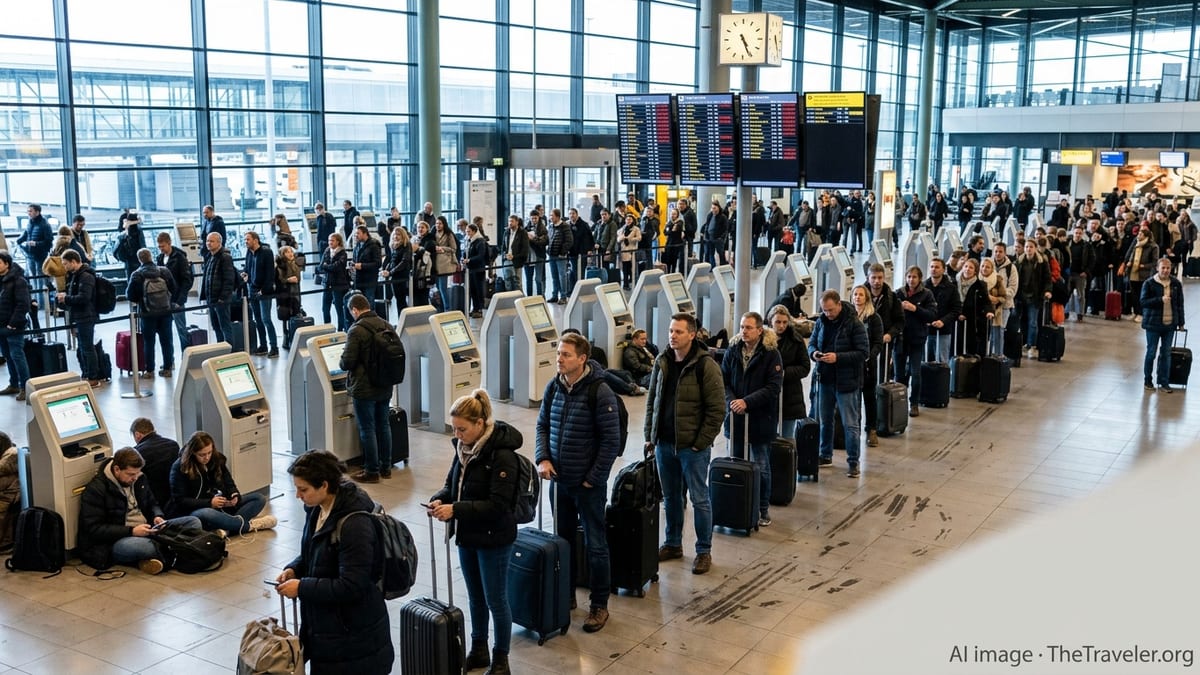
Wide-Scale Disruption Hits One of Europe’s Busiest Hubs
Amsterdam Airport Schiphol, one of Europe’s primary transfer hubs, experienced significant operational disruption, resulting in a tightly concentrated wave of cancellations and delays that rippled across the continent. Publicly available flight monitoring data indicates that nine departures and arrivals were cancelled while approximately 252 flights faced delays, affecting both short-haul and medium-haul networks.
The disruption left departure boards filled with amber and red notices for delays and cancelled services, with knock-on impacts to crews, aircraft rotations and connecting itineraries. Passengers traveling to and from Northern and Southern Europe were particularly affected as aircraft and crew were held at Schiphol awaiting clearance to depart.
Reports from aviation tracking services show that while the number of outright cancellations remained limited compared with previous large-scale shutdowns, the concentration of delays created significant congestion in terminals and at gates. Even modest schedule changes at a major hub can trigger a chain reaction, and the latest episode underlined how vulnerable highly networked operations remain to localized disruption.
Airlines working with tight turnaround times faced further challenges as inbound delays cascaded into late departures, leaving many travelers facing missed connections and unplanned overnight stays. With aircraft and crews out of sequence, some flights departed hours behind schedule while others were removed from the timetable entirely.
Major Carriers Affected on Key Routes
KLM, the largest operator at Schiphol, experienced notable disruption, with multiple services departing late or cancelled as the hub struggled to absorb the operational strain. Partner airline Air France, as well as Scandinavian carrier SAS and low-cost operator easyJet, all reported delayed or disrupted services linked to Amsterdam rotations, according to published coverage and timetable data.
Key intra-European routes bore the brunt of the disruption. Flights between Amsterdam and Oslo were affected as aircraft arriving late from previous sectors created gaps in the schedule, forcing some passengers onto later departures or alternative routings. In some cases, travelers reported being rebooked via other Scandinavian or Northern European airports when direct services were no longer viable.
Connections to Paris, an essential link in the joint KLM–Air France network, were also hit. Delays on this busy corridor reverberated through onward long-haul connections, as missed links at both Amsterdam and Paris forced airlines to rearrange itineraries at short notice. Travel to and from Barcelona, one of Europe’s most popular leisure destinations, also saw disruptions, with delayed departures leading to late-night arrivals and limited same-day alternatives.
Low-cost and full-service carriers alike were affected, underscoring that disruption at a major hub rarely remains confined to a single airline. With shared airspace, runway capacity and ground handling resources, delays can quickly spread between operators even when their networks and business models differ.
Passengers Face Long Queues, Missed Connections and Overnight Stays
For travelers on the ground, the operational statistics translated into missed connections, long queues and hours of uncertainty. Social media posts and passenger accounts describe crowded customer service desks at Schiphol and at outstations such as Oslo, Paris and Barcelona, as travelers sought new itineraries, meal vouchers and hotel accommodation.
Some passengers connecting through Amsterdam reported being held on aircraft awaiting a gate, further compressing already tight transfer windows. Others arrived to find their onward flight delayed multiple hours or cancelled outright, triggering a scramble for remaining seats on later departures. Those traveling on the last flights of the day often faced the prospect of overnight stays and rearranged plans for meetings, holidays or onward transport.
The disruption highlighted the importance of flexible contingency plans for travelers using major hubs. Public guidance often encourages passengers to monitor airline apps and airport information screens closely during irregular operations, as rebooking options and departure times can shift rapidly when dozens or hundreds of flights are affected simultaneously.
Travelers caught up in the latest delays also faced a familiar mix of practical and financial concerns, including additional hotel nights, meals and lost nonrefundable reservations at their final destinations. Consumer organizations in Europe routinely remind passengers that under European air passenger regulations, carriers may have obligations to provide care and, in certain circumstances, compensation when delays or cancellations fall within an airline’s control.
Operational Strain and Europe-Wide Knock-On Effects
While specific causes for individual cancellations and delays varied by flight, operational data and recent aviation trend reports indicate a complex mix of factors underpinning irregular operations at major European hubs. These can include staffing constraints, ground handling bottlenecks, technical issues and air traffic control restrictions that reduce usable runway capacity and force airlines to slow their schedules.
When such issues affect a hub like Amsterdam, the repercussions extend well beyond the Netherlands. Aircraft and crews that start their day at Schiphol often operate multi-leg sequences touching several countries. A delay early in the rotation can disrupt flights many hours and thousands of kilometers away, including services into and out of Oslo, Paris and Barcelona.
Recent analyses of European flight operations have also highlighted the sensitivity of airline networks to even modest constraints in airspace or ground operations. When flight movements must be spaced out more widely or when de-icing, baggage handling or refueling take longer than planned, on-time performance can deteriorate rapidly. As airlines operate fuller schedules to meet sustained travel demand, there is less slack in the system to absorb sudden shocks.
Publicly available coverage of previous episodes at Schiphol shows that once disruptions reach a critical threshold, airlines may begin trimming flights from the schedule to stabilize operations and reduce further knock-on delays. The decision to cancel a limited number of flights, such as the nine removed in the latest incident, can be part of an effort to restore more predictable service for the remaining passengers.
What Travelers Should Know When Flying Through Amsterdam
The latest disruption at Amsterdam offers several practical lessons for travelers planning journeys through major hubs. Travel experts often recommend allowing more generous connection times when itineraries rely on a single airport that is already operating close to capacity, especially during periods of seasonal weather challenges or known infrastructure strain.
Passengers are also encouraged to keep airline apps, email notifications and airport information channels close at hand on the day of travel. In many recent cases across Europe, rebooking tools in airline apps or via online self-service platforms have allowed affected travelers to secure alternative flights more quickly than those relying solely on airport desks, which can become overwhelmed during large-scale disruptions.
Travelers with time-sensitive plans may also benefit from researching alternative routings in advance, such as rail links between nearby hubs or secondary airports that can serve as backups if Amsterdam experiences sudden disruption. While not all tickets allow changes without fees, knowing the geography of alternative options can help passengers make faster decisions when minutes count.
As Amsterdam Schiphol continues to play a central role in European connectivity, episodes such as the latest round of cancellations and delays serve as a reminder of both the efficiency and fragility of modern air travel. For hundreds of passengers this week, a small cluster of cancelled flights and a few hundred delays were enough to reshape journeys, highlight the importance of real-time information and reinforce the need for resilience in both airline networks and personal travel plans.