

More news on this day
Travelers moving through Baltimore/Washington International Thurgood Marshall Airport faced severe disruption today, with 136 flight cancellations and 25 delays grounding journeys to and from Washington D.C. and major cities across the United States.
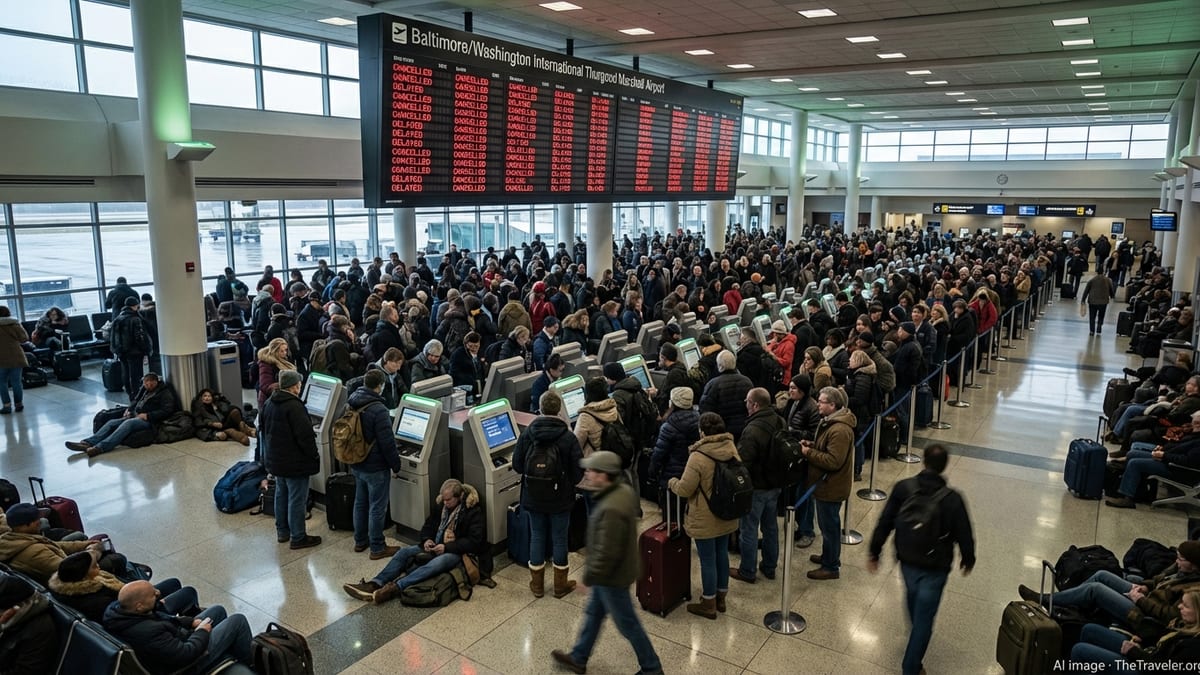
Heavy Disruptions Hit a Key Mid-Atlantic Hub
The wave of cancellations at Baltimore/Washington International Thurgood Marshall Airport, commonly known as BWI, has transformed a routine travel day into an exercise in uncertainty for hundreds of passengers. Flights serving Washington D.C., New York, Atlanta, Chicago, Orlando and other major U.S. destinations have been among those most affected, as schedules unraveled over the course of the morning and afternoon.
According to live operational data, BWI recorded 136 cancellations and 25 delays within, into or out of the United States today, an unusually high figure even for one of the busiest airports on the East Coast. The disruption has rippled outward through the national network, as missed connections and repositioning challenges forced airlines to adjust schedules at other hubs.
Airport officials and airline representatives were working through the day to rebook passengers, reassign crews and reposition aircraft. However, with so many flights removed from the schedule in such a short window, same day alternatives have been limited, particularly for travelers bound for popular hubs where seats are already tight.
While operations at BWI have not ground to a complete halt, the concentration of cancellations across a handful of high frequency domestic routes has magnified the impact. Travelers who arrived at the terminal this morning expecting minor delays instead encountered departure boards dominated by red cancellation notices and long lines at customer service desks.
Southwest, Spirit, Delta and United Bear the Brunt
The disruption has fallen heaviest on Southwest Airlines, which maintains a substantial presence at BWI and uses the airport as a key connecting point for its national network. A large share of today’s cancellations have been linked to Southwest operations, affecting flights to and from cities such as Atlanta, Chicago, Orlando, Nashville and Denver. The airline has also experienced a cluster of delays on departures that did operate, as crews and aircraft cycled through the constrained schedule.
Low cost carrier Spirit Airlines, along with full service operators Delta Air Lines and United Airlines, have also seen their operations at BWI hit. Although the number of cancelled flights for these carriers is smaller than Southwest’s, their role in connecting Baltimore and Washington area travelers to major hubs like Detroit, Minneapolis, Houston and Newark has amplified the effect. For many passengers, a single cancelled leg at BWI meant the loss of an entire multi segment itinerary.
Passengers on Delta and United, in particular, reported extensive waits for rebooking assistance as agents tried to secure seats on remaining departures. Some travelers were offered re-routes through alternate hubs or onto flights departing from Washington Dulles International or Ronald Reagan Washington National, but availability varied widely depending on destination and fare type.
For Spirit customers, the limited number of daily frequencies on certain routes meant that a cancellation often translated into at least a one day delay in reaching their final destination. With budget carriers typically operating leaner schedules, the margin for recovery after a disruption is significantly narrower than for larger legacy airlines with multiple daily flights on trunk routes.
Travelers to and from Washington D.C. Face Difficult Choices
The disruption at BWI has had particular consequences for those traveling to and from the Washington D.C. region. Many visitors treat BWI, Washington Dulles and Reagan National as interchangeable options when booking flights to the capital area, but today’s wave of cancellations underscored how quickly that flexibility can evaporate when one of the three major airports experiences severe operational strain.
Some passengers arriving from other U.S. cities discovered upon landing that their onward connections through BWI to D.C. area destinations had been canceled, forcing them to decide between overnighting near the airport or arranging ground transportation into the capital. Others, who had booked itineraries routing out of BWI to return home, were confronted with last minute flight cancellations that left them searching for alternatives at Dulles or Reagan National, often at significantly higher walk up fares.
Business travelers on tight schedules were among those hardest hit. With a significant number of cancellations concentrated on routes serving major commercial centers such as New York, Boston, Chicago and Atlanta, some faced the prospect of missing meetings and events that had been tightly scheduled around same day out and back itineraries. Rail services offered one alternative for those bound for cities along the Northeast Corridor, but capacity constraints limited how many stranded air passengers could make a last minute switch.
For international travelers who rely on domestic connections through BWI to reach transatlantic and Latin American flights from other hubs, the disruption created additional complications. Even a short delay or cancellation on an initial BWI sector can cause passengers to miss onward long haul departures, potentially leading to days of disruption and added accommodation costs if replacement seats are scarce.
Knock On Effects Across Major U.S. Cities
The impact of today’s cancellations and delays has not been confined to Maryland. Because BWI is tightly integrated into the domestic airline network, the loss of dozens of departures and arrivals has cascaded into schedules at other major airports, including Atlanta, Chicago, Orlando, Denver, Dallas and New York area airports. Aircraft and crews that were due to route through Baltimore are instead sitting idle or being repositioned, creating gaps in rotations elsewhere.
Travel data from recent nationwide disruption events show that even a localized surge in cancellations can have hours long or even days long repercussions for the wider network. When a flight is cancelled at the start of a multi leg sequence, the aircraft and crew may miss several subsequent planned sectors, each of which then must be delayed, combined with other services or cancelled altogether. That pattern appears to be repeating today as airlines adjust operations in response to BWI’s bottleneck.
Major hubs such as Atlanta, Chicago O Hare and Orlando, which routinely handle heavy inbound and outbound traffic to and from BWI, have reported their own pockets of delay as airlines work to accommodate displaced passengers and improvise new routings. In some cases, extra capacity has been added on select departures to absorb demand from cancelled Baltimore flights, though gate and runway availability limit how much additional flying can be added at short notice.
For leisure travelers headed to vacation destinations in Florida, the Caribbean and the West, the timing of cancellations has been particularly painful. With weekend trips and school breaks often tightly packed into limited vacation windows, losing a full day of travel can mean sacrificing pre booked hotel nights, tours or cruise departures, even when airlines offer refunds or future travel credits.
Operational Strain Highlights System Vulnerabilities
Today's disruption at BWI fits into a broader pattern of strain across the U.S. aviation system, where airlines, airports and air traffic control are operating closer to the edge of available capacity. While the immediate triggers for today's 136 cancellations and 25 delays include a mix of operational issues, crew scheduling constraints and knock on effects from earlier irregular operations, the scale of the disruption reveals how vulnerable the system can be when multiple stressors converge.
Recent national data show that average delay times and the percentage of late or cancelled flights at BWI have generally tracked above national norms during peak months. When a high volume day encounters staffing challenges, equipment issues or weather fluctuations at key points in the network, recovery can quickly become complex, particularly for airlines that run tight schedules designed to maximize aircraft utilization.
Aviation analysts note that while large scale meltdowns attract the most attention, the type of concentrated disruption seen at BWI today can be equally damaging for consumer confidence. Travelers who experience repeated cancellations or significant delays on routes they rely on for business or family travel may reconsider their choice of carrier or even the airport they use, especially in regions like the Mid Atlantic where multiple airports serve overlapping catchment areas.
The situation is also a reminder of the delicate balance airlines must strike between operational efficiency and resilience. Investments in additional reserve crews, spare aircraft and more generous scheduling buffers can help absorb shocks, but they carry financial costs that carriers must weigh against competitive pressures to keep fares low.
Stranded Passengers Confront Long Lines and Limited Options
Inside the terminal at BWI, the human cost of the disruption has unfolded in scenes that have become familiar during recent years of heightened volatility in air travel. Lines at airline customer service counters and rebooking kiosks stretched deep into concourses as passengers sought new itineraries, refunds or accommodation vouchers. Many travelers reported waiting more than an hour to speak with an agent, only to find that same day options were already exhausted on their preferred routes.
With seats scarce and weather and operational constraints limiting the ability of airlines to add extra flights, passengers increasingly turned to alternative arrangements. Some groups banded together to rent cars or arrange ride share journeys to cities as far away as New York, Boston and Charlotte. Others scrambled to secure last minute hotel rooms near the airport after learning that their rebooked departures would not leave until the following day.
Families traveling with children and older passengers faced added challenges as they navigated crowded terminals and uncertain timelines. For those arriving from long haul or overnight journeys, the prospect of trying to rest in departure lounges while waiting for rescheduled flights added a layer of fatigue and stress. Airport staff and volunteer teams circulated through the concourses, assisting with wayfinding and offering guidance on transportation and accommodation options.
Social media posts from stranded travelers captured a mix of frustration and resignation, with some expressing understanding of safety driven cancellations while criticizing what they described as inadequate communication about the evolving situation. Real time flight tracking apps and airline notifications helped many stay informed, but the rapid pace of schedule changes meant information was sometimes outdated by the time passengers reached departure gates.
What Today’s Chaos Means for Future Travel Plans
The operational turmoil at Baltimore/Washington International today is likely to prompt fresh questions among travelers about how to plan for resilience in their own itineraries. Consumer advocates have long encouraged passengers to build in longer connection times, favor morning departures when possible and avoid tight same day turns for important events, all strategies that can help mitigate the impact of sudden cancellations or rolling delays.
Travel planners also note that diversifying airport choices within a metropolitan region can be beneficial when one facility experiences severe disruption. For the Washington D.C. area, that may mean comparing options from BWI, Dulles and Reagan National not just on price, but on schedule robustness, historical on time performance and the range of alternative flights available if something goes wrong.
For airlines, today’s events add to the pressure to demonstrate that they have learned from previous high profile disruption episodes and invested in more robust operational planning, technology and customer service. Clearer communication during irregular operations, more transparent rebooking policies and better coordination with airport authorities and ground transport providers are among the measures passenger groups say could soften the impact when days like this occur.
In the immediate term, however, the priority at BWI remains getting stranded travelers where they need to go. As the day wears on and more flights either depart or are formally removed from the schedule, airlines will be working to untangle the web of missed connections and disrupted rotations so that normal operations can resume as swiftly as conditions allow.