

More news on this day
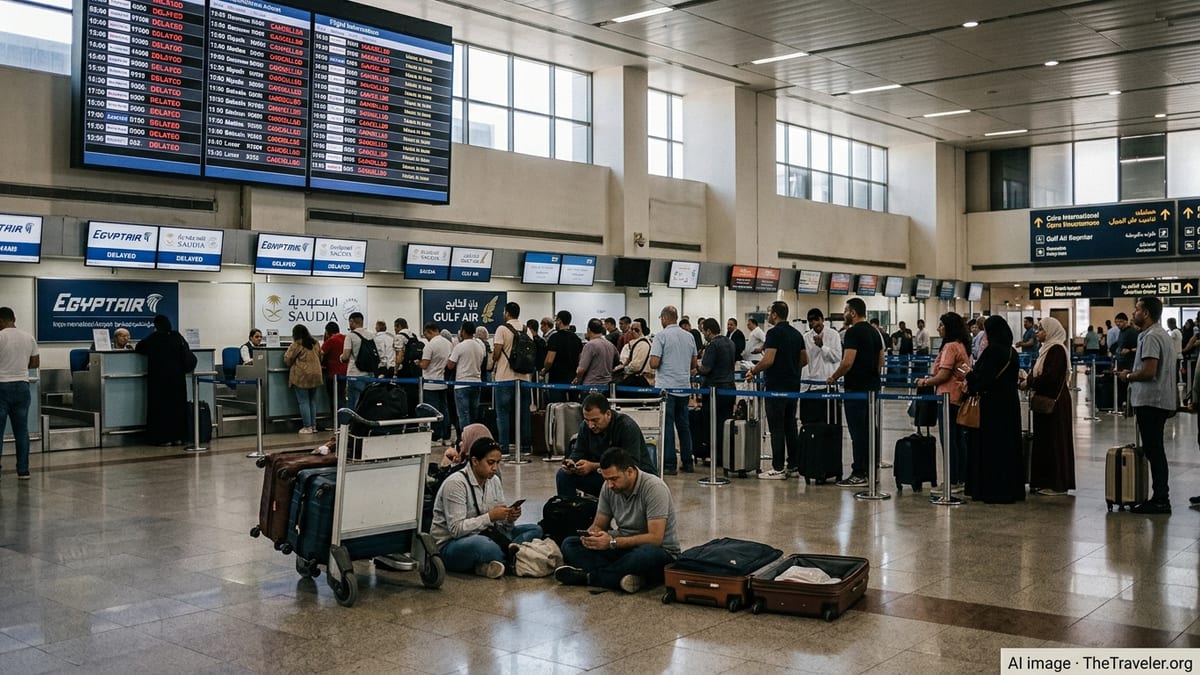
Travellers at Cairo International Airport faced mounting disruption today as EgyptAir, Saudia and Gulf Air grounded 19 flights and racked up more than 100 delays, unsettling links between Egypt and major Gulf destinations including Dammam, Luxor, Riyadh, Medina and Bahrain.
Get the latest news straight to your inbox!
Groundings Snarl Cairo’s Role as Regional Hub
Publicly available airport information and regional aviation tracking data indicate that Cairo International Airport has become a flashpoint in a wider pattern of Middle East air travel disruption, with 19 flights operated by EgyptAir, Saudia and Gulf Air grounded over the course of the day. The cancellations have been accompanied by over 100 delayed departures and arrivals, affecting both point to point travellers and those connecting onward across Africa, Europe and Asia.
The grounded services involve a mix of domestic Egyptian routes and international flights linking Cairo to key Gulf gateways. Routes connecting Cairo with Dammam, Riyadh and Medina in Saudi Arabia, as well as services involving Bahrain and Luxor, feature prominently among the affected operations. Delays on these corridors are amplifying pressure on already constrained regional airspace and complicating efforts by airlines to keep wider networks running.
Reports from regional media and aviation monitoring platforms suggest that the disruptions at Cairo are not isolated, but part of a broader recalibration of schedules prompted by changing airspace conditions and operational challenges across the Middle East. However, the concentration of grounded and delayed flights in and out of Cairo underlines the airport’s central role as a transfer point linking North Africa with the Gulf and beyond.
Airline schedules remain fluid, with carriers adjusting departure times throughout the day as slots, crew availability and rerouting options shift. Passengers are being advised through airline channels and airport announcements to monitor flight status closely and expect irregular operations on short notice.
Knock-on Effects Across Dammam, Riyadh, Medina and Bahrain
The suspension of multiple Cairo services is sending ripple effects across Saudi Arabia and Bahrain, particularly on high demand routes that typically feed business travel, labour traffic and family visits. Flights connecting Cairo with Dammam and Riyadh, two of Saudi Arabia’s busiest commercial centres, are experiencing rolling delays, lengthening journey times and reducing same day connection options.
Medina, a key religious destination, is also seeing schedule volatility as Cairo based services are rescheduled or held on the ground. According to published coverage of the current regional aviation environment, Saudi airports remain operational but subject to airspace constraints, with some routes forced to adopt longer detours. These changes are contributing to extended flight times and complicating aircraft rotations on links that pass through Cairo.
In Bahrain, Gulf Air’s network adjustments are intersecting with the Cairo disruptions to create additional uncertainty. Regional briefings on Middle East aviation note that Gulf hubs such as Bahrain and Dammam have become critical alternatives while neighbouring airspaces face varying levels of restriction, putting extra strain on already busy corridors. Reduced predictability around Cairo departures is therefore feeding directly into congestion and schedule compression at Gulf airports.
For travellers moving between the Gulf and onward destinations in Europe and Africa via Cairo, missed or at risk connections are emerging as a significant concern. With many itineraries built around tight transfer windows, even moderate delays on Cairo legs can cascade into overnight stays or complete rebookings once passengers reach Dammam, Riyadh, Medina or Bahrain.
Luxor and Domestic Links Squeezed by Operational Pressures
While the most visible impact is on international flights, domestic connections are also being hit. Luxor, one of Egypt’s major tourism gateways, has seen services to and from Cairo postponed or cancelled as EgyptAir reprioritises aircraft and crews. This is occurring just as regional tourism operators hoped to stabilise itineraries following earlier waves of disruption linked to airspace constraints and higher fuel costs.
Tourism industry reporting indicates that operators serving Nile cruises and Upper Egypt excursions rely heavily on reliable Cairo Luxor shuttles to move tour groups on fixed schedules. When these flights are grounded or heavily delayed, downstream activities such as river departures, hotel stays and onward excursions can be thrown off by a full day or more, adding costs for both companies and travellers.
Domestic pressure is exacerbated by the fact that Cairo handles a dense mix of short haul Egyptian services alongside medium haul regional flights. When aircraft and crews are tied up by delays on international routes to the Gulf, the knock on effect often falls on shorter domestic sectors, which may be consolidated, retimed or cancelled to free up capacity.
For independent Egyptian travellers and residents commuting between Cairo and cities such as Luxor, the result is longer waits in terminals, fewer same day options and a greater reliance on last minute rebooking. Travel forums and social media posts from within Egypt suggest that some passengers are pivoting to rail or road where feasible, particularly on routes entirely within the country.
Regional Airspace Constraints and Fuel Costs Deepen Disruptions
The disruption at Cairo is unfolding against a backdrop of wider Middle East aviation instability. Recent international coverage has highlighted airspace closures or restrictions across parts of the Gulf and Levant, alongside military activity that has narrowed available corridors, forcing airlines to reroute around sensitive areas and accept longer flight paths.
Industry analysis shows that these elongated routes are driving up fuel burn and operating costs, echoing recent reports from European carriers that have cited surging jet fuel prices linked to conflict and supply bottlenecks. Some airlines operating in and out of the region have already announced targeted fare increases or capacity reductions as they grapple with higher costs and more complex routing.
For EgyptAir, Saudia and Gulf Air, such conditions make it harder to absorb irregular operations at a major hub like Cairo. When airspace options are limited and schedules are tightly wound around constrained corridors, the margin to recover from a delay or technical issue shrinks considerably. Grounding a flight can become a last resort to reset rotations, but it immediately translates into stranded travellers and missed onward segments.
Security and risk briefings focused on Middle East aviation suggest that volatility is likely to persist in the near term, with airlines continuously reassessing flight paths and schedules in response to changing conditions. This uncertainty feeds back into passenger planning, as travellers face increasing difficulty predicting whether itineraries involving multiple stops across the region will operate as ticketed.
What Travellers Through Cairo Should Expect Now
For those currently booked to travel through Cairo International Airport, publicly available guidance from airlines and airports across the region points to one consistent theme: flexibility is essential. With EgyptAir, Saudia and Gulf Air all adjusting services, passengers can expect last minute retimings, aircraft swaps and occasional outright cancellations on routes touching Cairo, Dammam, Luxor, Riyadh, Medina and Bahrain.
Many carriers are directing customers to rely on official airline apps and airport information screens for near real time updates, as schedules loaded into reservation systems may lag behind on the day of travel. Travellers with fixed time commitments at their final destination face the greatest risk, particularly if journeys involve tight connections through Cairo or secondary Gulf hubs.
Consumer advocacy information on air travel disruptions notes that, depending on ticket type and jurisdiction, affected passengers may be entitled to rerouting, vouchers or refunds when flights are significantly delayed or cancelled. However, the complex interplay of non European carriers, transit hubs and conflict related airspace issues means that compensation rules can be difficult to navigate on multi leg itineraries involving Cairo and Gulf airports.
For now, regional aviation observers expect Cairo’s role as a critical North Africa Gulf bridge to remain under strain while airlines continue balancing safety, regulatory requirements and commercial realities. As long as airspace restrictions and elevated fuel costs persist, travellers passing through Cairo, Dammam, Luxor, Riyadh, Medina and Bahrain are likely to encounter a more fragile and unpredictable flight network than in previous years.