

More news on this day
Travelers passing through Singapore Changi Airport are facing renewed disruption this week, as more than a dozen flights operated by Qatar Airways, Gulf Air, Scoot, Thai Airways and Singapore Airlines are cancelled or heavily curtailed, snarling routes to Doha, Phuket, Jakarta, Kuala Lumpur and other regional hubs.
Get the latest news straight to your inbox!
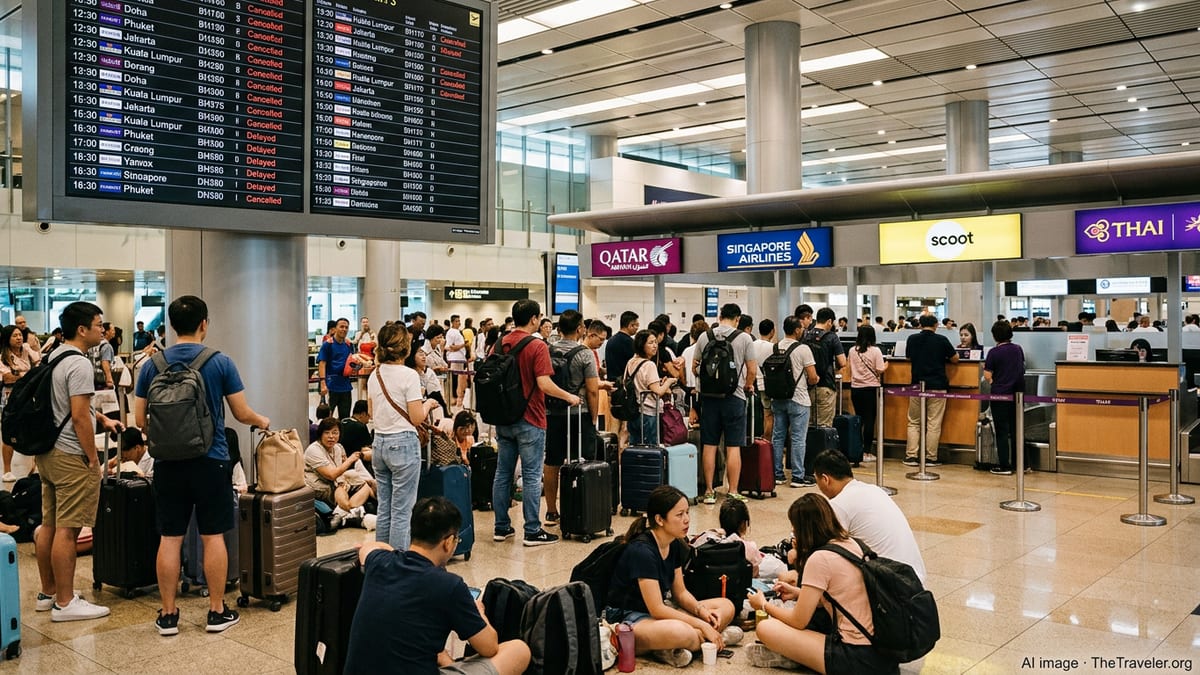
Middle East Airspace Crisis Ripples Into Singapore
The latest wave of cancellations comes as airspace restrictions linked to the ongoing crisis in the Gulf continue to squeeze capacity on flights to and from Doha and other Middle Eastern hubs. Qatar’s partial reopening of emergency corridors has allowed a limited schedule to resume, but the knock-on effects are still being felt across Asia, with Singapore one of the hardest hit gateways.
Flight data and airline advisories show that Qatar Airways has dramatically reduced its operations between Doha and Singapore, with several Singapore–Doha services scrubbed or consolidated in recent days. Passengers report flights for mid-March already disappearing from apps and booking systems, leaving them scrambling to secure alternative routings at short notice.
At the same time, Gulf Air and other carriers reliant on transiting the affected corridors have trimmed their schedules through the region. While some flights are operating under special approvals, capacity remains far below normal, turning Singapore’s usually smooth connections to Europe, the Middle East and Africa into a patchwork of ad hoc solutions.
Singapore’s own flag carrier group has also moved to protect operations and crew safety. Singapore Airlines and its low-cost arm Scoot have extended earlier suspensions of selected Middle East services, effectively closing off another set of options for travelers who might otherwise have rerouted via Changi.
Routes to Doha, Phuket, Jakarta and Kuala Lumpur Affected
Among the most affected routes is the busy Singapore–Doha corridor, a crucial link for Southeast Asia passengers heading onward to Europe, the Americas and the Middle East. Multiple Qatar Airways flights on this route have been cancelled or shifted onto a sharply reduced timetable, and travel agents in Singapore report that remaining seats are selling out quickly as stranded passengers vie for space.
The disruption is also radiating across short-haul regional routes. Services connecting Singapore with popular leisure destinations such as Phuket and Jakarta, as well as high-frequency business shuttle flights to Kuala Lumpur, have come under strain as airlines reshuffle aircraft and crews. While not all cancellations on these sectors are directly tied to the Gulf airspace issue, the need to reposition aircraft for long-haul coverage and to stay within crew duty limits is amplifying the impact.
Scoot and Thai Airways, both key players in the Singapore–Thailand market, have reported irregular operations on some services to Phuket and Bangkok as they adjust schedules around connecting traffic. Travelers have encountered last-minute timing changes, equipment swaps and, in some cases, outright cancellations, forcing overnight stays or unplanned detours via secondary airports.
In Indonesia and Malaysia, flights linking Singapore to Jakarta and Kuala Lumpur are generally continuing but not immune to disruption. Aviation analysts note that even a relatively small number of cancellations on these trunk routes can quickly cascade into missed onward connections for long-haul passengers, especially those who had originally planned to travel through Doha or other Gulf hubs.
Passengers Face Long Lines, Reroutes and Limited Options
For travelers, the operational complexity behind the scenes is translating into long queues at customer service counters, extended hold times on airline hotlines and a scramble to find any available seat out of Singapore. Passengers with itineraries involving Doha report spending hours on the phone seeking reroutes via alternative hubs such as Bangkok, Kuala Lumpur or Hong Kong.
Some travelers have managed to secure rebookings on Singapore Airlines, Thai Airways or other regional carriers, with improvised routings that add many hours and extra stops to journeys. Others, particularly those originating in Phuket or secondary Southeast Asian cities, have found themselves funneled toward Singapore only to discover onward flights cancelled upon arrival at Changi.
Travel agents say that premium cabins and school-holiday dates are now particularly constrained, with flexible fares and loyalty status often determining who can be accommodated first. Budget-conscious travelers are facing tough choices between waiting several days for a suitable replacement flight or paying significantly higher prices for remaining economy seats on competing airlines.
In online forums, passengers describe situations where confirmed bookings through Doha vanished from their records after cancellations, adding confusion to already stressful circumstances. Consumer advocates in the region are urging travelers to keep written documentation of any airline communications and to monitor bookings proactively rather than relying solely on automated notifications.
Airlines Issue Flexible Policies but Warn of Continuing Disruption
In response to the prolonged turbulence, several airlines serving Singapore have rolled out or extended flexible rebooking and refund policies. Qatar Airways has announced a rolling series of travel alerts and updated limited schedules designed to prioritize stranded customers, while signaling that capacity will remain constrained as long as airspace restrictions are in place.
Singapore Airlines and Scoot have advised customers booked on affected Middle East routes to consider alternative destinations or dates, offering change fee waivers and, in some cases, fare difference concessions for those willing to reroute via other hubs. However, these options are subject to availability, and travelers report that desirable dates often disappear within hours of being released.
Thai Airways and regional low-cost carriers are likewise adjusting their rules on changes for passengers whose itineraries rely on disrupted connections through the Gulf. Some are allowing one-time free date changes on tickets touching Doha or adjacent routes, while others are focusing on maintaining schedule reliability on core regional sectors such as Singapore–Bangkok or Singapore–Phuket.
Despite these measures, airline executives caution that the situation remains fluid. Any further changes in airspace permissions, fuel prices or regional security assessments could trigger additional alterations to flight plans, leaving carriers balancing operational integrity with the need to get passengers to their destinations.
What Travelers Through Singapore Should Do Now
With the disruption showing little sign of an immediate resolution, aviation experts are advising travelers transiting or departing from Singapore to take a more hands-on approach to their plans. That starts with checking flight status directly with the operating carrier in the 24 to 48 hours before departure, rather than relying on third-party booking sites or generic app notifications.
Flexible routing has become increasingly important. Passengers heading from Southeast Asia to Europe or the Middle East are being urged to consider itineraries via non-Gulf hubs where possible, including larger Asian, European or South Asian gateways that still have robust connectivity. In practice, that may mean accepting longer journey times or overnight layovers in exchange for a higher chance of operating flights.
Travelers with imminent departures are also being encouraged to build in additional buffer time for connections at Changi, particularly if arriving from regional points such as Phuket, Jakarta or Kuala Lumpur. Even when their own flights are operating, delays elsewhere in the network can lead to last-minute gate changes and tighter transfer windows.
For those yet to buy tickets, industry watchers suggest booking with carriers that have clear, written policies on rebooking and refunds in the current environment, and considering travel insurance that explicitly covers airspace-related disruptions. With cancellations from Qatar Airways, Gulf Air, Scoot, Thai Airways and Singapore Airlines all converging on Singapore, the city’s normally seamless role as a global transit hub has become more fragile, and forward planning is now essential for anyone passing through.