

More news on this day
Travelers passing through Fargo’s Hector International Airport on March 16 are facing widespread disruption, with multiple flights to major hubs in Chicago, Minneapolis and Denver canceled or heavily delayed as severe late-winter weather snarls airline operations across the Upper Midwest.
Get the latest news straight to your inbox!
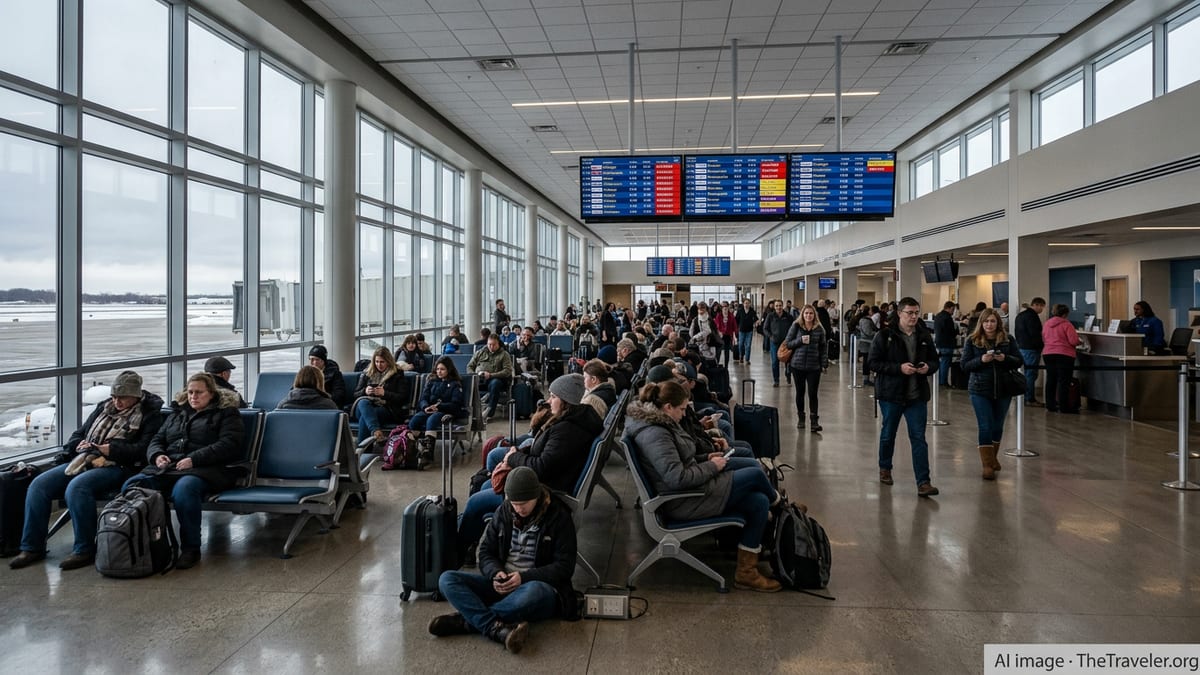
Weather Turmoil at Major Midwest Hubs Ripples Into Fargo
Publicly available flight tracking data and airline status pages on March 16 indicate that a powerful late-season storm system centered over the Chicago region, combined with gusty conditions around Denver and low clouds and snow bands affecting parts of Minnesota, has triggered cascading schedule problems across several major hubs. Chicago O’Hare, Minneapolis St. Paul and Denver International are all reporting significant delays and cancellations, with smaller spoke airports such as Fargo’s Hector International particularly hard hit.
Reports from passengers and aviation enthusiasts on social media describe crowded concourses and rolling waves of cancellations at O’Hare throughout March 15, with wind gusts strong enough to reduce runway capacity and force airlines to pare back operations. In Denver, travelers have posted accounts of extended holding patterns and diversions as storms pushed through the Front Range, while multiple airlines have highlighted reduced arrival rates and crew reassignments in public advisories.
Because Fargo relies heavily on nonstop connections to Chicago, Minneapolis and Denver for onward domestic and international travel, any significant disruption at those hubs tends to ripple quickly through the local schedule. Even when conditions at Hector International itself remain relatively manageable, aircraft and crews arriving from affected hub airports may be delayed or unable to operate at all, leading to same-day cancellations that strand passengers with little advance warning.
Operational data published by the airport ahead of the current travel period shows a dense pattern of early morning and mid-day departures from Hector International to Chicago O’Hare, Minneapolis St. Paul and Denver on carriers including Delta, United and American. With many of those flights feeding into already strained hub operations, a single wave of weather-related schedule cuts can suddenly leave Fargo-originating passengers with no same-day options to reach their intended connections.
Which Hector International Flights Are Most Affected
As of the morning of March 16, the worst impacts are concentrated among the core hub routes that link Fargo to Chicago O’Hare, Minneapolis St. Paul and Denver. Airline status tools show early morning and mid-day departures to Chicago on legacy carriers among the first to be scrubbed, particularly flights intended to connect Fargo travelers into busy eastbound bank periods at O’Hare. Several of those departures are listed as canceled outright rather than delayed, reflecting aircraft and crew displacement from the previous day’s turmoil.
Flights to Minneapolis St. Paul, one of Hector International’s most heavily used connection points, are also seeing a mix of cancellations and significant delays. While publicly available weather information around Minneapolis has at times appeared less severe than in Chicago, airlines are still contending with ripple effects from tight aircraft rotations, deicing requirements and redistributed capacity. The result for Fargo-based passengers is a patchwork of status updates, with some Minneapolis-bound departures operating close to schedule while others are removed from the board with little lead time.
Denver-bound flights, which provide an important westward connection for North Dakota travelers, are experiencing disruptions tied both to local weather in Colorado and to the knock-on effects from strained national networks. Some departures from Fargo to Denver are currently listed with extended departure holds or “awaiting aircraft” notes, while others have moved into canceled status as airlines attempt to consolidate passengers onto a smaller number of operating services.
Travelers should be prepared for the possibility that even flights still showing “on time” in the early hours of the day could shift to delayed or canceled as hub airports update their traffic management plans. Historically, days that follow major weather disruptions at large hubs often involve repeated schedule adjustments as airlines work to reposition aircraft and crews and clear overnight backlogs.
How to Check Whether Your Flight Is on the Cancellation List
For those booked to travel through Hector International on March 16 and in the next several days, the most reliable way to verify flight status is through airline-operated digital channels. Airline mobile apps and official websites typically provide near real-time departure and arrival information, gate assignments, and notifications when flights are delayed, canceled or rebooked. Many apps also allow travelers to self-service rebooking when disruptions occur, often without the need to call customer service.
Passengers can also monitor the online departure and arrival boards published by Hector International itself, which aggregate schedule changes across all carriers serving the airport. While these boards may occasionally lag behind airline systems by a few minutes during periods of intense disruption, they still offer a useful overview of which routes are being most heavily affected at any given time and whether particular banks of flights to Chicago, Minneapolis or Denver are more prone to cancellation.
Travelers who purchased tickets through online travel agencies or third-party platforms should be aware that disruption notices from those providers might not arrive as quickly as alerts sent directly by airlines. In a fast-moving situation such as the current Midwest storm system, relying solely on email confirmations from intermediaries can result in missed updates. Checking the airline’s own tools directly is generally the fastest way to see whether a flight out of Fargo has been delayed, canceled or rerouted.
At the airport, departure boards and public address announcements may confirm last-minute changes, but long lines at customer service desks are likely when large numbers of flights are disrupted simultaneously. Passengers who have already confirmed their new itineraries via app or website can often proceed directly to security or, in the case of cancellations, exit the terminal to arrange accommodations, reducing time spent in congested service areas.
Rebooking, Refunds and Practical Tips for Stranded Passengers
With multiple hub-bound flights from Hector International affected, many travelers are finding that same-day rebooking options are limited, particularly for peak-time departures toward Chicago, Minneapolis and Denver. Publicly available information from several major airlines indicates that they have issued flexible travel waivers for parts of the Midwest through mid-March, allowing customers to change travel dates or routings without standard change fees, provided that new itineraries fall within specified time windows and booking classes.
Stranded passengers are encouraged to search for alternative routings that may avoid the most heavily impacted hubs, when possible. For example, some carriers may allow Fargo-originating travelers to connect via different mid-continent or western hubs if space is available, even if those routings are less direct. In practice, however, capacity constraints during major disruption events can make such alternatives scarce, especially for larger groups or travelers seeking to remain on the same itinerary.
Accommodation and meal arrangements can vary widely depending on the circumstances of each cancellation. When disruptions are directly tied to severe weather or air traffic control constraints, published airline policies often limit compensation, focusing instead on fee-free rebooking rather than hotel or voucher support. Travelers with trip insurance or coverage through certain credit cards may have additional options and should review their policy terms to understand eligibility for reimbursement of hotels, meals or alternate transportation.
Given the likelihood of continued knock-on delays even after the current storm system moves through, passengers with flexibility may wish to proactively adjust nonessential travel scheduled for March 16 and 17, especially if itineraries rely on tight connections at Chicago, Minneapolis or Denver. Those who must travel should build extra time into their plans, keep mobile devices fully charged for receiving alerts, and consider carrying essential items in hand luggage in case checked bags are separated or delayed.
What to Expect at Hector International in the Coming Days
While the most acute disruption is unfolding on March 15 and 16, publicly available forecasts and airline schedule data suggest that Hector International may continue to feel effects from the Midwest storm pattern over the next 24 to 48 hours. Recovery at major hubs can take time, as airlines work through aircraft repositioning, crew scheduling limits and passenger backlogs created by multiple waves of cancellations.
Fargo travelers heading to Chicago, Minneapolis or Denver later in the week should monitor their bookings closely, even if they are not scheduled to fly until after the immediate storm window. Historically, days following major weather events at hub airports can still feature elevated rates of delays, last-minute aircraft swaps and occasional cancellations as carriers rebalance capacity to meet demand.
Airport observers note that Hector International’s relatively compact size can be both an advantage and a challenge during disruption events. On the one hand, shorter walking distances and fewer terminals make it easier for passengers to move between check-in counters, security lanes and gates when plans change quickly. On the other hand, limited gate space and fewer backup aircraft options mean that even a small number of canceled or delayed flights can create noticeable congestion, particularly during early morning departure banks.
For now, the most important step for anyone booked to travel through Hector International is to confirm flight status repeatedly in the hours leading up to departure. With hub airports in Chicago, Minneapolis and Denver still working through weather-related backlogs, schedules may continue to shift throughout the day, and flights that appear unaffected early in the morning can still change status as the regional aviation picture evolves.