

More news on this day
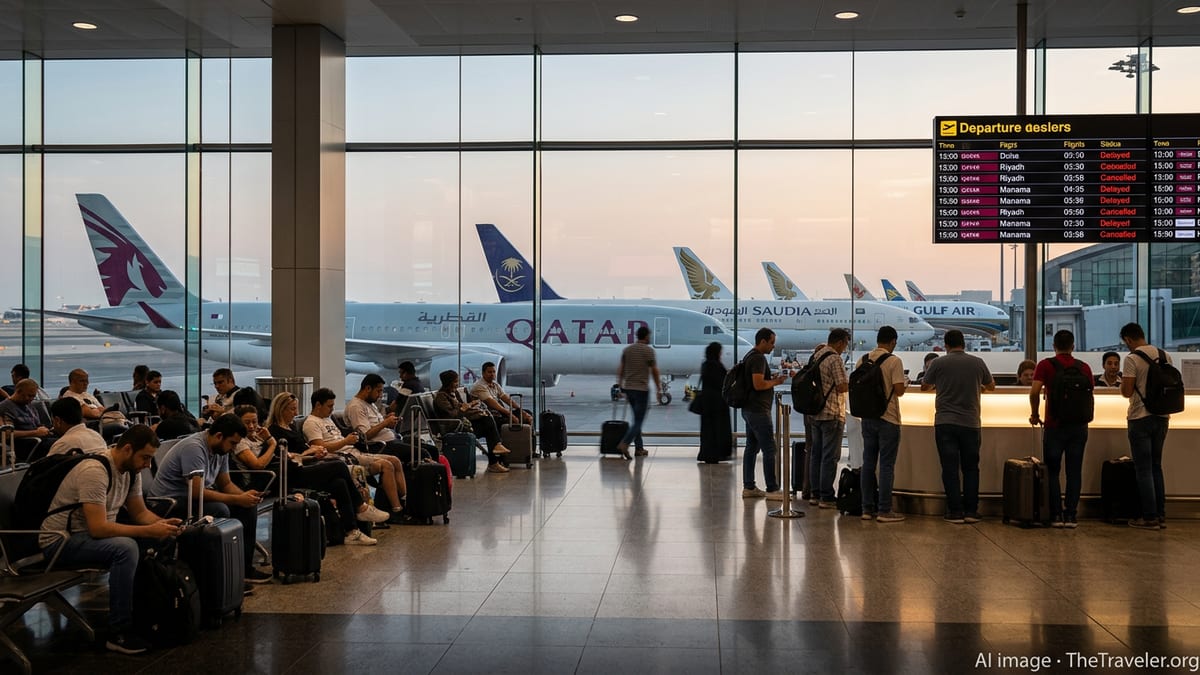
Air travel across key Middle East hubs has been thrown into fresh turmoil as dozens of flights operated by Qatar Airways, Gulf Air and Saudia are reportedly grounded or delayed across Doha, Riyadh and Manama, leaving thousands of travelers scrambling to rebook, reroute or secure refunds amid ongoing regional airspace restrictions.
Get the latest news straight to your inbox!
Regional Tensions Keep Pressure on Gulf Aviation
The latest wave of disruption is unfolding against the backdrop of continuing military escalation in the region, which has triggered rolling airspace closures and capacity caps across parts of the Middle East. Publicly available information from government notices, airline advisories and industry analyses indicates that restrictions first imposed in late February 2026 continue to ripple through airline schedules, including at Doha’s Hamad International Airport, Riyadh’s King Khalid International Airport and Bahrain International Airport.
Qatar’s airspace was initially closed after missile attacks linked to the wider conflict, with only limited emergency and evacuation corridors gradually restored under strict conditions. Reports indicate that standard commercial operations for Qatar Airways remain significantly curtailed, with only a controlled number of relief and repatriation flights operating on specified dates and routes. This has forced extensive cancellations and timetable changes for services that normally use Doha as a major connecting hub.
Similar uncertainty surrounds operations in Bahrain and Saudi Arabia. Regional aviation and consultancy updates describe periods of suspended or reduced flight activity in Bahrain’s airspace and constrained operations affecting routes into and out of Riyadh, as carriers continually adjust to evolving risk assessments and air traffic restrictions. Gulf Air and Saudia have both had to trim schedules, consolidate services and reroute aircraft around sensitive airspace, adding to the cumulative disruption now being felt by passengers across three of the Gulf’s most important connecting points.
Within this broader context, the current snapshot of disruption affecting at least 60 grounded flights and 22 postponements across Qatar Airways, Gulf Air and Saudia represents only part of a much larger pattern of operational instability that has developed since the end of February.
Where Disruptions Are Hitting Travelers the Hardest
For passengers, the most visible impact is at the terminal level. At Hamad International Airport in Doha, reduced departures, rolling cancellations and last minute schedule changes have left many travelers in prolonged transit, sometimes for days, as they wait for new routings or relief flights. According to published coverage and traveler accounts, priority on the limited outbound services has often been given to families, elderly passengers and those with urgent medical or humanitarian needs.
In Riyadh, publicly accessible flight-status data and airline communications suggest that Saudia has been selectively operating services but with significant retiming, consolidation of frequencies and occasional aircraft swaps. Travelers connecting through Riyadh report being moved to alternative departures on short notice, or shifted to different routings entirely, as the carrier attempts to keep key long haul links functioning while avoiding restricted airspace.
Manama’s Bahrain International Airport is also experiencing knock-on effects. Information referenced in regional business and immigration advisories points to periods in which Bahrain’s airspace has faced temporary suspensions or heightened restrictions, limiting Gulf Air’s ability to operate its full network. Passengers on multi-segment journeys via Manama are particularly exposed, as a single cancellation in the Gulf can cause onward flights to misconnect and be dropped from itineraries.
The combination of constrained airspace, tactical schedule cuts and operational caution means that published timetables for Qatar Airways, Gulf Air and Saudia are subject to change with little warning. Even flights that appear confirmed in booking systems have, in some cases, been re-timed or rerouted only hours before departure, underscoring the need for travelers to monitor their reservations closely.
What Airlines Are Offering on Rebooking, Rerouting and Refunds
In response to the evolving situation, Qatar Airways, Gulf Air and Saudia have all published irregular-operations policies outlining options for affected customers. Publicly available guidance from airline trade portals, customer advisories and travel-agency briefings indicates that carriers are generally allowing one or more of the following: free date changes within a defined window, rerouting via alternative hubs when capacity allows, or refunds for flights that are cancelled outright.
Qatar Airways has circulated extended guidelines for tickets with original departure dates around the end of February and the first half of March, permitting additional flexibility in some cases when flights are cancelled due to security-related closures. Reports from passengers and travel agents describe instances in which travelers have been rebooked onto partner or even non-partner airlines via alternative hubs, particularly when stranded away from their home country. However, such solutions appear to depend heavily on seat availability and may require persistent follow-up.
Gulf Air and Saudia are also adapting their policies to cope with fluctuating schedules. According to regional travel-industry summaries, both carriers have been waiving certain change fees on affected routes and, where possible, rerouting passengers through less impacted airports in the wider network. Refunds are typically offered when the airline cancels a flight and no reasonable alternative is available within a practical time frame.
Travelers should note that each airline applies its own detailed conditions, including booking-channel rules and eligibility periods, and these may change as the situation develops. Checking the latest policy pages before contacting customer service can help passengers understand their options and speed up discussions about rebooking or refunds.
Practical Steps for Stranded and At-Risk Passengers
For travelers caught up in the latest wave of cancellations at Doha, Riyadh or Manama, staying proactive is crucial. Airline and airport apps, as well as booking-management tools offered by online travel agencies, remain the fastest way to detect changes to departure times, routings or aircraft types. Recent traveler experiences suggest that some passengers have been automatically reprotected on new itineraries without direct notification, making it important to refresh bookings regularly.
Those who find themselves stranded in transit should document all communications with airlines and keep boarding passes, cancellation notices and any receipts for accommodation, meals or ground transport that become necessary due to an extended stay. While reimbursement policies vary, particularly when disruptions are linked to security events rather than operational issues, a clear paper trail can support later claims where compensation or reimbursement is offered.
Passengers yet to travel but booked on Qatar Airways, Gulf Air or Saudia through Doha, Riyadh or Manama in the coming days may wish to review alternative routings via less affected hubs, especially for non-essential trips. According to travel-advice bulletins and corporate mobility alerts, some organizations are temporarily steering staff away from routings through heavily impacted airspace, even when flights remain technically available, in order to reduce the risk of being stranded.
Travelers who booked with frequent flyer miles or through codeshare partners should be prepared for additional complexity, as changes sometimes need to be coordinated between multiple carriers or loyalty programs. In such cases, starting with the issuing airline or program and clearly stating the security-related nature of the disruption can help unlock more flexible options.
Key Considerations Before Booking or Rebooking Through the Region
Given the fluid situation, industry observers recommend that travelers weigh both operational reliability and personal risk tolerance when deciding whether to route through Doha, Riyadh or Manama in the short term. Even as limited services resume or schedules are republished, the broader security context means that further disruptions remain possible with little notice.
Flexible booking conditions have become particularly important. Tickets that allow free date changes, minimal penalties for rerouting and clear refund provisions may justify a modest price premium under current conditions. Travel-insurance policies should be checked carefully for clauses relating to war, civil unrest and government-imposed airspace closures, as coverage for these scenarios can be restricted.
Finally, travelers are advised by published government and corporate advisories to stay informed not only about their specific flights, but also about any official travel guidance related to the wider region. While many journeys will still operate as planned, the combination of security concerns, constrained airspace and heavily loaded rebooking channels means that anyone flying through Doha, Riyadh or Manama over the coming days should build in extra time, remain flexible and be prepared for plans to change at short notice.