

More news on this day
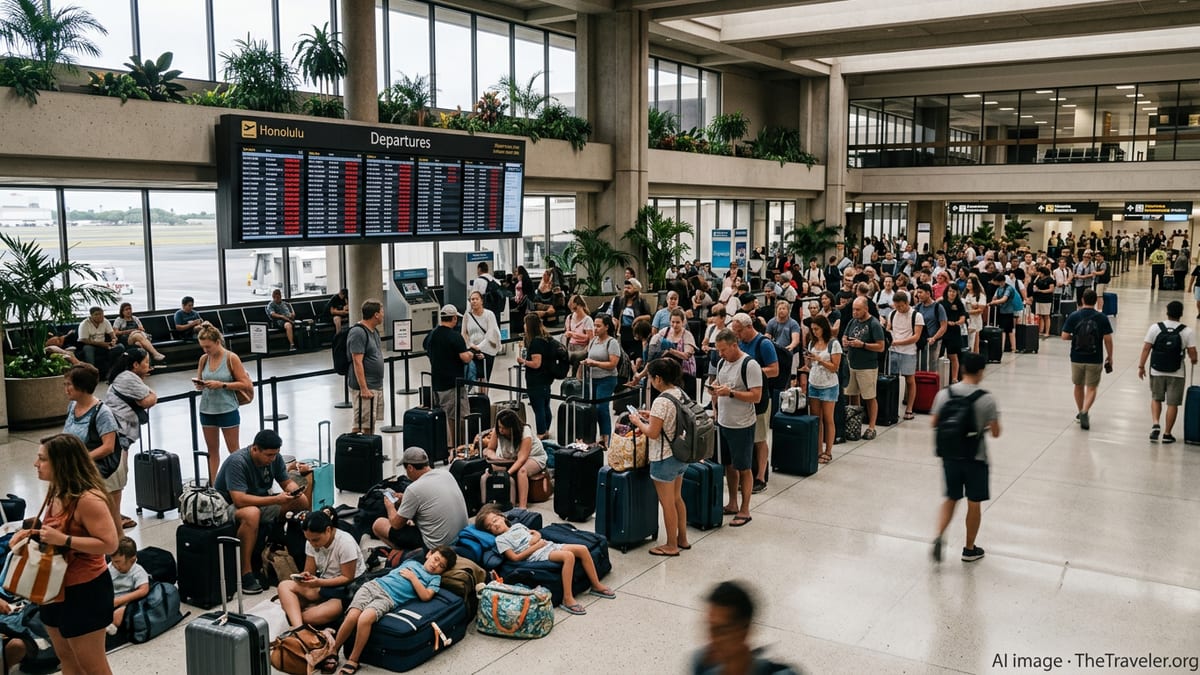
A wave of weather-related disruptions and cascading airline cancellations at Honolulu’s Daniel K. Inouye International Airport over the past several days has stranded visitors, snarled interisland connectivity, and raised fresh questions about the resilience of Hawaii’s tourism infrastructure during peak travel periods.
Get the latest news straight to your inbox!
Severe Weather Triggers Widespread Flight Disruptions
A powerful bout of severe weather affecting the Hawaiian Islands between March 12 and March 15 led to substantial schedule upheaval at Daniel K. Inouye International Airport in Honolulu, the state’s primary air hub. Public travel alerts show major carriers activating weather waivers for flights to, from, and through Honolulu, allowing passengers to rebook trips without change fees as storms disrupted operations.
According to published coverage and airline advisories, the weather system created a knock-on effect across the archipelago, with Honolulu at the center of the turbulence. Delays and cancellations there rippled outward to neighbor island airports such as Kahului, Lihue, and Kona, complicating itineraries for visitors who rely on tight interisland connections to reach resort destinations.
While severe weather is not uncommon in the Pacific, the timing and intensity of this event coincided with a busy spring travel window. The result was a sharp mismatch between heavy demand and suddenly constrained capacity, leaving many travelers waiting for open seats as airlines worked to reset their schedules.
Observers following airline operations note that such events can quickly overwhelm even well-prepared systems when most flights are heavily booked. In Hawaii’s case, the state’s geographic isolation and reliance on airlift mean there are few alternatives once large portions of the schedule are disrupted at the main Honolulu gateway.
Travelers Face Stranded Nights and Scrambled Itineraries
Reports from passengers traveling through Honolulu over the past week describe missed connections, overnight stays, and last-minute reroutings as airlines struggled to re-accommodate customers. Social media posts reference long waits in terminal areas, shifting departure times, and uncertainty about when seats would become available on heavily oversold routes.
Accounts shared on public forums outline scenarios in which visitors attempting to leave the islands were pushed back a day or more, sometimes routed via multiple mainland hubs before reaching their final destinations. Others describe the opposite problem: flights into Honolulu segmenting poorly with onward interisland services, leaving travelers unexpectedly overnighting on Oahu or scrambling to rearrange hotel bookings.
Some travelers indicated they received travel vouchers or the option to change flights without penalty, but still faced significant disruption to carefully planned vacations. With hotel, car rental, and activity reservations often nonrefundable or difficult to modify at short notice, even a single cancellation in Honolulu could cascade into hundreds of dollars in additional costs for individual visitors.
For those already anxious about long overwater flights and tight layovers, the sudden instability of schedules at Daniel K. Inouye International Airport intensified stress. Families traveling with young children, older visitors, and international tourists with limited English or unfamiliarity with U.S. consumer rules appeared particularly vulnerable to the prolonged uncertainty.
Pressure on Hawaii’s Tourism Lifeline
The latest episode of travel chaos arrives at a delicate moment for Hawaii’s visitor economy. Recent data from state transportation and tourism agencies highlight that passenger volumes through Honolulu have been climbing back toward, and in some segments exceeding, pre-pandemic levels, even as international markets such as Japan and Canada show uneven recovery patterns.
Economic forecasts from local research groups emphasize that Hawaii’s dependence on air travel remains disproportionate compared with many U.S. destinations. Virtually every visitor from the continental United States and abroad must pass through a limited set of airports, with Honolulu functioning as the primary gateway. When operations at Daniel K. Inouye International Airport seize up, the effect is magnified across hotels, tour operators, restaurants, and small businesses statewide.
Analysts warn that repeated episodes of large-scale disruption, whether driven by weather, infrastructure issues, or airline restructuring, can influence visitor perception. Travelers who experience long delays, confusing rebooking processes, and unplanned expenses may reconsider a return trip or opt for alternative sun-and-sand destinations that appear more logistically predictable.
Industry watchers also point out that Hawaii’s tourism model leaves little slack in the system. High load factors on flights, staffing transitions linked to airline mergers, and ongoing cost pressures mean there are fewer spare crews and aircraft available when storms or mechanical issues force schedule changes at Honolulu.
Airlines, Infrastructure and Capacity Constraints Converge
The recent turmoil has also unfolded against a backdrop of structural shifts in Hawaii’s aviation sector. Publicly available corporate filings and local news coverage detail ongoing integration work as major carriers adjust fleets, staffing, and routes serving Honolulu, including at Terminal 2 and associated cargo facilities. Job cuts and realignments in the months ahead are expected to reshape how some airlines operate within the airport.
At the same time, state transportation statistics show Honolulu handling millions of passenger movements a year, with international arrivals from Japan, Korea, and other Asia-Pacific markets layered on top of robust U.S. mainland demand. Even incremental growth in traffic can strain terminal space, security screening capacity, baggage systems, and ground transport links if improvements do not keep pace.
Recent initiatives such as new electric people-mover vehicles within the airport complex underscore attempts to modernize the traveler experience. However, passenger feedback shared in public forums suggests that on-the-ground changes can feel inconsistent, with some travelers praising upgraded facilities while others report crowding, long queues, and confusion during irregular operations.
When severe weather and airline schedule adjustments coincide with these broader capacity and transition challenges, the result at Daniel K. Inouye International Airport can be what many travelers in recent days have described as organized chaos at best and total gridlock at worst.
Calls for Greater Resilience and Clearer Communication
The fallout from the latest wave of cancellations is prompting renewed discussion among tourism stakeholders, commentators, and frequent travelers about how Hawaii can bolster the resilience of its primary gateway. Suggestions circulating in public debate include clearer, more centralized communication tools, stronger coordination between airlines and state agencies, and better real-time information for visitors unfamiliar with the airport layout or local conditions.
Travel advocates frequently stress the importance of proactive messaging during disruptions, including candid estimates of delays and realistic timelines for recovery. When passengers at Honolulu are given early warning that flights may not operate as planned, they are more likely to secure alternative accommodations, adjust onward bookings, or modify expectations before arriving at the airport.
Some analysts argue that in an era of climate volatility and tight aviation networks, Hawaii will need to plan for major operational interruptions at Daniel K. Inouye International Airport as recurring events rather than rare shocks. This could mean scenario planning that spans airlines, hotels, and local tourism boards to ensure stranded passengers can access essential services and clear information without overwhelming any single provider.
For now, as airlines work through backlogs and weather patterns ease, schedules at Honolulu are gradually stabilizing. Yet the images and first-hand accounts emerging from the past several days serve as a reminder that Hawaii’s world-famous beaches and resorts are only as accessible as the flights that connect the islands to the rest of the world.