

More news on this day
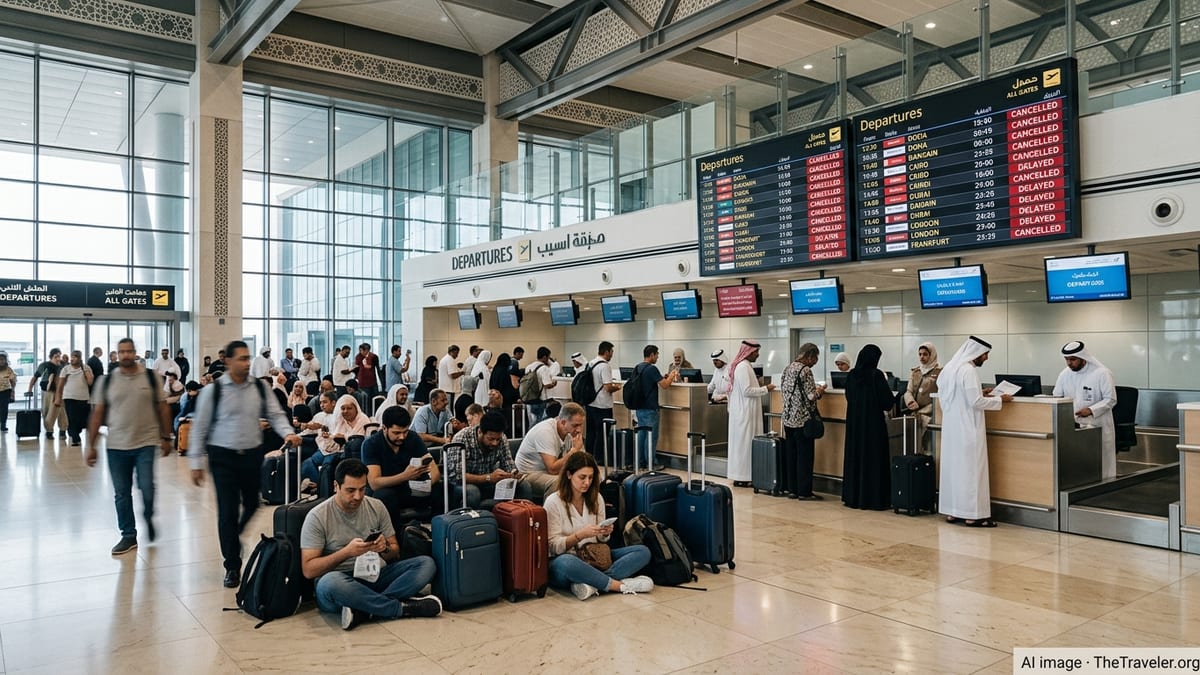
Passengers at Muscat’s Seeb International Airport faced a fresh round of cancellations and long delays on Sunday as disruptions affecting Gulf Air and Qatar Airways rippled across key routes linking Muscat with Bahrain, Doha, Cairo, Luxembourg and other major cities.
Get the latest news straight to your inbox!
Regional Airspace Turmoil Spills Into Muscat
Travel disruption at Seeb International Airport is unfolding against a backdrop of wider instability across Middle East air corridors. Publicly available aviation and security bulletins for March 2026 describe partial and full airspace closures in several Gulf states, together with repeatedly amended flight schedules and constrained capacity on remaining services. This regional picture has left Muscat handling diverted aircraft, irregular operations and frustrated travelers trying to rebook onward journeys.
Reports indicate that Muscat has been functioning as a regional exit and diversion point during recent airspace shutdowns, with some airlines routing aircraft through Oman when primary hubs were restricted. That has put extra operational pressure on Seeb International Airport, where ground handling teams, immigration desks and baggage services have been operating close to capacity during peak disruption windows.
Within this volatile environment, three flights operated by Gulf Air and Qatar Airways and serving Muscat and nearby hubs were cancelled over the weekend, according to live schedule snapshots and passenger accounts shared on travel forums and airline tracking platforms. A wider cluster of departures and arrivals showed extended delays, in some cases stretching beyond three hours as carriers adjusted routings and crew allocations.
While comprehensive, real-time statistics are difficult to verify in such fast-changing conditions, the pattern emerging in Muscat mirrors a broader reduction in Gulf-wide frequencies. With airlines prioritising limited corridors and essential services, non-essential or lower-yield rotations have been particularly vulnerable to last-minute cancellation.
Gulf Air Grounding Deepens Connectivity Gaps
Gulf Air’s difficulties have been a central factor in the latest wave of disruption. Passenger advisories and airline communications circulated in early March indicated that the Bahraini carrier had suspended most scheduled operations because of the closure of Bahrain’s airspace, with its primary hub at Bahrain International Airport effectively offline for regular commercial traffic.
This grounding has immediate consequences for Muscat, historically linked to Bahrain by multiple weekly Gulf Air services that feed onward connections into the airline’s regional and European network. With key Bahrain rotations removed from the timetable, travelers departing Seeb International Airport have lost a common one-stop option to destinations across the Levant, Europe and parts of Asia that are normally reached via Manama.
The current situation has also complicated recovery plans for stranded passengers. Flyers who began their journeys on Gulf Air from outstations and were due to connect via Bahrain or Muscat now face fragmented itineraries, with segments cancelled and remaining legs showing as “scheduled” but still subject to change. Public posts from affected passengers describe repeated rebookings, vanished bookings in airline apps and uncertainty over when a stable schedule will return.
Travel industry advisories suggest that, for the time being, alternative routings via non-affected hubs such as certain Indian or European gateways are absorbing some of the displaced demand. However, seat availability is tight and, in many cases, considerably more expensive than originally booked Gulf Air itineraries, leaving some passengers opting to delay travel altogether.
Qatar Airways Cancellations Stretch From Doha To Cairo And Europe
Qatar Airways operations have also been heavily constrained in recent weeks, following the closure and subsequent partial reopening of Qatari airspace and Hamad International Airport. Publicly available information and traveler accounts for late February and March 2026 describe wholesale cancellations of commercial flights, followed by a limited schedule of repatriation and “safe corridor” services focused on major capitals such as London, Paris and Frankfurt.
This restricted operating pattern has had a tangible impact on passengers moving through Muscat. Some Qatar Airways flights that would normally route directly through Doha between Asia, the Gulf, North Africa and Europe have instead been cancelled outright, with Muscat occasionally used as a diversion point or as a temporary holding location during earlier phases of the disruption. Travelers have reported lengthy ground delays in Muscat after diversions, as well as onward segments to cities such as London or Colombo that were later cancelled or rescheduled.
Connections to Cairo and other North African destinations have been particularly fragile. Flight-tracking data and passenger messages posted on social platforms refer to multiple cancellations on Doha to Cairo services through mid-March, with tickets repeatedly reissued and then voided as Qatar Airways adjusted its limited operating schedule. For Muscat-based travelers, the loss of predictable one-stop itineraries via Doha to Cairo, North Africa and parts of Europe has narrowed options, especially for time-sensitive business and family travel.
Routes toward northern Europe are also affected. Luxembourg and other secondary European cities that typically see passengers routed via Gulf hubs have experienced knock-on disruption, with some services removed from booking systems and others showing as heavily delayed or waitlisted. In practice, many passengers seeking to reach these destinations from Muscat are being encouraged to route via major European hubs served by airlines that are less exposed to Gulf airspace constraints.
Passengers Face Long Delays, Limited Support And Rising Fares
For travelers on the ground, the operational complexity behind the current disruption translates into long waits, uncertainty and additional cost. Posts shared on travel forums during March describe itineraries that were cancelled multiple times, tickets that disappeared from airline apps after repeated changes, and customers who arrived at airports only to learn that their flights had been removed from the schedule earlier that day.
Several passengers recount extensive queues at airport and city ticketing offices, with staff working from rapidly changing guidance and limited ability to guarantee new travel dates. Long call-center wait times and overloaded digital channels have added to the frustration for travelers trying to secure earlier rebookings, particularly on popular segments between Doha, Dubai, Muscat and major South Asian and European cities.
Tight capacity on alternative airlines has also pushed fares sharply higher on remaining routes, making last-minute self-rebooking an expensive proposition. Some travelers have opted to purchase fully refundable backup tickets on other carriers while keeping their original Gulf Air or Qatar Airways bookings open, effectively hedging against further cancellations but tying up significant funds in multiple tickets.
There are additional complications for those who planned multi-city itineraries that included stopovers in Doha or Bahrain. In some cases, hotel stays and onward legs to destinations such as Cairo or Luxembourg are now detached from the original inbound flights, leaving travelers to navigate separate refund rules for accommodation, ground transport and tours while they wait for airlines to clarify long-term scheduling.
What Travelers Through Muscat Can Expect In The Coming Days
With regional airspace conditions still unsettled in late March 2026, aviation analysts and travel risk advisories suggest that disruption throughout the Gulf is likely to persist for at least several days, and potentially longer. Airlines are expected to continue prioritising limited corridors and essential routes, meaning that additional cancellations or significant delays at Seeb International Airport remain possible on short notice.
Industry guidance for passengers transiting Muscat emphasizes the importance of checking flight status frequently on the day of travel, monitoring email and mobile notifications from airlines, and allowing extended connection times where itineraries involve transfers through hubs such as Doha or other Gulf airports. Travelers are also being urged to review fare conditions and flexible-change policies introduced by carriers in response to the airspace closures, which in some cases allow multiple date changes without additional fees.
For now, Seeb International Airport is expected to retain an important role as a diversion and relief hub while Bahrain and Qatar work through their respective operational constraints. Passenger volumes may therefore remain uneven, with quiet periods punctuated by surges in diverted or rebooked travelers arriving on short notice.
Although there are early signs that some airlines are exploring expanded schedules from early April onwards, recent experience suggests that full normalization could be gradual rather than immediate. Until regional airspace restrictions are definitively lifted and carriers restore regular timetables, passengers moving between Muscat, Bahrain, Doha, Cairo, Luxembourg and other affected destinations are likely to face a higher-than-usual risk of last-minute changes to their travel plans.