

More news on this day
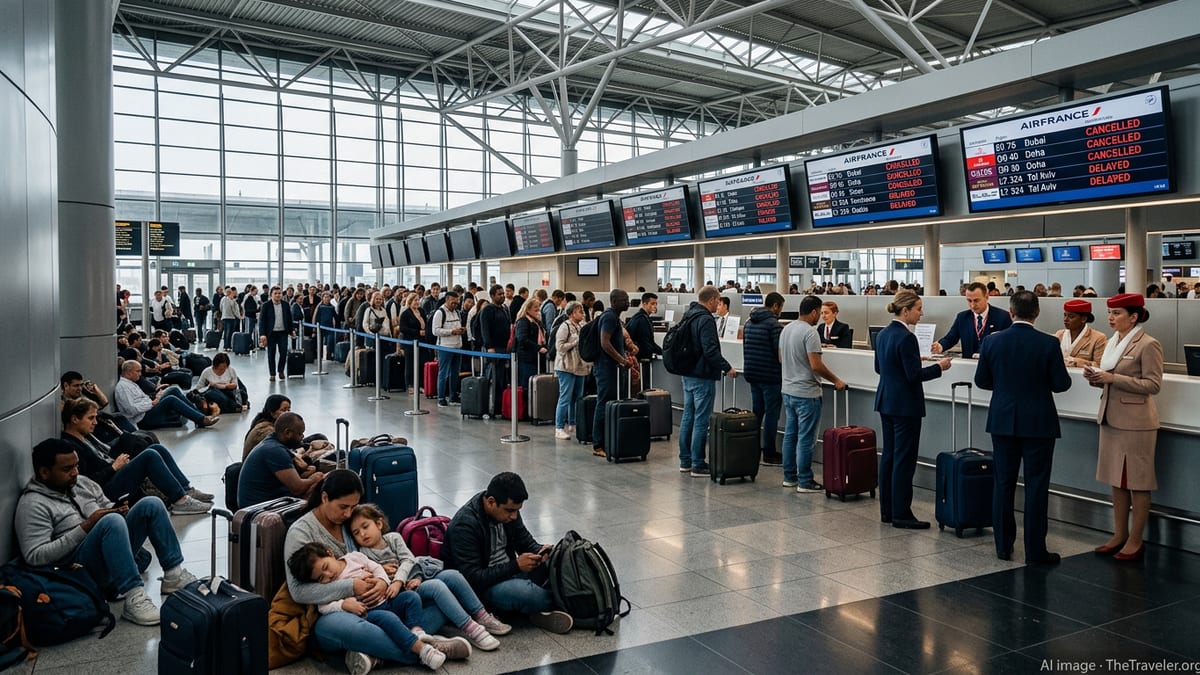
Thousands of passengers were left stranded or severely delayed at Paris Charles de Gaulle Airport on March 5 as at least 31 flights were canceled and more than 100 delayed, after a cascading wave of airspace closures linked to the conflict in the Middle East forced major international airlines including Air France, El Al, Emirates, Etihad Airways and Qatar Airways to abruptly cut services.
Major Paris Hub Hit by Global Airspace Crisis
Operational data from European air travel trackers on Thursday showed that Paris Charles de Gaulle, one of Europe’s busiest hubs, recorded 27 to 31 flight cancellations and well over 100 delays in the space of a single day, putting intense pressure on terminal operations and airline customer service desks. The disruption came on top of days of upheaval across the Middle East, with multiple countries closing their airspace following U.S. and Israeli strikes on Iran and retaliatory attacks in the region.
While Charles de Gaulle itself remained open, the airport’s role as a key bridge between Europe, the Gulf and Asia made it especially vulnerable to the knock-on effects of those closures. Airlines that rely heavily on Middle East airspace for long-haul routes found themselves forced to suspend, reroute or dramatically extend flight times, leaving aircraft, crew and passengers out of position.
Air France, the airport’s dominant carrier, confirmed broad cuts to its schedule on routes touching the region, including services to Tel Aviv, Beirut, Dubai and Riyadh, feeding directly into Thursday’s disruption in Paris. Flights operated by Gulf-based carriers that normally funnel passengers through Dubai, Abu Dhabi and Doha were also curtailed, intensifying pressure on remaining services at Charles de Gaulle.
Industry analysts say the disarray underscores how dependent global aviation has become on a relatively narrow set of air corridors stretching across the Middle East and the Caucasus. With key segments of that airspace fully or partially closed, long-haul networks across Europe, Asia and Africa are experiencing one of the worst cascade failures in more than a decade.
Air France, Gulf Carriers and El Al Among Worst Affected
Among the airlines most visible in Thursday’s turmoil were Air France, El Al and the major Gulf carriers that serve Paris Charles de Gaulle. Air France has progressively suspended flights to several Middle Eastern destinations in recent days, and on March 5 a portion of its long-haul network through CDG remained canceled or heavily delayed as aircraft and crews were stranded away from base.
Emirates, Etihad Airways and Qatar Airways all continued to operate sharply reduced schedules as their home hubs in Dubai, Abu Dhabi and Doha coped with local suspensions and regional airspace restrictions. Many of their regular Paris-bound services either did not operate or were replaced by one-off repatriation flights with limited capacity, catching connecting passengers in Paris off guard.
Israeli flag carrier El Al, which has faced rolling disruptions since the escalation of hostilities, saw additional knock-on effects for its Paris operations as routing options narrowed. With Israeli airspace under heightened restrictions and much of the surrounding region effectively closed, El Al’s services to and from Europe have been subject to frequent last-minute changes.
Other carriers serving Paris Charles de Gaulle, including British Airways and several European and Asian airlines with routes that typically overfly the Middle East, reported delays as they were forced to detour around closed airspace. Longer flight times translated into late arrivals in Paris and missed onward connections, amplifying the disruption throughout the day.
Travelers Face Long Queues, Patchy Information and Difficult Choices
Inside CDG’s terminals on Thursday, travelers encountered long queues at airline service counters and transfer desks as they sought rebooking options or information on when flights might resume. Many reported receiving notification of cancellations only hours before departure, leaving limited time to adjust plans or secure alternative transport.
With hub carriers stretched, some passengers were offered overnight accommodation in airport hotels, while others were given meal vouchers and lists of later flights that were already heavily oversubscribed. For long-haul travelers arriving from North America or Africa and expecting same-day onward connections via Paris to the Gulf, South Asia or Southeast Asia, the sudden collapse of connecting options meant an unplanned stay in France or a scramble to route via northern corridors through Turkey, Central Europe or the North Atlantic.
Airport staff and ground handlers at Charles de Gaulle worked to manage crowding around departure boards and security checkpoints as rolling gate changes and late-arriving aircraft forced constant adjustments. Public announcements in French and English urged passengers to remain close to their gates, even as those assignments shifted throughout the day.
Travel advisers say the situation illustrates the importance for long-haul passengers of monitoring flight status up to the moment of leaving for the airport and of booking flexible tickets where possible. Under European passenger-protection rules, airlines operating out of EU airports are required to offer rebooking or refunds in the event of cancellations, but in a systemic shock of this scale, available seats on alternative services can quickly run out.
Rerouting Challenges and Limited Relief Flights
The closures of multiple Middle Eastern airspaces have forced airlines to redesign routes in real time, frequently adding hours to flight times or making some itineraries temporarily unviable. Carriers that would normally route Paris-originating flights through the Gulf on their way to Asia have been experimenting with more northerly tracks over the Caucasus and Central Asia, but these options are constrained by already busy skies and, in some cases, their own safety assessments.
For Emirates and Etihad Airways, which typically operate dense banks of connecting flights through their UAE hubs, the near-total suspension of regular services has prompted the use of limited repatriation and relief flights. Some of those special operations include departures from Paris to Dubai or Abu Dhabi that are open only to passengers with previously canceled tickets or documented onward travel, further limiting options for stranded travelers at CDG attempting to buy their way out of the disruption.
Qatar Airways, which has suspended its regular operations while Qatari airspace remains closed, has begun mounting a small number of relief flights on select days to move passengers caught in transit. However, the scale of the backlog means that it could take several days, if not longer, for many travelers at European hubs such as Paris to secure seats.
Alternative routings via North American or northern European hubs have been complicated by parallel disruptions at airports including Frankfurt and Amsterdam, where weather and the broader crisis have produced their own waves of delays and cancellations. As a result, some travel agents are advising passengers to consider postponing nonessential long-haul trips through the region until normal patterns begin to re-emerge.
What Passengers at Charles de Gaulle Should Do Now
With the situation evolving by the hour, aviation authorities and consumer groups are urging passengers traveling through Paris Charles de Gaulle over the coming days to proceed with caution. Travelers are advised not to head to the airport unless their flight status is confirmed as operating, and to ensure airlines have up-to-date contact details for text or email alerts in case of last-minute changes.
Under European regulations, passengers whose flights are canceled are entitled to choose between rebooking at the earliest opportunity, rebooking at a later date or receiving a refund for the unused portion of their ticket. Airlines must also provide basic care in the event of long delays, including meals and, when necessary, hotel accommodation, although the precise level of compensation for knock-on disruption caused by external geopolitical events may vary by case.
Experts recommend that travelers stranded at CDG keep all receipts for meals, accommodation and alternative transport, in case they need to file claims with airlines or travel insurers later. They also suggest travelers document communications with carriers, including screenshots of cancellation notices and revised itineraries.
While there are signs that some Gulf hubs are beginning to plan additional relief services and selective resumptions, aviation analysts caution that it may take several days before the full extent of the disruption at Paris Charles de Gaulle and other major European airports becomes clear. For now, passengers passing through the French capital’s main international gateway are being told to brace for continued uncertainty and to build extra time and flexibility into any journey that relies on long-haul connections through the affected region.