

More news on this day
Hundreds of long haul passengers were left in limbo at Paris Charles de Gaulle Airport on Monday as a wave of cancellations and delays by El Al, Qatar Airways, Emirates and Air France disrupted at least 15 flights and delayed 96 more to New York, Dubai, Tokyo and other major global hubs.
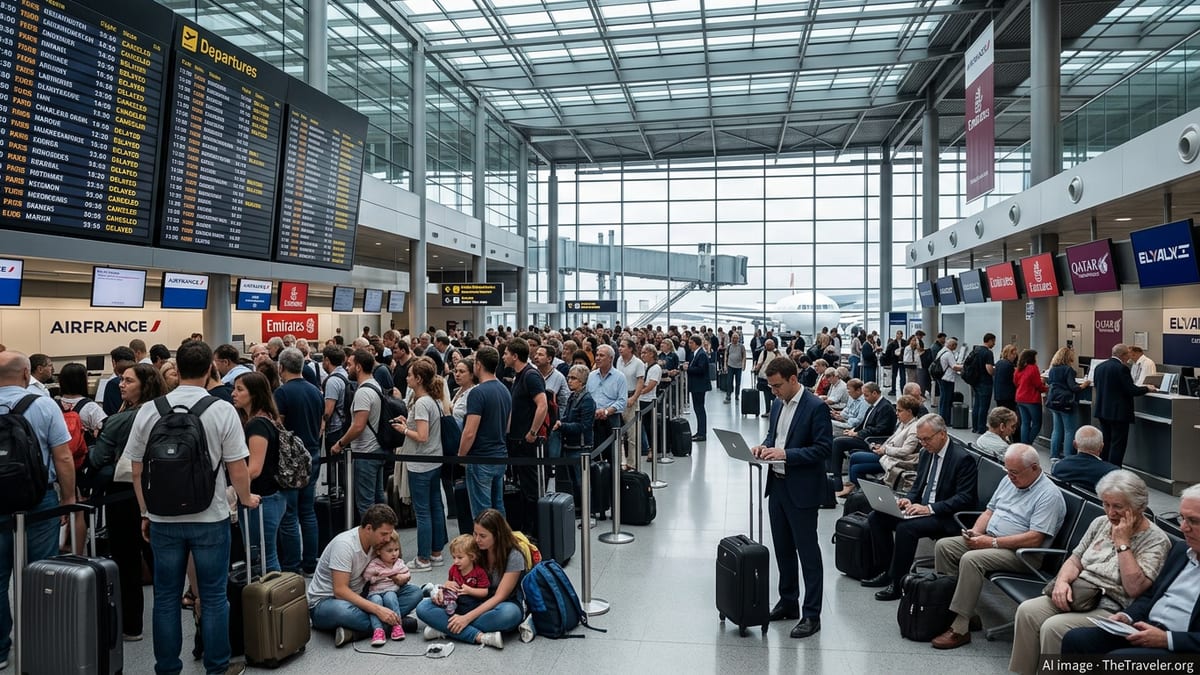
Ripple Effects From Middle East Airspace Closures Hit Paris
The latest disruption at Europe’s second busiest hub comes against the backdrop of severe airspace restrictions across the Middle East that have forced carriers to reroute or suspend services. Emirates and Qatar Airways have already slashed schedules from their Gulf hubs in recent days, while Air France has extended a suspension of flights to and from Dubai and Riyadh until later this week, putting further pressure on connecting flows through Paris.
Air travel data for Europe shows that airports such as Paris Charles de Gaulle have been absorbing a growing share of the knock on impact, with mounting delays on services to Asia, North America and the Gulf as airlines navigate longer routings around closed airspace and manage aircraft and crew imbalances.
At Charles de Gaulle, the result on Monday was a cluster of cancellations and rolling delays that particularly affected departures to New York, Dubai and Tokyo, where many passengers were due to connect to onward services across the Americas and Asia Pacific.
Airport staff said they were working with airlines to rebook stranded travelers, but available seats on alternative departures were limited due to ongoing disruption at other European hubs that would normally help absorb overflow traffic.
Disrupted Flights to New York, Dubai, Tokyo and Beyond
Among the hardest hit on Monday were long haul services operated by Emirates and Qatar Airways to Dubai and Doha, often used by European passengers as gateways to Asia, Australia and Africa. With flights from the Gulf already curtailed, the disruption at Paris meant some travelers attempting to return via Dubai or Doha instead found themselves facing overnight stays and uncertain onward connections.
Transatlantic routes also saw significant disruption. Air France and partner carriers trimmed departures to New York, and passengers reported lengthy waits at customer service desks as agents attempted to reroute them through other European airports where capacity still existed.
Flights to Tokyo and other key Asian cities were likewise delayed or canceled as airlines balanced the need to avoid restricted airspace with schedules that had already been stretched thin in recent days. For travelers who had stitched together complex multi segment itineraries, a missed departure from Paris often meant the loss of an entire sequence of onward flights.
With 15 cancellations and 96 delayed departures or arrivals recorded in the affected period, airport displays showed a patchwork of revised departure times. In many cases, estimated delays for long haul services stretched from one to four hours as crews and aircraft were repositioned.
Passengers Face Long Queues, Confusion and Limited Options
Inside the terminals, the operational numbers translated into long lines at check in counters and transfer desks for the affected airlines. Travelers reported waiting more than an hour to speak with agents as stranded passengers attempted to secure hotel vouchers, meal coupons or alternative routing.
Those booked on El Al and Qatar Airways services found options especially constrained as their carriers were already heavily affected by the wider regional disruption. Many were offered rebookings one or two days later, prompting some to search on their own for open seats on other airlines departing from different European cities.
Airport announcements urged passengers not to proceed to security until they had confirmed their flight status and, where possible, to manage changes through airline apps and websites rather than queuing in person. Nevertheless, for travelers with tight visa windows or fixed commitments at their destinations, digital tools did little to ease the uncertainty.
Families with children and older travelers were among the most visibly affected, sitting on the floor near power outlets and clustered around information screens as they waited for updated departure times. Airport staff walked the lines distributing bottled water and basic information leaflets summarizing passenger rights under European Union rules on delays and cancellations.
What Travelers Need to Know About Their Rights
Under European Union regulations, passengers departing from Charles de Gaulle on any airline, or flying into the airport on a carrier based in the bloc, are covered by common rules on compensation and care in the event of significant delays or cancellations. Depending on the length of the delay and the distance of the flight, travelers may be entitled to meals, refreshments, hotel accommodation and in some cases financial compensation.
For long haul routes such as Paris to New York, Dubai or Tokyo, delays of three hours or more on arrival can trigger compensation if the cause lies within the airline’s control, such as crew or operational planning problems. When disruption is attributable to extraordinary circumstances like sudden airspace closures, airlines are still obliged to provide care including meals and accommodation, but direct cash compensation may not apply.
Consumer advocates at the airport on Monday urged passengers to document their experience carefully, including keeping boarding passes, receipts and screenshots of delay notifications. They also recommended that travelers who accept vouchers for disrupted flights review the terms closely to ensure they do not inadvertently waive potential claims under European regulations.
With multiple carriers involved in the Charles de Gaulle disruption, passengers with tickets issued by one airline but operated by another were advised to clarify which company is responsible for handling claims and arranging care, as this can vary depending on the specific booking and codeshare arrangements.
Ongoing Uncertainty as Airlines Adjust Schedules
Airlines serving Paris indicated that schedules would remain fluid over the coming days as they continued to monitor developments in the Middle East and adjust routings accordingly. Air France has already warned customers of continuing changes on selected services to the Gulf and beyond, while global partners are issuing rolling travel waivers that allow passengers to rebook or change destinations without standard fees.
Industry analysts noted that the combination of airspace closures, rerouting and airport congestion across Europe has created a fragile operating environment in which even minor weather or technical issues can quickly cascade into widespread disruption. With key hubs such as Dubai and Doha still running reduced schedules, capacity for recovery remains limited.
For now, travelers planning to pass through Charles de Gaulle to long haul destinations are being urged to check their flight status repeatedly in the 24 hours before departure and to allow additional time for connections. Where possible, flexible tickets and travel insurance with disruption coverage are being recommended, particularly for complex multi leg journeys reliant on Middle East or European hubs already under strain.
As airlines and authorities work to stabilize the situation, the scenes at Paris on Monday served as another reminder of how quickly international air travel can be thrown off course, and how vulnerable travelers remain to disruptions far beyond the airport where they check in.