

More news on this day
Travelers across South America faced hours of disruption at Santiago’s Comodoro Arturo Merino Benítez International Airport on February 20, as 34 delayed flights and two cancellations rippled through key regional routes linking the Chilean capital with Buenos Aires, São Paulo and Lima, affecting operations by LATAM Airlines, American Airlines and Aerolíneas Argentinas.
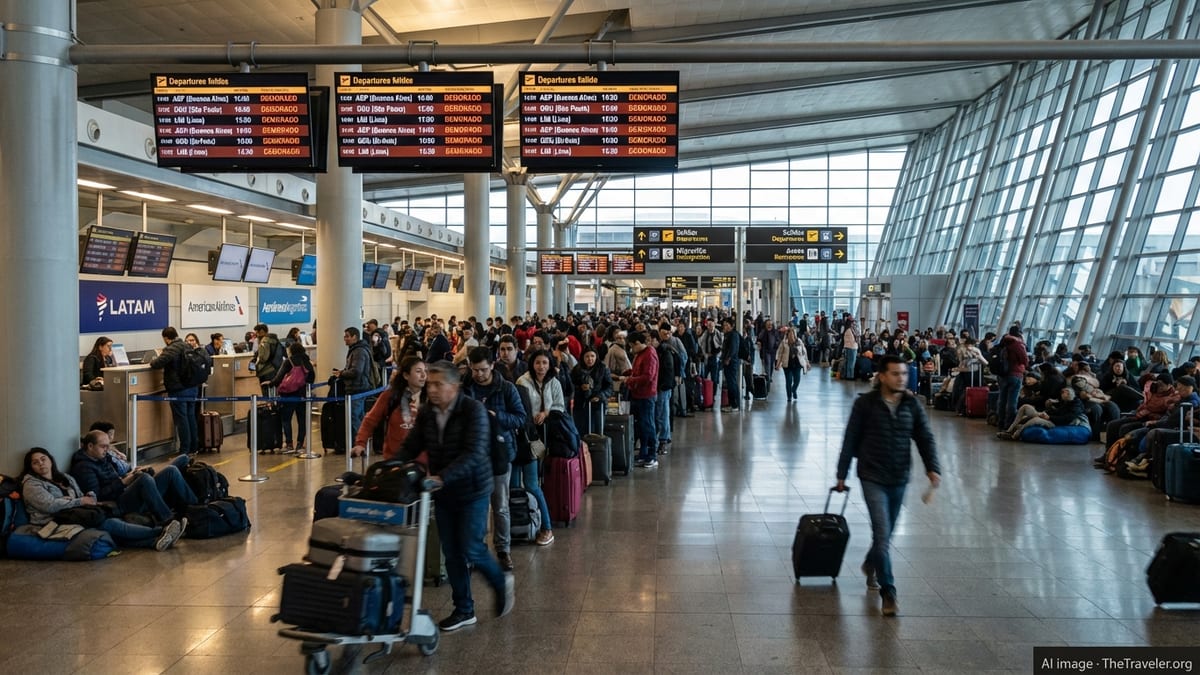
Major South American Hub Struggles With Morning Meltdown
The disruption unfolded in the early and mid-morning hours at Santiago’s main international gateway, one of the busiest air hubs in the Southern Cone. While Santiago frequently handles weather and congestion-related slowdowns, the volume and concentration of delays reported on February 20 created an unusually severe operational bottleneck for airlines and airport authorities.
Operational data and airline status boards showed a cluster of late departures and arrivals on regional trunk routes, particularly those linking Santiago with Buenos Aires, São Paulo and Lima. These corridors are vital for business travelers, connecting traffic to long-haul services, and leisure passengers taking advantage of high-season demand across the Andes and along the Pacific coast.
Although most of the affected flights eventually departed or arrived, the cumulative effect of 34 delays and two outright cancellations created knock-on impacts throughout the day. Many passengers missed onward connections, others were forced to rebook for later departures, and both airlines and ground handlers scrambled to reassign aircraft and crew.
The problems hit at a sensitive moment for South American aviation, with carriers still working to match capacity with strong demand during the austral summer peak while coping with tight staffing and an air traffic system that leaves little room for error.
Flights From Buenos Aires, São Paulo and Lima Bear the Brunt
The most affected services were those operating on some of the region’s busiest cross-border routes. Flights from Buenos Aires’ Ezeiza and Aeroparque airports, São Paulo’s Guarulhos hub and Lima’s Jorge Chávez International Airport experienced a mix of moderate and extended delays, according to airline status updates and regional aviation trackers.
Several morning departures from Buenos Aires to Santiago, including services scheduled by LATAM and Aerolíneas Argentinas, left well behind timetable, compressing turnaround times in Chile and forcing airlines to reshuffle afternoon rotations. In some cases, passengers bound for further connections in Santiago found their onward journeys rescheduled for later in the day.
Services from São Paulo to Santiago also saw schedule disruption, with LATAM flights encountering delays that spilled into the midday bank of departures. São Paulo Guarulhos is a critical hub feeding long-haul flights to Europe and North America, and delays on the Santiago leg complicated connections for travelers planning to link through Brazil or Chile the same day.
Traffic from Lima, another key LATAM hub, similarly felt the strain. While most flights ultimately operated, passengers reported long lines and repeated gate changes as airlines attempted to keep aircraft and crew within legal operating limits while absorbing the delay shock at Santiago.
LATAM, American Airlines and Aerolíneas Argentinas Under Pressure
LATAM, the dominant carrier at Santiago and a major operator on all three affected corridors, shouldered much of the disruption. With multiple daily frequencies between Santiago and Buenos Aires, São Paulo and Lima, even relatively short delays across several flights had an outsized impact on the carrier’s network, stretching aircraft utilization plans and crew rosters.
American Airlines, which relies on Santiago as a key South American spoke for its long-haul network to the United States, faced its own operational challenges. Delayed arrivals into the Chilean capital complicated the timing of onward flights and increased the risk of misconnected passengers, particularly those continuing on to North America from other South American points via Santiago.
Aerolíneas Argentinas, already under scrutiny at home following large-scale disruption linked to labor actions and political tensions around the Argentine aviation sector, was also caught in the turbulence. Its regional flights into Santiago from Buenos Aires experienced knock-on effects from earlier operational issues, leaving some passengers stranded on both sides of the Andes with limited alternative options on short notice.
Collectively, the three airlines had to balance customer recovery measures, such as meal vouchers and hotel accommodation in certain cases, with the practical limitations of high-season load factors. With many flights operating near capacity, finding available seats for rebooked travelers became a significant challenge.
Passengers Confront Long Queues, Missed Connections and Poor Sleep
Inside Santiago’s terminal, the disruption translated into long, slow-moving lines at check-in counters, security checkpoints and airline service desks. Travelers arriving from Argentina, Brazil and Peru to connect onward to domestic Chilean destinations or long-haul flights reported sprinting through the terminal to reach new gates after last-minute reassignments.
Some passengers described spending much of the night or early morning in the airport, stretched across benches or sitting on the floor near their boarding gates as rolling departure times crept later. Families with young children and elderly travelers were particularly affected, as areas around food outlets and rest zones filled to capacity.
The tension was heightened for those holding separate tickets or low-cost fares that offered limited protection in the event of irregular operations. Without through-check protection, some travelers were left to negotiate directly with multiple carriers when one delayed leg caused them to miss a separately booked onward flight.
While airlines did issue rebooking options and, in some cases, accommodation and transport vouchers, the sheer volume of affected passengers and the complexity of their itineraries meant that not all received immediate solutions. Social media channels were peppered with complaints about waiting times at customer service counters and confusion around compensation eligibility.
Operational Strains Exposed at a Key Regional Hub
The morning’s chaos at Comodoro Arturo Merino Benítez International Airport highlighted structural vulnerabilities that have been building across South America’s aviation system. A reliance on a small number of major hubs, such as Santiago, São Paulo and Lima, leaves the region’s air traffic especially vulnerable when even a handful of flights are significantly disrupted at peak hours.
Airlines have been working to rebuild schedules and fleet deployment after the worst of the pandemic-era downturn, but capacity across many South American routes remains tightly calibrated. This means that when irregular operations hit, there are fewer spare aircraft and crews available to step in and stabilize the network quickly.
Meanwhile, the airport itself faces the challenge of processing a rapidly recovering wave of travelers with infrastructure that, although upgraded in recent years, can quickly become stretched. Extended queues at immigration and security, along with crowded departure lounges, have become a more frequent feature during peak travel days, raising questions about the system’s resilience in the face of more serious disruptions.
Industry analysts note that while individual delays may stem from a mix of weather, air traffic control restrictions or technical checks on aircraft, the cumulative picture on days like February 20 suggests a network operating close to its limits, with little slack to absorb shocks.
Regional Context: Labor Unrest and Weather Complications
The travel chaos in Santiago did not occur in isolation. Across the region, carriers have been grappling with a combination of labor disputes, cost pressures and seasonal weather that can quickly turn a tight schedule into a day-long headache for passengers.
In Argentina, a nationwide strike organized by the CGT labor federation on February 19 forced Aerolíneas Argentinas to cancel hundreds of flights, disrupting travel plans for tens of thousands of passengers and creating a backlog that spilled into neighboring countries a day later. Some of the delayed and canceled services into Santiago on February 20 were directly or indirectly linked to aircraft and crew being out of position after the walkout.
Elsewhere, intermittent thunderstorms over major Brazilian hubs and low-visibility conditions at Andean airports have added complexity for flight planning teams. Operations into and out of high-altitude and coastal airports require carefully managed approach and departure windows, and minor weather-related delays can quickly cascade when aircraft are scheduled to perform multiple legs in rapid succession.
Together, these factors have contributed to a sense of ongoing fragility in South American aviation during what should be a lucrative high season for tourism, underscoring how disruptions in one market can swiftly reverberate through several others.
How Airlines and Airport Authorities Responded
As delay statistics mounted at Santiago, airlines moved to stabilize operations and ease the immediate pressure on travelers. Several carriers, including LATAM and American Airlines, activated contingency plans that prioritized maintaining long-haul connectivity and consolidating lightly booked flights where possible to free up aircraft and crews.
Ground handlers at Comodoro Arturo Merino Benítez Airport worked extended shifts to speed up baggage handling and aircraft turnaround times once delayed flights began to arrive. Additional staff were deployed to assist with passenger flow at check-in, boarding gates and information desks, although travelers still reported long waits during the busiest hours.
Airport authorities made public announcements urging passengers to arrive early for flights and to monitor airline apps and message alerts for the latest information. Digital screens across the terminal were updated frequently as airlines adjusted departure times, gate assignments and, in a few cases, aircraft types to better match demand and operational constraints.
While the immediate priority was to get stranded travelers to their destinations, the day’s events are likely to prompt a deeper review of coordination between airlines, the airport operator and Chilean air traffic control, particularly during the early morning peak when a large share of regional flights cluster into narrow time windows.
What Travelers Should Do on Disrupted Days
For passengers planning trips through Santiago and other major South American hubs in the coming days, travel experts recommend taking extra precautions. Arriving at the airport earlier than usual, particularly for morning flights, can offer more time to navigate potential queues and to respond quickly if a flight’s status changes at short notice.
Using airlines’ mobile apps or text alert systems can also help passengers stay ahead of disruption. Many travelers during the February 20 chaos first learned of delays or gate changes via push notifications, allowing them to adjust plans before joining long lines at service counters.
Where possible, booking through itineraries on a single ticket, rather than a patchwork of separate reservations on different airlines, can provide stronger protection in the event of missed connections. Through-tickets give carriers a clearer obligation to re-accommodate travelers when an earlier leg runs late, a margin of safety that proved valuable for some Santiago-bound passengers.
Frequent flyers also suggest traveling with a basic “disruption kit” that includes snacks, water, a power bank, essential medications and a light blanket or sweater. With aircraft and terminals sometimes becoming unexpectedly crowded and services stretched, having a few essentials to hand can make long waits in an airport more manageable.