

More news on this day
Passengers at São Paulo-Guarulhos International Airport faced long lines, missed connections, and hours of uncertainty today as at least 9 flights were canceled and more than 100 were delayed, disrupting travel plans across São Paulo, Rio de Janeiro, Brasília, and other major Brazilian cities.
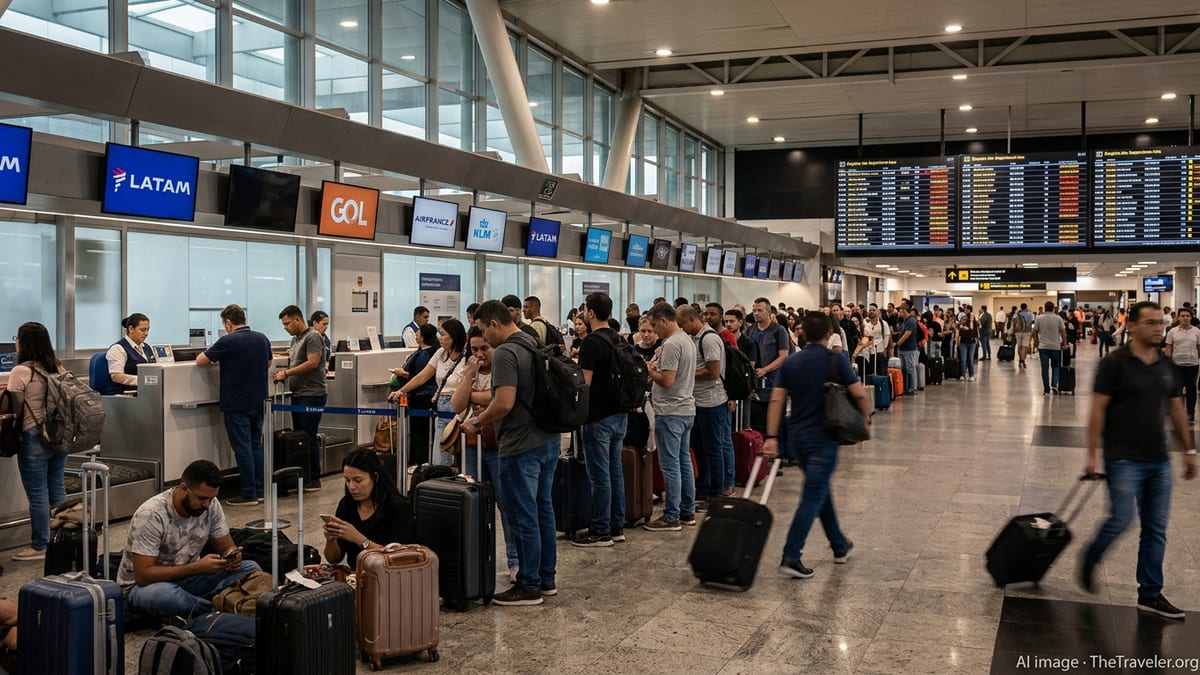
Wide-Scale Disruptions at Brazil’s Busiest International Hub
By mid-afternoon, operational data from São Paulo-Guarulhos, Brazil’s largest international gateway, showed a growing tally of canceled and delayed flights affecting both domestic and international routes. While cancellations remained in the single digits, delays climbed into triple figures, leaving aircraft and crews out of position and passengers queued at service counters throughout the terminals.
According to airport and industry monitoring data, the disruption involved a mix of Brazilian carriers, including LATAM and GOL, alongside foreign airlines such as Air France and KLM operating long-haul services to Europe and beyond. The irregular operations created a bottleneck in key banks of departures and arrivals, particularly around peak morning and evening periods when connections are heaviest.
Guarulhos, which handles tens of millions of passengers annually and concentrates a large share of Brazil’s international traffic, is particularly sensitive to timing disruptions. Even a relatively small number of cancellations and missed departure slots can quickly cascade across the network, affecting flights not only in São Paulo but also in Rio de Janeiro, Brasília, and several regional capitals.
Terminal concourses were described by travelers as crowded but orderly, with loudspeaker announcements frequently updated and airlines attempting to rebook affected customers onto later flights. Nonetheless, many passengers reported waits stretching well beyond the scheduled departure times printed on their boarding passes.
LATAM, GOL, Air France, KLM Among Affected Carriers
The disturbance at Guarulhos hit a cross-section of airlines, highlighting how tightly interlinked Brazil’s domestic and international air networks have become. LATAM and GOL, the country’s largest domestic operators, saw rotations disrupted on high-demand routes linking São Paulo to Rio de Janeiro, Brasília, Belo Horizonte, Porto Alegre, Recife, and other key cities.
For international travelers, the impact was amplified by delays and schedule changes on widebody flights operated by Air France and KLM between São Paulo and major European hubs. Even modest delays on transatlantic services can mean missed onward connections in Europe, forcing rebookings and unexpected overnight stays for passengers who planned tight itineraries.
Airline staff spent much of the day prioritizing re-accommodation for travelers with immediate connections, while also managing baggage rerouting and meal and lodging vouchers where required by Brazilian consumer and aviation regulations. In some cases, passengers reported being moved between carriers under existing interline agreements to reach their destinations sooner.
Although each airline cited slightly different operational factors, the net effect was similar: a day of uneven schedules, stretched customer-service lines, and a complex puzzle of aircraft and crew movements that will likely take several more rotations to fully normalize.
Ripple Effects in Rio de Janeiro, Brasília, and Beyond
The challenges at Guarulhos were quickly felt in other major Brazilian airports, underlining Guarulhos’ role as a central hub. Flights linking São Paulo with Rio de Janeiro’s Galeão and Santos Dumont airports experienced knock-on delays, with inbound aircraft arriving late and subsequent departures pushed back accordingly.
In Brasília, one of the country’s principal domestic hubs and a frequent connection point for northern and central-west regions, boards showed late arrivals from São Paulo throughout the day. These delays, in turn, affected departures to secondary cities, forcing some passengers to spend longer layovers in the capital than originally planned.
Similar patterns emerged in cities such as Curitiba, Belo Horizonte, Salvador, and Recife, where aircraft operating on tight turnaround schedules could not depart on time after arriving late from Guarulhos. Regional carriers and codeshare partners attempting to feed international services out of São Paulo were particularly exposed, as any delay threatened the integrity of onward long-haul connections.
Ground transportation links were also put under pressure as some travelers opted to reroute via São Paulo’s domestic Congonhas Airport or even switch to intercity buses and private transfers in an attempt to salvage time-sensitive itineraries.
Passengers Endure Long Waits, Missed Events, and Uncertainty
For the thousands of travelers caught in the disruption, the statistics of nine cancellations and over one hundred delays translated into personal stories of missed meetings, postponed vacations, and anxious calls home. Families traveling with children described the difficulty of keeping them entertained in crowded boarding areas as departure times were repeatedly updated.
Business travelers connecting through São Paulo on tight schedules reported scrambling to reschedule conferences, client meetings, and internal events. Some chose to remain airside in hopes of quick rebookings, while others left the airport in search of hotel rooms as the prospect of same-day arrival at their destinations diminished.
Airlines attempted to ease tensions by distributing meal vouchers, opening additional customer-service counters, and reinforcing digital channels so that passengers could manage rebookings via apps and messaging platforms. Still, the sheer volume of affected travelers meant that response times were often slower than usual, testing patience and adding to the sense of uncertainty.
Airport authorities reminded passengers of their rights under Brazilian regulations, including access to communication, food, and accommodation support during extended delays, as well as options for refunds or rebooking when cancellations occur. Many affected travelers carefully documented their experiences with photos, timestamps, and receipts in case they pursue compensation later.
Outlook for the Coming Hours and Travel Advice
By late afternoon, operational indicators suggested that airlines and airport management were gradually regaining control of the schedule, though residual delays were expected to persist into the evening. Some carriers proactively adjusted departure times and temporarily reduced frequencies to allow for a gradual reset of aircraft and crew rotations.
Travel experts recommend that anyone flying into or out of São Paulo-Guarulhos over the next 24 hours monitor flight status closely through airline apps and official airport channels. Passengers with critical same-day connections in Rio de Janeiro, Brasília, or other Brazilian cities are advised to build in extra buffer time where possible or explore earlier departures.
For travelers yet to begin their journey, airlines encouraged checking in online and arriving at the airport earlier than usual, particularly during evening peaks. Those with flexible itineraries may find it worthwhile to inquire about alternative routings, including via other hubs or on partner airlines, to reduce the risk of extended airport stays.
While the disruption appeared to be contained to a single day of irregular operations, experience at Guarulhos has shown that even brief periods of concentrated delays can reverberate for several rotations. For now, passengers and airlines alike will be hoping for a swift return to the smooth, predictable schedules that Brazil’s busiest international airport strives to maintain.