

More news on this day
Days of rolling delays at São Paulo–Guarulhos International Airport are rippling across Brazil and into neighboring countries after a rare shutdown of São Paulo’s airspace and a separate emergency return involving a transcontinental flight, according to airline data and published coverage reviewed through April 12.
Get the latest news straight to your inbox!
Power failure triggers rare shutdown of São Paulo airspace
On April 9, a power failure at the São Paulo Area Control Centre briefly halted almost all takeoffs and landings in one of Latin America’s busiest air corridors. Publicly available operational summaries indicate that controllers suspended traffic for a little over an hour, forcing ground stops at Guarulhos, Congonhas and Viracopos, the three airports that anchor metropolitan São Paulo’s aviation network.
Reports compiled since the incident show that the pause quickly translated into hundreds of delays and cancellations nationwide. Data collated by travel-industry outlets point to more than 800 delays and over 200 cancellations across Brazil on April 10 alone, with São Paulo–Guarulhos listed among the hardest-hit hubs as airlines struggled to absorb the earlier airspace shutdown.
Analysis published by aviation observers notes that São Paulo’s terminal airspace functions as a control valve for much of Brazil’s domestic and international traffic. When that valve temporarily closed, aircraft and crews were left out of position, a problem that could not be repaired simply by restoring power. The result was a multi-day backlog that continued to disrupt schedules heading into the weekend.
Brazil’s civil aviation framework includes a pre-crisis protocol for such large-scale events, and public information indicates that it was activated after the outage. While the measure is designed to prioritize safety and gradually normalize flows, it can also entail revised slot allocations and tactical rerouting that prolong recovery at already constrained airports.
Guarulhos delays cascade through Brazil’s main trunk routes
By April 10 and 11, São Paulo–Guarulhos had become the focal point of the disruption. Figures compiled from airport and airline dashboards cited in local coverage show Guarulhos recording close to 200 delays and dozens of cancellations on April 10, followed by another wave of disruptions the next day as carriers attempted to realign aircraft rotations.
Domestic shuttle routes linking Guarulhos with Rio de Janeiro, Brasília, Belo Horizonte and other major cities were among the worst affected. Missed rotations on these “air bridge” services meant aircraft did not arrive where they were needed for onward legs, forcing some airlines to scrub flights entirely while others operated with significant delay. Observers note that Brazil’s point-to-point carriers depend heavily on such trunk routes, which magnified the operational shock once Guarulhos began the day out of rhythm.
International traffic also felt the strain. Guarulhos is the primary Brazilian gateway for long-haul services to North America and Europe, as well as regional flights to Chile, Argentina, Peru and Colombia. With arrival banks landing late and departure banks pushed back to accommodate crew rest limits, travelers reported missed connections onward to Santiago, Buenos Aires and Bogotá, feeding a secondary wave of schedule changes at those airports.
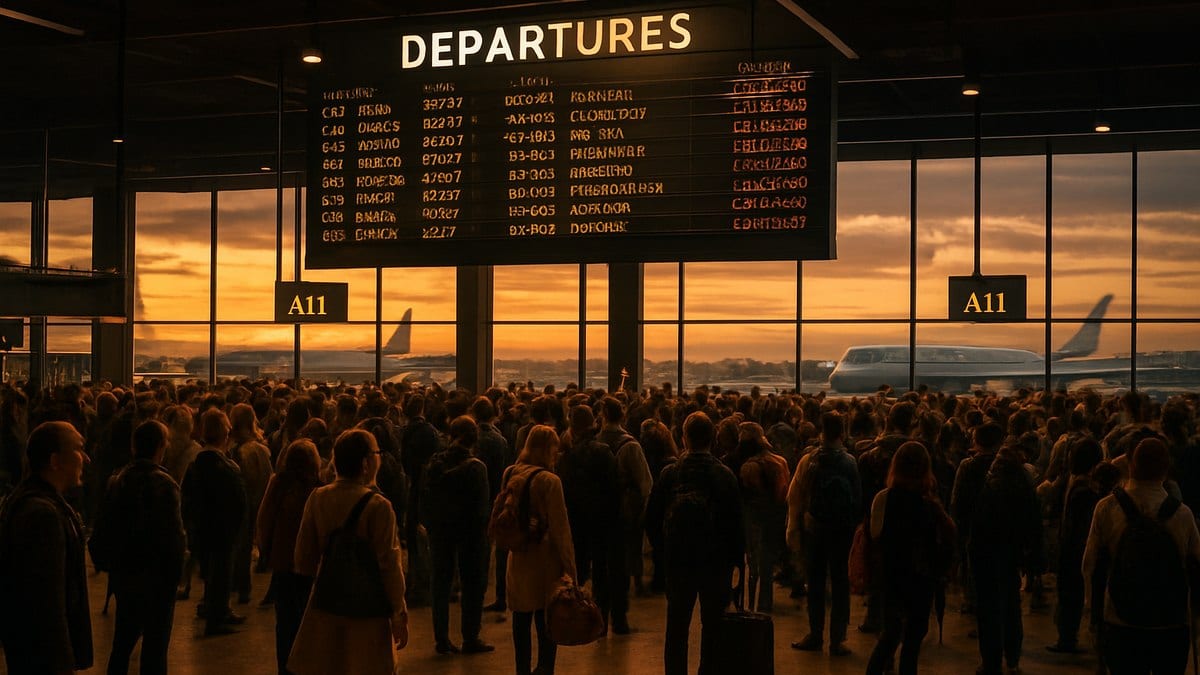
Several monitoring sites tracking day-of-operations performance highlighted prolonged queues at check-in and security in Guarulhos’ terminals, as airlines reprotected passengers and reissued boarding passes for revised itineraries. Publicly accessible flight boards reviewed across the two days show clusters of departures leaving more than two hours behind schedule, especially during the morning and late-evening peaks.
Emergency return adds pressure to already fragile schedules
The system shock from the April 9 airspace outage has been compounded by a separate high-profile incident at Guarulhos less than two weeks earlier. On March 29, a Delta Air Lines Airbus A330 operating flight 104 from São Paulo to Atlanta experienced a left-engine failure shortly after takeoff and returned safely to Guarulhos. Video of the aircraft showing visible engine fire and debris falling near the runway has circulated widely in international media.
According to publicly available accounts of the event and airline statements reported in news coverage, departures and arrivals were temporarily halted while emergency services responded and the runway was inspected. Although the stoppage was shorter than the later April 9 airspace shutdown, it occurred during a late-evening long-haul departure bank, forcing diversions and extensive delays for transcontinental services scheduled behind the damaged aircraft.
While investigations into the engine failure are ongoing under the oversight of Brazil’s accident investigation authorities, operational analysts point out that such incidents can have lingering knock-on effects. Aircraft substitution, technical inspections and crew duty-time limitations all add pressure to network planning, particularly on long-haul routes where spare capacity is limited. With Guarulhos already operating close to capacity at peak times, this earlier disruption left little margin when the broader airspace problem unfolded in early April.
Combined, the two events have highlighted how quickly São Paulo’s main hub can shift from normal operations to severe congestion. Even when individual incidents are contained without injuries, the recovery window can stretch across multiple days and affect passengers far beyond Brazil’s borders.
Regional knock-on effects from Bogotá to Buenos Aires
The impact of Guarulhos’ rough fortnight has extended across South America. Regional carriers and international airlines alike route aircraft through São Paulo as a key connecting point, linking southern Brazil and Argentina with the Andean region and onward long-haul destinations. When schedules from Guarulhos slip, arriving and departing services in other capitals tend to follow.
Operational reports from Colombia’s El Dorado International Airport in Bogotá on April 10, for example, show several dozen delays and cancellations as airlines attempted to recover from earlier disruptions in their networks. While multiple factors influenced those numbers, analysts quoted in regional aviation coverage point to the cumulative effect of missed connections and aircraft arriving late from Brazil and neighboring markets.
In Chile and Argentina, online flight-status tools reviewed over recent days show São Paulo-linked services among those departing behind schedule, particularly on evening departures designed to connect with transatlantic banks in Guarulhos. Each delayed arrival can erode the planned buffer time for aircraft turnarounds, making it harder for operations teams to restore punctuality before the next day’s flights.
Industry commentary across South America increasingly frames these events as a stress test for a regional network that has grown rapidly in recent years but still depends on a handful of megahubs. With Guarulhos at the center of that web, any serious disruption in São Paulo is likely to be felt on departure boards from Lima to Montevideo.
Passengers face long waits as airlines work through backlog
For travelers, the operational complexities translate into hours spent in terminals and, in some cases, unexpected overnight stays. Brazilian travel media tracking day-of disruptions on April 10 and 11 describe scenes of crowded departure halls at Guarulhos, Congonhas and Brasília as passengers queued to rebook missed flights or seek meal and accommodation support.
Brazil’s passenger-rights regulations set out minimum standards of assistance in cases of extended delay or cancellation, including communication, food, and lodging depending on the length and cause of the disruption. Consumer advocates speaking in published commentary in recent days have urged passengers to document expenses and keep boarding passes, stressing that compensation rules vary depending on whether delays stem from controllable operational issues or extraordinary circumstances.
Airlines operating in and out of Guarulhos have been advising customers through public channels to check flight status frequently and allow extra time at the airport. Some carriers have also temporarily relaxed change-fee policies on specific dates, according to customer-facing notices, in an effort to spread demand across different departure times while crews and aircraft are repositioned.
Travel planners recommend that anyone connecting through São Paulo in the near term build in wider layover windows and avoid tight same-day transfers between domestic and international legs. Network data from the past week indicate that, even as overall punctuality improves, residual delays at Guarulhos and other Brazilian hubs can still disrupt itineraries that leave little margin for error.