

More news on this day
Hundreds of international travellers have been left stranded in Thailand after flight disruptions at Bangkok’s Suvarnabhumi Airport triggered 15 cancellations and 93 delays, snarling connections on Thai AirAsia, Cathay Pacific, Thai Vietjet, El Al and other carriers operating through Doha, Abu Dhabi, Muscat and key transit hubs across Asia and the Gulf.
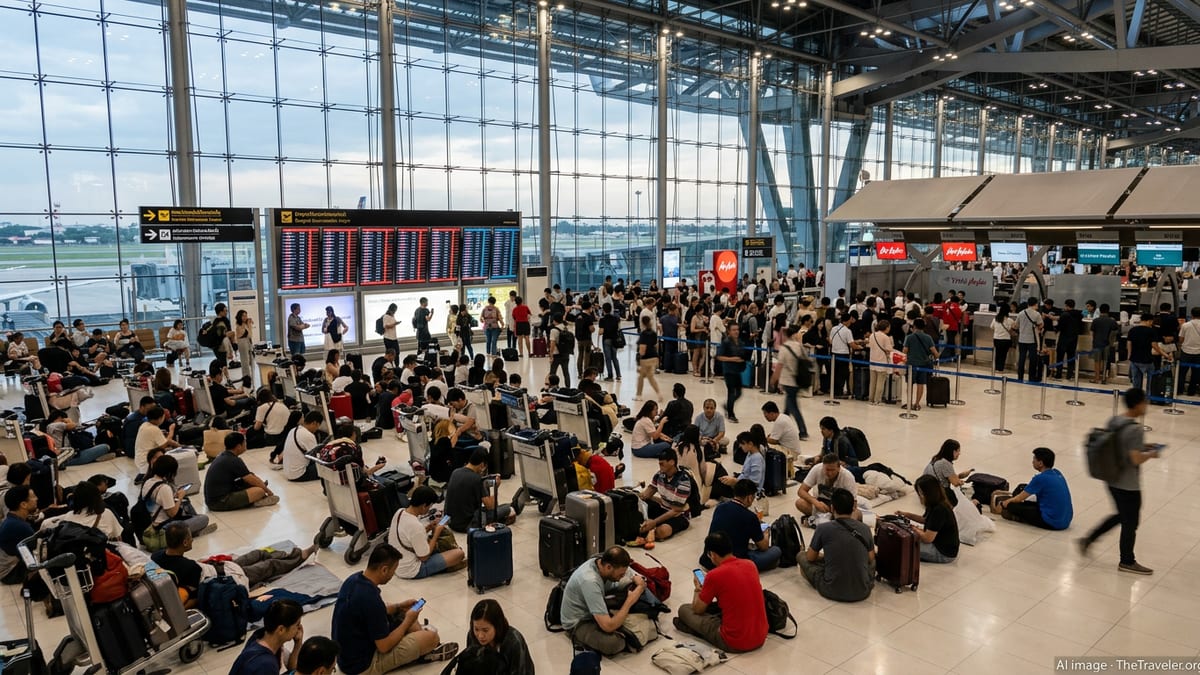
Suvarnabhumi Becomes Flashpoint in Widening Regional Disruptions
The latest figures from aviation data providers show Suvarnabhumi among Asia’s hardest-hit airports as ongoing Middle East airspace closures and operational suspensions at Gulf hubs feed through to long-haul and regional schedules. While the current tally at Bangkok stands at 15 cancellations and 93 delays, officials and analysts warn that rolling timetable changes mean the numbers are likely to keep shifting through the week.
Many of the affected departures involve services that typically route via Doha, Abu Dhabi or Muscat, or rely on feed from those hubs. With flights arriving from the Gulf heavily delayed or cancelled, onward sectors from Bangkok to Europe, the Middle East and secondary Asian cities are being rescheduled or dropped at short notice, leaving passengers in terminal limbo.
Check-in halls at Suvarnabhumi were reported to be crowded but orderly as ground staff scrambled to rebook passengers and arrange overnight accommodation. Airport operators have stressed that the facility remains fully open and that essential services, including rail links and security screening, are functioning normally despite the disruption to airline schedules.
For many travellers, however, the practical effect is a forced, unplanned stay in Thailand. With seats on alternative routings scarce and longer detours around restricted airspace adding hours to flight times, some passengers have been told to expect multiple days of delay before they can reach their final destinations.
Airlines from Asia and the Middle East Adjust Schedules
The cancellations and delays at Bangkok reflect a wider recalibration of networks by airlines across Asia and the Gulf. Carriers that depend on Doha, Abu Dhabi and Muscat as through-hubs have cut frequencies, retimed departures and, in some cases, temporarily suspended routes as they navigate airspace restrictions over parts of the Middle East.
Thai AirAsia and Thai Vietjet are among the low-cost operators most exposed on short and medium-haul links feeding into larger intercontinental partners. Disruptions to inbound passengers from the Gulf and onward connections to Europe have forced schedule thinning on select Bangkok routes, particularly overnight and early-morning services designed to connect with banked departures from Doha and Abu Dhabi.
Cathay Pacific and El Al have also been swept up in the operational turbulence. While their core hubs lie outside Southeast Asia, their services intersect with the same constrained corridors and connecting banks at Gulf airports, meaning timetable reliability has deteriorated on shared city pairs. El Al’s reliance on tightly timed links across the region has made its Bangkok-bound passengers especially vulnerable to missed or cancelled connections.
Network planners say that as long as airspace over key Middle Eastern corridors remains restricted, airlines will face a choice between flying longer diversionary routings that raise costs and block times, or cutting capacity altogether. Both options feed directly into the kind of cancellations and late departures now being seen at Suvarnabhumi.
Knock-on Effects Reach Doha, Abu Dhabi, Muscat and Beyond
The situation in Bangkok cannot be separated from the severe operational constraints gripping major Gulf hubs. With Dubai, Doha and Abu Dhabi all experiencing periods of full or partial suspension in recent days, the flow of transit passengers between Europe, Asia and Australia has been sharply reduced, placing intense pressure on alternative gateways such as Muscat.
Hamad International in Doha and Zayed International in Abu Dhabi, normally among the world’s most reliable transfer points, have seen waves of cancellations as local carriers trim schedules in response to airspace closures and security assessments. This has had a cascading impact on connecting itineraries booked through Thailand, where many travellers use Bangkok as a staging point for onward Gulf and European flights.
Muscat, one of the few Gulf airports operating more consistently, has become a critical relief valve. However, the sudden surge in rerouted traffic has pushed its own operations close to capacity, limiting the ability of airlines to absorb stranded passengers from Bangkok and other Asian hubs. Travellers who might previously have been reprotected via a quick Gulf transfer are now enduring lengthy layovers or multiple-stop routings through secondary Asian or European cities.
Beyond the Gulf, major airports in India, China and Southeast Asia are reporting parallel spikes in delays as airlines juggle fleet and crew availability. The resulting patchwork of schedule changes has complicated efforts by passengers stuck in Thailand to piece together viable alternatives, even when they are willing to accept circuitous routings home.
Passengers Confront Long Queues, Limited Options and Confusing Information
For those caught in the disruption at Suvarnabhumi, the immediate experience is one of uncertainty and frustration. Travellers describe long lines at airline service desks, with rebooking agents trying to manage a constantly shifting inventory of available seats as new cancellations are pushed through global distribution systems.
Some passengers on Thai AirAsia and Thai Vietjet services connecting to long-haul partners have reported multiple reissues of their tickets in a single day, as provisional reroutings via one Gulf hub are invalidated by fresh schedule cuts and replaced by alternatives via another. Others on Cathay Pacific or El Al itineraries have found that even once they leave Bangkok, further disruption awaits at their next transfer point.
Information flow remains a key challenge. While airline apps and departure boards show real-time status updates, rolling delays have meant that flights initially listed as slightly late have been pushed back repeatedly before being cancelled outright. Consumer advocates urge passengers to rely on official airline channels for the latest information, but also to document communications and keep receipts for meals and accommodation in case of future reimbursement claims.
Hotels near Suvarnabhumi and in central Bangkok are seeing a brisk uptick in last-minute bookings from stranded travellers. Local tourism operators say that while the disruption is unwelcome, many visitors are choosing to treat the delay as an unexpected extension of their stay, using the extra days to explore the city or nearby beach destinations while they wait for confirmed departures.
Travel Advisories and What Passengers Should Do Next
Airports and airlines are urging anyone due to travel through Bangkok, Doha, Abu Dhabi or Muscat in the coming days to monitor their bookings closely and avoid heading to the airport until they have received explicit confirmation that their flight is operating. Same-day schedule changes remain common, and some carriers are only finalising operational decisions a few hours before departure as they track evolving airspace restrictions.
Most major airlines affected by the current wave of cancellations are offering fee-free rebooking or refunds for passengers booked on disrupted flights. However, policies vary by carrier and by point of origin, and some travellers have expressed confusion about their entitlement to hotel accommodation, meal vouchers or cash compensation when disruption stems from broader geopolitical or airspace issues.
Travel agents recommend that passengers stranded in Thailand ask explicitly about rerouting options that avoid the most heavily constrained Gulf hubs, even if that means longer itineraries through East Asia or Europe. Seats on such alternatives are limited, but can significantly reduce waiting times compared with holding out for a restored direct connection via Doha or Abu Dhabi.
With no clear timeline for a full return to normal traffic patterns across the Middle East, industry analysts expect Suvarnabhumi and other Asian gateways to continue feeling the ripple effects. For now, travellers are being advised to build in extra contingency time, stay flexible about routing and be prepared for last-minute schedule changes as airlines, airports and regulators work to stabilise one of the most important air corridors in global travel.