

More news on this day
Hundreds of passengers were left stranded at Tehran’s Imam Khomeini International Airport on Sunday as at least 14 flights were cancelled and two more delayed, snarling key routes to London, Dubai and Istanbul amid widening airspace closures triggered by the latest Iran conflict.
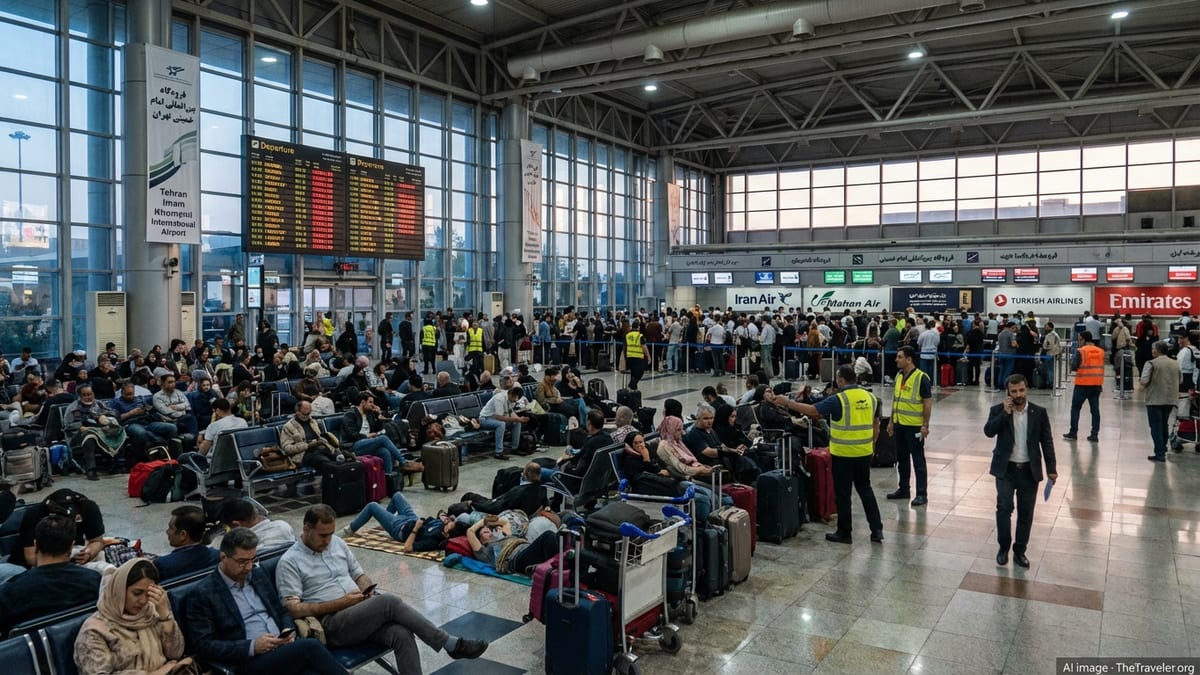
Regional Airspace Shutdown Brings Tehran Departures to a Standstill
The disruption at Imam Khomeini International Airport unfolded as Iran and several neighboring states restricted or closed portions of their airspace following retaliatory strikes and heightened military activity across the region. Aviation authorities said airlines operating in and out of Tehran were forced to ground or reroute services as safety concerns mounted and flight paths over conflict zones became unusable.
By mid-afternoon, departure boards at the capital’s main gateway showed a cluster of cancellations and rolling delays on both regional and long-haul services. Flights that would normally connect Tehran with major hubs such as London, Dubai and Istanbul were scrubbed or held on the ground, stranding outbound travelers and creating an immediate backlog of incoming passengers whose aircraft had been diverted or turned back mid-route.
Airport staff, already stretched by days of mounting tension, struggled to manage growing queues at airline desks as travelers sought answers and rebooking options. Public address announcements urged passengers to remain in the terminal and monitor airline counters rather than proceeding to security, reflecting uncertainty over which departures would still operate.
The cascading cancellations in Tehran mirrored a broader aviation freeze across the Middle East, where key hub airports have temporarily curtailed operations and airlines have adjusted schedules hour by hour in response to shifting security assessments.
Iran Air, Mahan Air and Foreign Carriers Forced to Scrap Key Routes
Flag carrier Iran Air and privately owned Mahan Air were among the most visibly affected at Imam Khomeini International Airport, with multiple regional and long-haul departures removed from the day’s roster. Services to Dubai and Istanbul, critical for both business and leisure travelers as well as for onward connections to Europe and Asia, were singled out by airport officials as particularly hard hit.
Foreign airlines, including Turkish Airlines and Emirates, also faced significant operational challenges as they attempted to adjust to sudden restrictions on transiting Iranian and neighboring airspace. Several departures that would normally link Tehran to Istanbul and onward European destinations were cancelled outright, while some westbound flights that did operate were forced to adopt longer, fuel-intensive routings to skirt closed skies.
Operational planners noted that the disruption was especially severe for carriers that rely on tightly timed connecting banks at their home hubs. With Dubai and Istanbul themselves grappling with knock-on effects from the regional crisis, a cancelled Tehran departure often meant missed onward connections for passengers booked through to London, North America and major European capitals.
Ground teams for international airlines worked through the day to accommodate stranded travelers with hotel vouchers, meal coupons and alternative itineraries where possible. However, with parallel cancellations rippling across the Gulf and eastern Mediterranean, spare seats on alternative flights were scarce and many passengers were told to expect extended waits before they could be rebooked.
Stranded Travelers Face Long Queues, Sparse Information and Rising Costs
Inside the terminal, the human impact of the disruption was immediately visible. Families returning from winter holidays, students heading back to universities abroad and medical travelers bound for treatment in Europe and the Gulf joined long, slow-moving lines at check-in and ticketing counters, many clutching printed boarding passes for flights that no longer existed.
Several passengers reported receiving cancellation notifications only after arriving at the airport, while others said they had no digital alert at all and learned of the disruption from departure boards or fellow travelers. With airline call centers and online chat services overwhelmed, securing timely information proved difficult, intensifying frustration among those facing missed connections, expiring visas or imminent work commitments abroad.
For many, the financial strain mounted quickly. Hotel availability around the airport tightened as airlines placed eligible passengers in nearby accommodations, leaving others to search for last-minute rooms at elevated prices. Travelers without comprehensive insurance or flexible tickets weighed whether to accept refunds and attempt to rebook themselves on later dates, or to wait in hope of priority re-accommodation by their carrier.
Airport retailers and cafés experienced a surge in demand as travelers settled in for what increasingly looked like an overnight or multi-day wait. Seating areas near the departure gates filled with passengers stretched out on benches and across the floor, some using luggage as makeshift pillows as they watched for any sign of improvement on the overhead screens.
Global Ripple Effects Reach London, Dubai and Istanbul
The bottleneck in Tehran contributed to a wider pattern of disruption along major east-west corridors linking Europe, the Middle East and Asia. Flights from London relying on connections through regional hubs such as Istanbul and Dubai were affected as cancellations and airspace restrictions forced carriers to rationalize schedules and prioritize certain routes over others.
Passengers booked on Iran Air, Mahan Air, Turkish Airlines and Emirates services between Tehran and London, Dubai or Istanbul reported receiving rerouting offers via alternative European or Central Asian gateways, often involving significant detours and extended layovers. In some cases, travelers opted to postpone their journeys entirely, uncertain how long the current phase of disruption would last.
The partial shutdown of Middle Eastern airspace has added hours to some long-haul journeys and rendered others temporarily unviable, aviation analysts said. Flights that would normally cross Iran, Iraq or the Gulf states are being pushed north or south, putting additional pressure on already busy corridors and making it harder for airlines to reposition aircraft and crew to where they are most needed.
Industry observers warned that even if the regional security picture stabilizes quickly, the backlog of displaced passengers and aircraft could take days to resolve. With airlines juggling crew duty-time limits, maintenance requirements and slot restrictions at major airports, restoring normal connectivity between Tehran and key global hubs will require careful sequencing and may involve further short-notice schedule changes.
Authorities Urge Passengers to Check Status and Expect Ongoing Disruption
Iran’s civil aviation officials and airport management at Imam Khomeini International Airport urged travelers to avoid unnecessary trips to the terminal and to verify their flight status directly with airlines before setting out. They cautioned that additional cancellations and delays remained likely as the regional security situation continued to evolve.
Airlines operating in and out of Tehran reiterated that passenger safety would remain the overriding priority in any decision to proceed with or suspend flights. Several carriers have published flexible booking policies, allowing affected customers to rebook travel dates or change destinations without penalty, particularly on routes touching the Middle East and eastern Mediterranean.
Travel experts advised passengers to keep all receipts for expenses incurred during the disruption, including accommodation, meals and local transport, in case partial reimbursement is available through airlines or travel insurance providers. They also recommended enrolling in carrier alerts and monitoring local news for updates on airspace restrictions that could affect future journeys.
With tensions still high and aviation authorities coordinating closely with military and diplomatic channels, there is little clarity on when full operations will resume at Imam Khomeini International Airport. For now, travelers face an extended period of uncertainty in which flexibility, patience and constant monitoring of flight information will be essential to getting in and out of Tehran.