

More news on this day
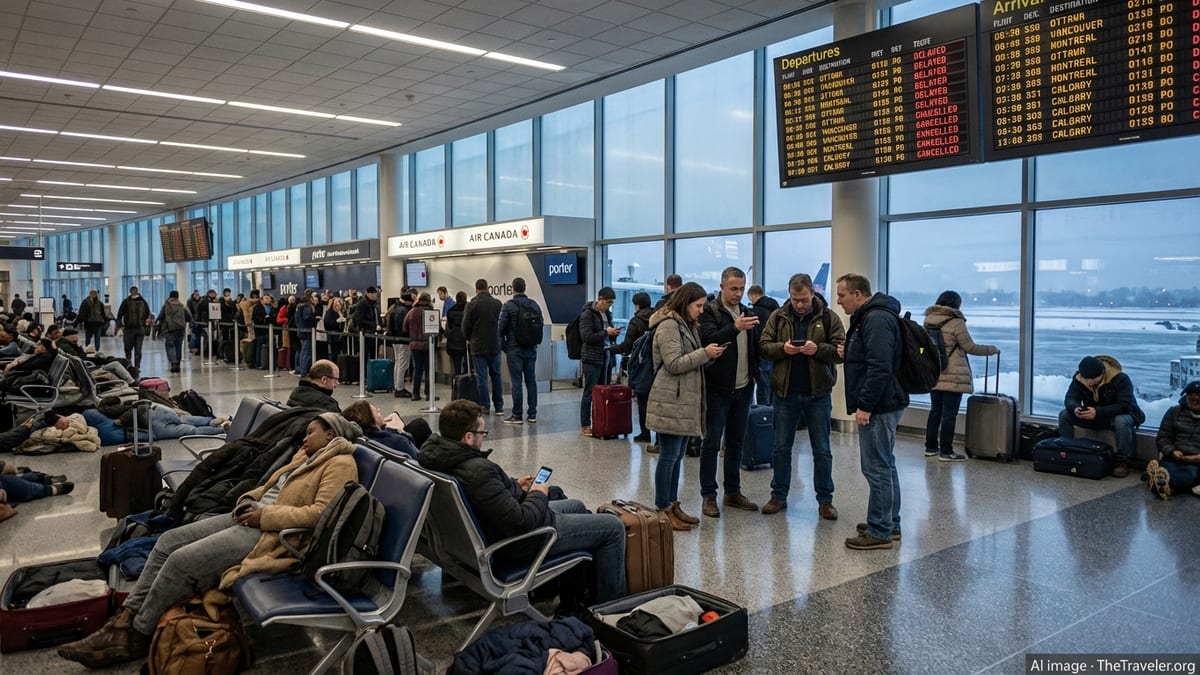
Hundreds of passengers were left stranded at Toronto Pearson International Airport on February 22, 2026, as 233 flights were delayed and 21 cancelled, snarling operations for major carriers and disrupting travel across Canada’s busiest corridors.
Mass Disruptions Ripple Through Canada’s Largest Hub
The day’s disruption at Toronto Pearson unfolded gradually but relentlessly, beginning with early-morning delays that quickly spread across the schedule. By afternoon, flight-tracking data showed 233 departures and arrivals running late and 21 outright cancellations, leaving check-in halls crowded and departure boards filled with red alerts. The problems affected both domestic and international services, complicating travel plans well beyond the Greater Toronto Area.
As the numbers climbed, airport staff were forced into a constant cycle of gate changes, boarding pauses, and last-minute crew adjustments. Airlines attempted to prioritize flights with the highest number of connecting passengers, but the sheer volume of disrupted services meant thousands found themselves stuck in limbo. Long lines formed at carrier service desks, with many travelers waiting hours for rebooking or hotel vouchers.
The disruption pushed Toronto Pearson’s already complex operation to the edge. Serving tens of millions of passengers a year, the airport is a central node in Canada’s air network, funnelling traffic between smaller regional communities and major global gateways. When its schedule falters, the impact is felt across the country and on key transborder and transatlantic routes.
Throughout the terminals, the atmosphere shifted from routine inconvenience to visible frustration. Families clustered around power outlets, business travelers worked from floor space near the gates, and visiting tourists tried to decipher revised itineraries announced over loudspeakers. For many, what had been planned as a straightforward journey became an unexpected test of patience.
Air Canada, Jazz, Porter and Others Scramble to Respond
Air Canada, the dominant carrier at Toronto Pearson, bore a significant portion of the disruption. With extensive domestic and international networks centered on the airport, even small scheduling disturbances can cascade quickly. On February 22, the combination of delayed aircraft, crew duty-time constraints, and tight turnaround windows left the airline juggling resources to keep high-demand routes operating, while less critical flights were delayed, consolidated, or cancelled.
Regional affiliate Jazz, which operates many of Air Canada’s shorter domestic and transborder services, also felt the strain. Its connections into cities such as Ottawa, Montreal, and smaller Ontario and Atlantic communities are essential for passengers relying on same-day onward travel. As sectors were pushed back or scrubbed entirely, stranded travelers in Toronto faced the added challenge of limited alternative options to reach smaller markets.
Porter Airlines, which has grown its presence at Toronto Pearson alongside operations at Billy Bishop Toronto City Airport, reported disruptions on several key routes linking Toronto with Ottawa, Montreal, and Western Canada. Porter’s point-to-point model traditionally offers some resilience, yet on a day of widespread operational stress it too saw departures depart late and services re-timed to accommodate aircraft and crew positioning.
Other carriers, including foreign airlines feeding long-haul traffic into Toronto’s hub, were not immune. Delays in Toronto complicated their global networks, as passengers missed onward connections to Europe, the United States, the Caribbean, and beyond. Airline representatives emphasized that rebooking options were being offered wherever possible, but realistically acknowledged that seat availability was limited during peak travel periods.
Weather, Congestion and Logistical Strains Combine
Airport and airline officials pointed to a convergence of factors behind the February 22 disruption. Seasonal weather patterns across central and eastern Canada have been unsettled, with recurring systems bringing periods of snow, freezing precipitation and gusty winds throughout February. Even when conditions remain technically flyable, de-icing requirements, reduced visibility, and air traffic flow restrictions can force slower operations, reducing the number of aircraft that can safely depart and arrive in a given hour.
On this day, lingering winter weather in both Ontario and other parts of the country meant that flights into Pearson were already arriving off-schedule. That created what operational planners refer to as a “stacked delay” scenario, where late inbound aircraft knock on to outbound services, and modest slippages early in the day compound into hours-long disruptions by evening. Crews reaching mandated duty limits added further complexity, requiring substitutions and, in some cases, aircraft sitting idle without a legal crew to operate them.
Air traffic management measures also played a role. When weather or congestion reduces capacity in a key sector of airspace, flow-control programs can require aircraft to depart later than planned or hold on the ground at origin airports. This can be particularly acute around a hub like Toronto Pearson, which handles an intricate mix of short-haul turboprops, regional jets, and widebody long-haul aircraft all competing for runway slots and gate positions.
The result was a fragile operation in which any additional technical snags or late-arriving crews tipped individual flights from “delayed” into “cancelled.” While such disruptions are an inherent risk in highly optimized, high-utilization airline schedules, the events at Toronto Pearson underscored just how quickly a confluence of operational challenges can leave hundreds of travelers without timely options.
Nationwide Impact on Ottawa, Vancouver, Montreal and Calgary
The knock-on effects stretched far beyond Toronto. As flights into and out of Pearson slogged through delays or were cancelled entirely, major Canadian cities including Ottawa, Vancouver, Montreal, and Calgary saw their own schedules thrown off balance. Aircraft that were supposed to originate in Toronto and continue onward never arrived on time, leading to secondary delays and, in some cases, cancellations downline.
In Ottawa and Montreal, key business and government corridors felt the strain, with frequent shuttle-style services operating at reduced reliability. Travelers connecting from those cities through Toronto to Western Canada, the United States, or Europe faced missed connections and improvised itineraries. Some elected to reroute entirely, asking airlines to move them through alternate hubs where space could be found.
Vancouver and Calgary, both major gateways in Western Canada, reported affected flights to and from Toronto as the day progressed. Westbound departures left late, pushing arrivals into the late evening and interfering with connections onto transpacific and regional flights. Eastbound travelers leaving British Columbia and Alberta also struggled with the uncertainty of whether their Toronto connections would still be viable by the time they landed.
Regional airports across the country, from Atlantic Canada to the Prairies, experienced a subtler but still serious impact. Because many of their services rely on tight connections through Toronto Pearson, a missed inbound flight could mean travelers had to wait until the next day for another opportunity to reach their final destination. Some communities with only one or two daily flights were particularly vulnerable, making the disruption felt well beyond the country’s largest cities.
Scenes of Frustration and Resilience Inside the Terminals
Inside Toronto Pearson’s terminals, the human consequences of the disruption were stark. Families returning from school breaks slept on their luggage in departure halls, while solo travelers scrolled through airline apps searching for earlier options that rarely appeared. Volunteers handed out water and snacks in some areas, and airport staff moved down queues to answer basic questions even as they encouraged passengers to use digital tools for detailed rebooking.
Boarding gates turned into impromptu information centers as airline agents made repeated announcements about revised departure times and changing aircraft assignments. Applause occasionally broke out when a heavily delayed flight was finally called for boarding, while audible groans followed announcements of further delays or cancellations. For many travelers, the most challenging aspect was the uncertainty, with updated departure times shifting by increments of 30 or 60 minutes throughout the day.
Despite the prevailing frustration, there were also displays of patience and cooperation. Passengers watched one another’s belongings during trips to concession stands, shared charging outlets and seating, and swapped travel tips on possible alternative routings through other hubs. Travel insurance desks and credit card lounges saw higher than usual foot traffic as travelers sought assistance with accommodation, meals, and trip interruption claims.
Airport authorities reiterated that they were working closely with airlines, security agencies, and ground-handling firms to restore normal operations as swiftly as possible. Public-address messages emphasized the importance of checking airline apps and notification systems before heading to the airport, a reminder aimed at preventing additional crowds from descending on an already overburdened terminal complex.
How Airlines Managed Rebooking, Care and Communication
As the scope of the disruption became clear, airlines activated irregular-operations protocols designed to manage passenger care and re-accommodation. Additional call center staff and digital support agents were brought online to handle a spike in customer contacts, while airport ticket counters extended operating hours. Many carriers encouraged travelers to manage changes via mobile apps and websites, which could process rebookings more quickly than in-person queues in many cases.
Flexible rebooking policies were introduced or expanded for affected passengers, often waiving change fees and fare differences for a limited time and on specific routes. For travelers facing overnight delays due to missed connections or cancelled flights, airlines assessed eligibility for hotel and meal vouchers, guided by local regulations and internal policies. Availability of nearby hotel rooms, however, became strained as the evening wore on.
Communication remained a central challenge. While flight-status notifications and push alerts provided real-time updates for many passengers, others without reliable connectivity or familiarity with airline apps relied on departure boards and gate announcements that sometimes lagged behind operational decisions. Discrepancies between different information sources heightened anxiety, with some travelers learning of a cancellation only after arriving at the airport.
In post-event assessments, both airlines and airport operators are expected to scrutinize how information was shared and how quickly passengers were offered viable alternatives. The growing reliance on digital tools, while invaluable for many, also raises questions about accessibility for less tech-savvy travelers or those without roaming data while in transit.
Pressure Mounts for Greater Operational Resilience
The events at Toronto Pearson add to a series of recent winter disruptions that have tested Canada’s aviation system. Earlier in February, a severe snowstorm had already caused widespread cancellations and delays at the airport, illustrating the vulnerability of densely scheduled networks to extreme weather. The latest disturbance, although driven by a slightly different mix of conditions, reinforces calls from passenger advocates for greater buffers in scheduling and improved contingency planning.
Aviation analysts note that carriers and airports worldwide have, over time, optimized their operations for efficiency, minimizing turnaround times and trimming spare capacity. While this approach keeps costs down in normal conditions, it can leave little room to absorb shocks when weather patterns shift or logistical constraints appear. At a hub as pivotal as Toronto Pearson, even small misalignments can quickly cascade across the national network.
Industry groups, regulators, and airport authorities are likely to continue discussions about investments in de-icing infrastructure, upgraded snow-removal equipment, and more robust staffing plans for peak winter periods. Enhanced real-time data sharing between airports, airlines, and air navigation services is also seen as a crucial tool in reducing the knock-on effects of disruptions.
For travelers, the latest episode underscores the value of preparing for unpredictability during winter travel. Flexible tickets, adequate connection times, and contingency plans for overnight stays are increasingly part of the calculus for those flying through major hubs during the storm-prone months. While the aviation system will keep striving for smoother operations, passengers passing through Toronto Pearson on days like February 22 are a reminder that even the most sophisticated networks remain at the mercy of weather and operational complexity.